Perimeter dan Luas

Illustrated · 1 min

Think of a two dimensional closed geometric shape, such as a triangle or a square. The continuous line that forms the border closing the shape is called the perimeter\color{red}{\text{perimeter}}. The length of the perimeter\color{red}{\text{perimeter}} of a shape can be calculated by adding up the length of each side of the shape. \\ For example: the triangle below has a perimeter of 7+7+7=217+7+7=21 and the rectangle has a perimeter of 7+7+5+5=247+7+5+5=24.

Triangle with sides 7
Rectangle with sides 5 and 7

Notice the white space inside the perimeter\color{red}{\text{perimeter}} of the shape. That space is called the area\color{blue}{\text{area}}. The area\color{blue}{\text{area}} of different shapes can be found using different formulas. The area formula for a quadrilateral is A=length×widthA=\text{length}\times \text{width} and the area formula for a triangle is A=12base×heightA=\frac{1}{2}\text{base}\times \text{height}. When calculating the area of a shape, the units will always be squared. i.e. The area of the rectangle above is 35 units235\text{ units}^2.

Interactive · 1 question

Example: Perimeter vs. Area

What is the difference between the perimeter and area of a shape?

The perimeter is the sum of all the side lengths of a shape.

The area is the amount of two dimensional space a shape occupies.

To better understand these two concepts and their differences, let's look at an example:

A green square with side 10 ft.

Above is the graph of a square yard. The brown border is a fence, while green square is the grass.

The perimeter of this square is the length of fence.

The area of this square is the amount of grass.

Let's calculate both:

perimeter=4 sides×10ft=40ft\text{perimeter} = 4 \text{ sides}\times 10 ft = 40 ft area=10ft×10ft=100ft2\text{area}=10ft \times 10 ft = 100 ft^2

Try it!

We have a shape with 55 sides. Their lengths are: 1,1,2,3,41, 1, 2, 3, 4. What can we say about this shape?

Choose one answer

Illustrated · 1 min

Perimeter vs. Area\textbf{Perimeter vs. Area}

The perimeter is the distance around the outside of a shape. Perimeter is measured in units (e.g., cm\text{cm}).

The area is the amount of space the inside of the shape takes up. Area is measured in square units (e.g., cm2\text{cm}^2).

Perimeter vs. Area of a Triangle\textbf{Perimeter vs. Area of a Triangle}
The perimeter of a triangle is the distance around the three sides. To depict the perimeter, there is a triangle with the sides colored turquoise. The area of a triangle is the amount of space it takes up in a plane. To depict the area, there is an identical triangle with the inside colored turquoise.

Image by Caroline Kulczycky

Perimeter vs. Area of a Circle\textbf{Perimeter vs. Area of a Circle}
The perimeter of a circle, also called the circumference, is the distance around its outside. To depict the perimeter, there is a circle with the outside colored turquoise. The area of a circle is the amount of space it takes up in a plane. To depict the area, there is an identical circle with the inside colored turquoise.

The perimeter of a circle is also called the circumference. Image by Caroline Kulczycky

Perimeter vs. Area of a Quadrilateral\textbf{Perimeter vs. Area of a Quadrilateral}
The perimeter of a quadrilateral (in this case a rectangle) is the distance around its four sides. To depict the perimeter, there is a rectangle with the sides colored in turquoise. The area of a quadrilateral is the amount of space it takes up in a plane. To depict this, there is an identical rectangle with the inside colored turquoise.

Image by Caroline Kulczycky

Video · + 1 min read

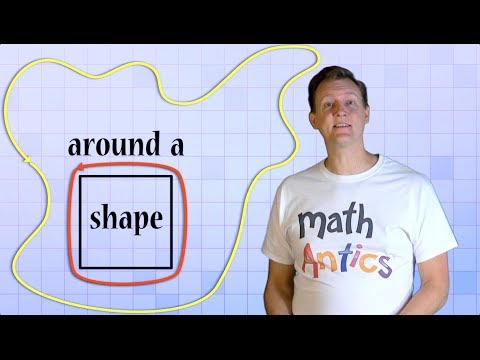
(Video) Area and Perimeter

by Math Antics

To compare perimeter and area, we first have to get an idea of what each of them means.

Let's start with perimeter. In this video, perimeter is defined as the distance, or length, around a shape.

Now, let's move onto area:

In this video, area is defined as the surface a shape covers.

There are formulas to calculating the perimeter and area of different shapes--feel free to continue the videos above to learn about the formulas!

Summary\large{\text{Summary}}

Try the questions below!

Yoko recently purchased a large painting. She wants to know how much wood she needs to build a frame, she also wants to know how much space the painting will take up on this wall in her room.

If she wants to know the former, what does she need to find out about the painting?

Choose one answer

Type a concept, like “slope” or “photosynthesis”.

↑ ↓ to choose · Enter to openSearch explanations and problems