Read · 1 min

+3 contributors


In our last lesson, we learned about logarithm scales. Now let's move onto our next topic in applications of logarithmic and exponential functions.
Benford's Law
Benford's Law is a property held by leading digits of numbers in large data sets seen in the real world.
At first, you might think that the digits through would appear as the first digit about the same number of times.
But that is not what happens.
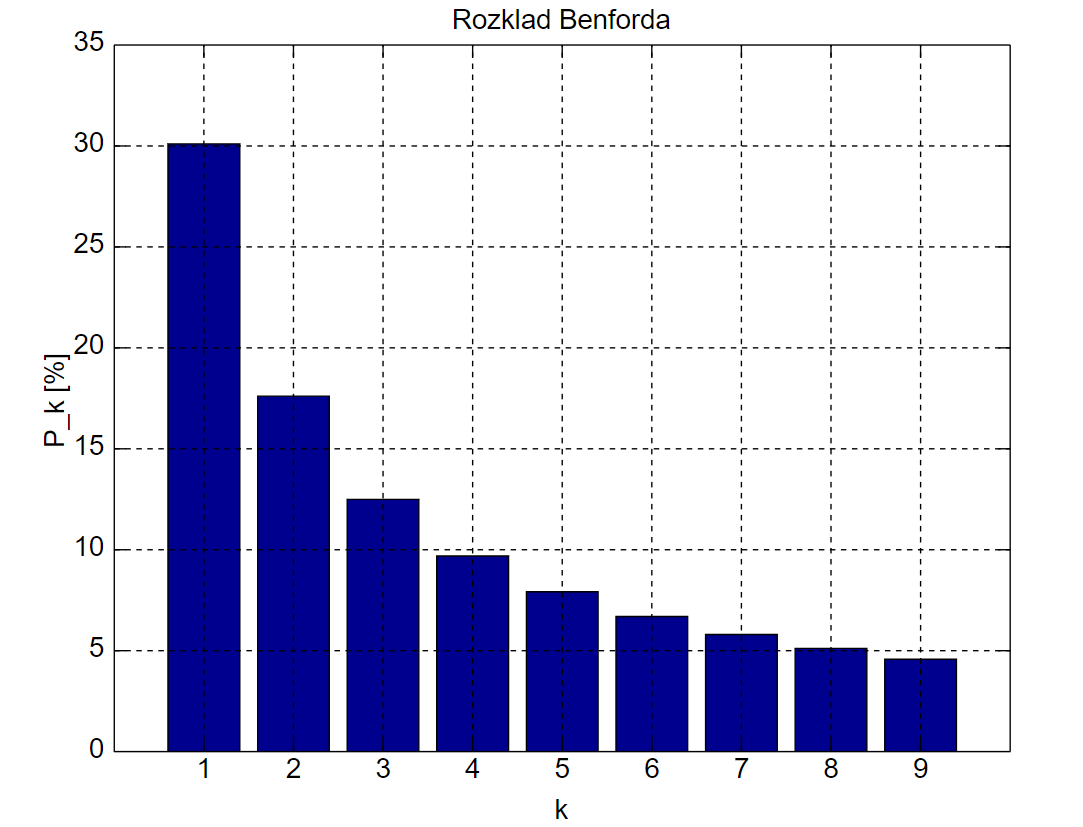
Instead, the leading digits follow a logarithmic pattern. The number appears most often as the first digit. The number appears less often than , but more often than . This pattern continues all the way down to , which appears the least often.
Even though it may seem surprising, this pattern shows up again and again in real-world data. According to the law, the formula for the approximate frequencies for each digit is:
So in large sets of data, appears as a leading digit approximately % of the time, appears approximately % of the time, all the way down to which appears approximately % of the time. The sum of all of these frequencies must be %, as they encompass every possible leading digit.
This pattern can appear in many types of data. For example, it can show up in the first digit of population numbers for different countries. It can also appear in numbers found in newspaper articles.
An interesting fact is that people are not very good at copying this pattern when they try to fake data.
Because of this, Benford’s Law is often used to help detect fraud. If the numbers do not follow the expected pattern, it may be a sign that something is wrong.