Logaritma Natural

Before this, knowBunga majemuke (logaritma natural)

Interactive · 1 question

##Learn all about continuously compounded interest!

When you put money into the bank, you might have heard about the bank giving you back interest. In this example, interest is essentially a percentage of the money in your bank account that the bank is giving back to you as a thank you for banking with them.

Interest can be taken, or compounded, at certain times of the year such as quarterly (every 3 months) or every year. However, continuously compounded interest is when the interest is compounded (or taken) constantly. While it is a very abstract concept to wrap your head around, think of it like instantaneous interest being taken on your money.

Luckily for us, there is an equation to help us find the value in our bank account after being continuously compounded! We use a variation of the natural log.

A=PertA = Pe^{rt}

Where...

A = final amount

P = initial amount

r = rate of interest

t = number of years

If given 3 of these variables, we can solve for the missing variable.

Let's try a sample problem!

Alina originally put $3000 in her bank account 6 years ago. She recently learns that her account has continuously compounded interest at a rate of 0.03%. How much money does she have in her account now?
Choose one answer

Video · + 1 min read

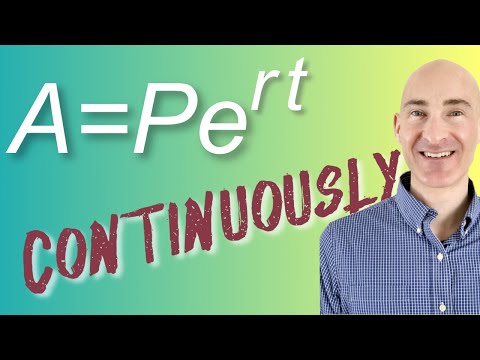
(Video) Compounding Continuously Pert Formula

by Mario's Math Tutoring

Exponential and logarithmic functions have many real life applications, as we've seen in graphs with logarithmic scales and the Richter scale, but especially in banking.

When you put money into a bank account, most banks give you interest on the money. In other words, they gift you a percentage of the money in your account as a thank you for banking with them. You can also have interest on a loan which is when you pay a certain percentage of money to a bank on the money borrowed. Interest can be compounded at different amounts, such as monthly or annually. Interest can also be compounded continually, in other words constantly.

The formula for calculating continuously compounded interest is:

A=PertA = Pe^{rt}

Where...

A = the final amount

P = the principal/initial amount

r = the rate of interest

t = time

Let's follow along with the problem Mario works through in his video.

We want to calculate the amount of money in a bank account after 7 years when the starting amount is 1000 dollars and the interest rate is 2%.

We can plug this information into the formula and calculate what the final amount will be.

A=1000e(0.2)(7)A = 1000e^{(0.2)(7)} A=1150.27A = 1150.27

Therefore, we know there is 1150.271150.27 dollars in the bank account after 7 years, meaning the account accrued 150.27150.27 dollars of interest total.

Illustrated · 1 min

Compound Interest, Continuously Compounded

You guessed it: compound interest is when interest is compounding continuously! When earning interest in a savings account, we are earning interest continuously over periods of time and are building on top of interest we have already earned, in addition to the principal amount.

This seems complicated, but don't fret! There is a continuous compounding formula that will calculate total interest earned. That means that we will be able to calculate the initial principal over certain compounding periods.

In contrast, simple interest will only calculate interest over one month.

Let's learn how to calculate compound interest.

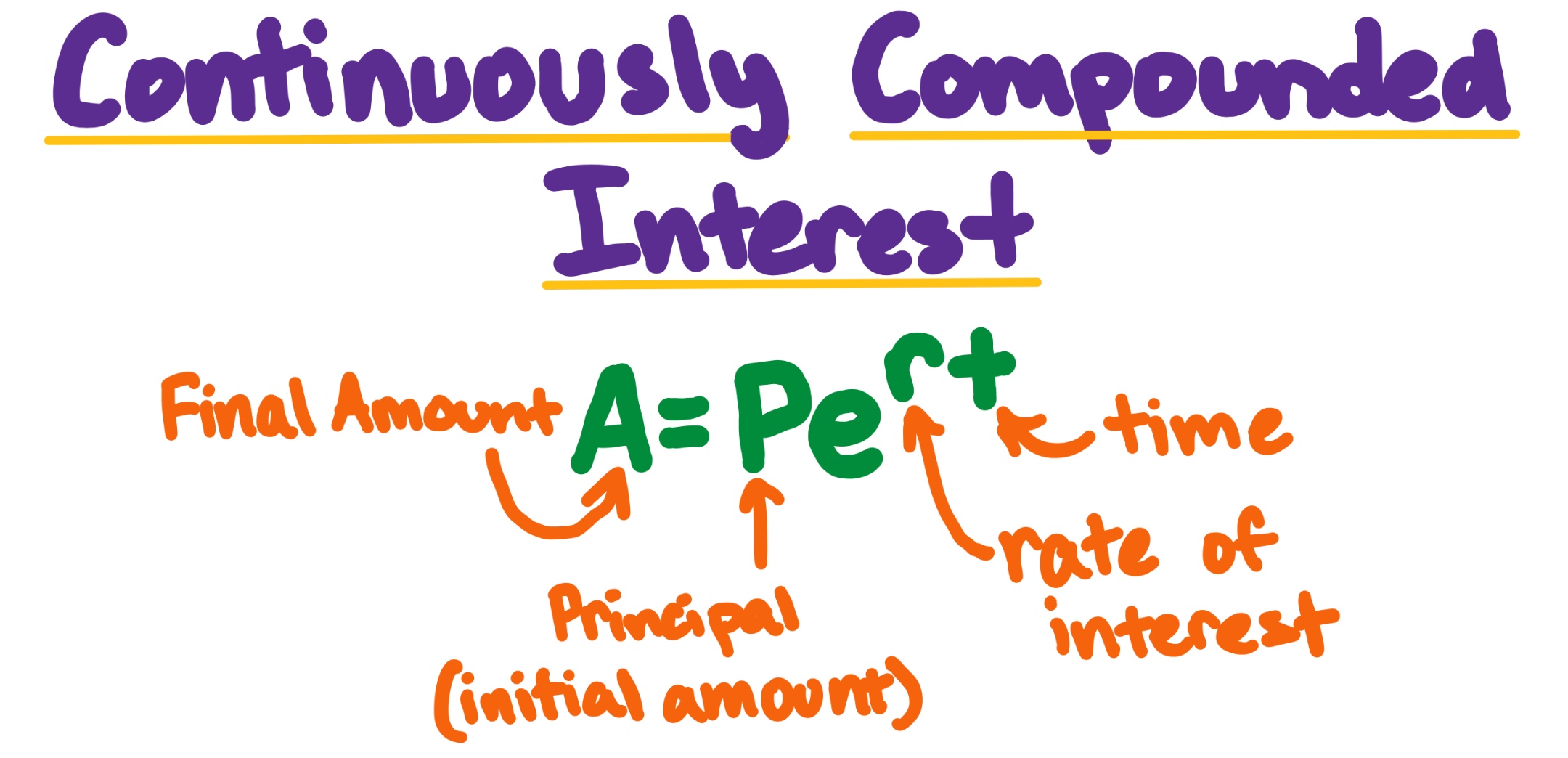
Continuously Compounded Interest

A = Pe^(rt)

where...

A = final amount
P = principal (initial amount)
r = rate of interest
t = time

Image source: by Trisha

In the next lesson, you'll learn more about solving compound interest problems.

Type a concept, like “slope” or “photosynthesis”.

↑ ↓ to choose · Enter to openSearch explanations and problems
