
Menyamakan penyebut

Before this, knowEquivalent Fraction — Definition & Examples

Illustrated · 2 min

Lowest Common Multiple/Lowest Common Denominator Visualizations

The Lowest Common Multiple (LCM) of two numbers is the smallest shared multiple between the two. Let's look at a few ways that we can find the LCM of two numbers.

List of Multiples

We're going to list out the multiples of 33 and 55 until they match. 3:3,6,9,12,155:5,10,15\begin{align}3&: 3,6,9,12,{\color{#29A603}{15}}\\ 5&: 5, 10, {\color{#29A603}{15}} \end{align}

Let's look at this with a graphic.

Every third cell is shaded red in the top row, and every fifth cell is shaded in the bottom row. These don't match up until the 15th column.

The top row has every 33 cells shaded, and the bottom row has every 55 cells shaded. Our LCM is the first box where the boxes in both rows are shaded. These don't line up until 1515. We could extend this to see the next set of common multiples as well, but after a certain point this becomes cumbersome. We can't easily use this method to find the LCM of larger numbers.

LCM With Prime Factorization

The best way to find the LCM of larger numbers is through prime factorization. Let's take a look of an example of this by finding the LCM of 1818 and 2424.

First, we're going to make a factor tree for both 1818 and 2424.

18 factors into 3*3*2. 24 factors into 3*2*2*2.

We have broken 1818 into 3⋅3⋅23 \cdot 3 \cdot 2, and 2424 into 3⋅2⋅2⋅23\cdot 2\cdot 2\cdot 2. We need to multiply each factor the greatest number of times that it is shown in either one of our trees. In this case, we see that 33 is a prime factor of 1818 two times. This means that we need to multiply 3⋅33\cdot 3. We also see that 22 is a prime factor of 2424 three times. This means we have to include 2⋅2⋅22\cdot 2\cdot 2 in our multiplication. Our full calculation for the LCM of 1818 and 2424 is as follows: 3⋅3⋅2⋅2⋅2=723\cdot 3\cdot 2\cdot 2\cdot 2=72 Let's check this by listing out the multiples of each number. 18:18,36,54,7224:24,48,72\begin{align} 18&: 18, 36, 54, {\color{green}{72}}\\ 24&: 24, 48, {\color{green}{72}} \end{align}

Another Method

There is an alternative way to see what the LCM is. Once we have the prime factorizations, we can write each one using exponent notation.

18=32×2118 = 3^{\color{green}{2}} \times 2^{\color{green}{1}} 24=31×2324 = 3^{\color{green}{1}} \times 2^{\color{green}{3}}

Then, we just use the largest power of each prime number that appears. The product of those powers is our LCM. The largest power of 33 appears is in 1818 and is 22. The largest power of 22 that appears is in 2424 and is 33. Thus the LCM is

32×23=9×8=723^2 \times 2^3 = 9 \times 8 = {\color{green}{72}}

Lowest Common Denominator

We can use the same method to find the lowest common denominator (LCD) between two fractions. Let's find the LCD between the fractions 712\frac{7}{12} and 58\frac58. We need to first find the LCM

12 has prime factors of 3, 2, and 2. 8 has prime factors of 2, 2, and 2.

We need to multiply the factors the highest number of times they appear in each factorization. 33 only appears once in the factors of 1212, and 22 appears three times in the factors of 88. 3⋅2⋅2⋅2=243 \cdot 2\cdot 2 \cdot 2=24 The lowest common denominator between 712\frac{7}{12} and 58\frac58 is 2424. We can now find equivalent fractions to 712\frac{7}{12} and 58\frac58 to let us add or subtract fractions. In this case, the equivalent fractions would be 1424\frac{14}{24} and 1524\frac{15}{24}.

Notice that to find the LCD we didn't care what the numerators were.
Read · 1 min

What is it?

We want to find common denominators of fractions. What we're really trying to do is find the LCM of the denominators.

LCM stands for Lowest Common Multiple and is called such because it is the smallest multiple of all the input numbers.

For example, LCM(1,6)=6LCM(2,4)=4LCM(4,6,2)=12LCM(1,3,5,2)=30\begin{align} &\text{LCM} (1,6) = 6\\ &\text{LCM} (2,4 )= 4\\ &\text{LCM} (4,6,2) = 12\\ &\text{LCM} (1,3,5,2) =30\\ \end{align} How can I find it?

  1. One method is to list out many multiples of each number and find the first number that appears on both lists.

For example, for LCM (12,15)(12, 15)

12:12,24,36,48,60,72,84,96,108,12015:15,30,45,60,75,90,105,12012: 12, 24, 36, 48, {\color{#29A603}{60}}, 72, 84, 96, 108, {\color{#8925AE}{120}} \\ 15: 15, 30, 45, {\color{#29A603}{60}}, 75, 90, 105,{\color{#8925AE}{ 120}}

Thus, LCM (12,15)=60(12, 15) = 60. Notice that 120120 is also a common multiple, but it is not the lowest common multiple. Any two numbers have an infinite amount of common multiples, but one one lowest common multiple.

  1. Another method is to prime factorize all the numbers, and then examine prime by prime make the largest power of each prime factor a factor of your LCM.

For example, for LCM (12,15,25)(12, 15, 25)

12=2×2×315=3×525=5×5\begin{align}12 &= 2\times 2\times 3\\ 15 &= 3 \times 5\\ 25 &=5\times 5\end{align}

Thus, LCM (12,15,25)=2×2×3×5×5=300(12, 15, 25) = 2 \times 2 \times 3 \times 5 \times 5 =300

What can it be used for?

It is often used to find the denominator you would be using if you would like to add multiple fractions with different denominators.

For example, if I wanted to evaluate 56+34+15\frac56 + \frac34 + \frac15, then I would need to first find LCM (6,4,5)(6,4,5).

Since LCM (6,4,5)=60(6,4,5)= 60, then we can rewrite all the fractions with denominator 6060. Then, we can simply add to solve. The denominators are alike, so we add the numerators.

56+34+15=5060+4560+1260=10760\frac56 + \frac34 + \frac15 = \frac{50}{60} + \frac{45}{60} + \frac{12}{60} = \frac{107}{60}

Actually, any common multiple of the 33 denominators would be an acceptable denominator, but it's easier to work with smaller numbers.

Video

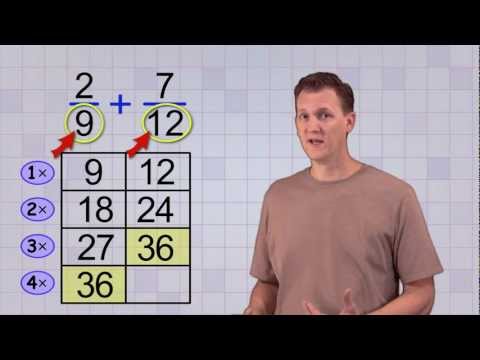
(Video) Common Denominator LCD

by Math Antics

Here's a good video by mathantics that shows you how to find the common denominator when adding or subtracting fractions.

Summary\large{\text{Summary}}

A common denominator is just as it sounds, a similar denominator that both fractions can have. You get this by taking the two different denominators and finding the least common multiple between them.

For example, let's try adding 23+14\frac23+\frac14 We will start by listing the multiples of each denominator. 3:3,6,9,12,15,⋯4:4,8,12,16,20,⋯\begin{align} &3:\quad3,6,9,{\color{#29A603}{12}},15,\cdots\\ &4:\quad4,8,{\color{#29A603}{12}},16,20,\cdots \end{align} The least common multiple they share is: 1212.

This is our least common denominator. To add these fractions, we need to multiply the top and bottom by the number that makes their denominators 1212. 2×43×4+1×34×3=812+312=8+312=1112\begin{align} &\frac{2 \times 4}{3 \times 4} +\frac{1 \times 3}{4 \times 3}\\ &=\frac{8}{12}+\frac{3}{12}\\ &=\frac{8+3}{12}\\ &=\frac{11}{12} \end{align}

Test Yourself: What is the least common denominator for 16\frac16 and 18\frac18?

Choose one answer

Type a concept, like “slope” or “photosynthesis”.

↑ ↓ to choose · Enter to openSearch explanations and problems

