When two (or more) fractions are equivalent, they have the same value.
Sometimes, equivalent fractions don't look alike at first. In fact, it can sometimes be hard to tell right away that two fractions actually have the same value.
The good news is that it's pretty easy to find out if two fractions are equivalent once you simplify and reduce them.
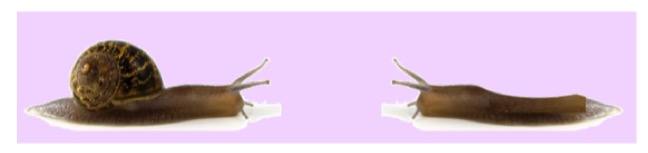
It might be a little gross and slimy, but think of equivalent fractions like a slug and a snail. They might not look the same at first—after all, the snail has a shell. But, when you simplify the snail by getting rid of its shell, it looks just like a slug. The snail becomes equivalent to the slug.
The same is true with fractions. To tell if they are equivalent, just reduce them down into their simplest forms (i.e., their slug form).
(NOTE: Please do not pull the shells off your neighborhood snails. Be nice to them).
Let's take a look at some examples of equivalent fractions.
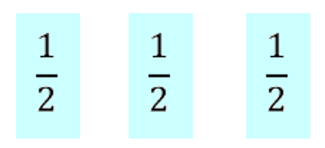
These 3 fractions don't look the same right now. But (spoiler alert), they are equivalent.
Which of the fractions above is in its reduced form?
What is the reduced form of 63?
What is the reduced form of 105?
So, once all of the fractions are reduced, we get:
Because the 3 original fractions all have the same value once they're simplified, we can say that they are all equivalent.
Let's try another approach, just to get a little more practice.
Which of the fractions below is equivalent to 54?
Which of the fractions below is equivalent to 132?
Which of these fractions is NOT equivalent to 43?
We say that two fractions are equivalent if they equal the same value. In other words, fractions are equivalent if they're equal.
While this might seem like a no brainer, it can sometimes be difficult to tell if two fractions are equal. For example, 519 and 11921 are equivalent fractions. I clearly can't tell.
Let's look at some methods at figuring out if two fractions are equivalent.
Draw a Picture
Drawing a picture is a good way to visually prove two fractions are equivalent but it can be time consuming for bigger fractions. Let's look at a simpler example with the fractions 21 and 42.
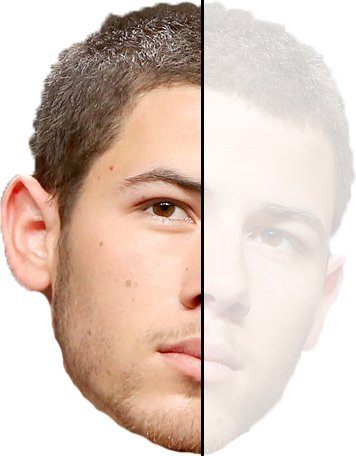
Here's 21 of Nick Jonas.
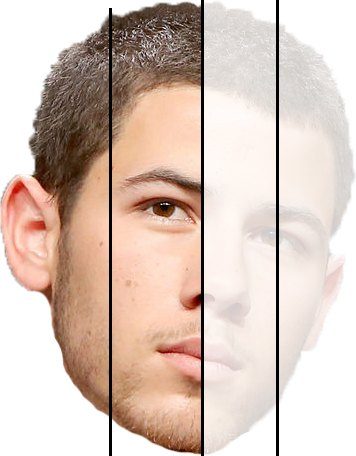
Here's 42 of Nick Jonas.
The top Nick Jonas face is divided into 2 equal parts with 1 part shaded in. This represents the fraction 21. The bottom Nick Jonas face is divided into 4 equal parts with 2 parts shaded in. This represents the fraction 42.
Notice that in both Nick Jonas faces, the filled in part is the exact same. This is because the fractions are equivalent. See now how this could get cumbersome to represent the fraction 11921?
Reduce
A more general way to see if fractions are equivalent is to reduce them to simplest form. Simplest form is when the numerator and denominator share no common factors other than 1.
Let's see if the fractions 183 and 427 are equivalent. Start with the first fraction and look to see what common factors they share by writing out the prime factorization of the top and bottom.
183=2×3×33
Since they share a 3, we can divide both the top and bottom by that.
183÷3÷3=61
This is the simplest form of the first fraction.
Let's check the second fraction now.
427=2×3×77
They both share a factor of 7, so we can remove that from both.
427÷7÷7=61
This is the simplest form of the second fraction. Notice that it is the same as the first fraction. Therefore, we know these two fractions are equivalent.
183=427
Notice they equal the same decimal value. Therefore, they're equivalent.
Creating Equivalent Fractions
In this area, a common problem you might encounter is as follows:
Find a fraction with a denominator of 40 that is equivalent to 51.
These problems will either ask you to find the numerator or the denominator of the equivalent fraction. To do this, we can rewrite the problem as follows:
51=40?
This resembles a problem about proportions. First, we look at the denominators, since that was what was given. What can we multiply 5 by to give us 40? The answer is 8.
Second, multiply the other part of the known fraction by this number. We are multiplying the top and bottom of the fraction by the same number so we know we aren't changing its value.
51×8×8=408
This gives us our equivalent fraction! Use any of the methods above to double check your work.
Try it Yourself!
Are the following fractions equivalent?
224 and 333
Try it Yourself!
Find a fraction with 68 in the numerator that's equivalent to 34.
Here's a video by Christine Munafo that explains equivalent fractions.
Summary
The first key piece of information is the word equivalent. Equivalent means equal amounts or an equal value of something.
An example of equivalent fractions would be 21 and 42. They may look different, but they each refer to the same amount of something.
The same amount is being shaded, but we're expressing it differently.
Since 21 and 42 are equivalent, we say that:
21=42
Creating Equivalent Fractions
Creating an equivalent fraction is simple. Suppose we have the fraction 83 and want to find the equivalent version of it with 16 in the denominator.
83=16?
To figure this out, we look at what number we can multiply 8 by to get 16. In other words, 16÷8. The answer is 2.
To get the new numerator, we just multiply the old one by the number we found, 2.
83⋅22=166
This works with multiplication and division.
In general, if a fraction can be reduced, then its simplest form is equivalent to the original fraction. The example 21=42 works well for this, because 42 reduces to 21. By the same logic, the following fractions are all equivalent to 21: