Menyusut atau memanjang secara horisontal

Before this, knowMemanjang atau menyusut secara vertikal

Illustrated · 1 min

Compress or Stretch Horizontally

Another transformation that can be applied to a function is stretching or compressing a function horizontally. \\ We can multiply a function by a positive constant cc to stretch and compress a function horizontally. \\
Given the graph of f(x)f(x), f(cx)f(cx) will be the graph of f(x)f(x) stretched horizontally if the value of cc is greater than 00 but less than 11 (0<c<10<c<1). f(cx)f(cx) will be the graph of f(x)f(x) compressed horizontally if the value of cc is greater than 11 (c>1c>1).

Example 1

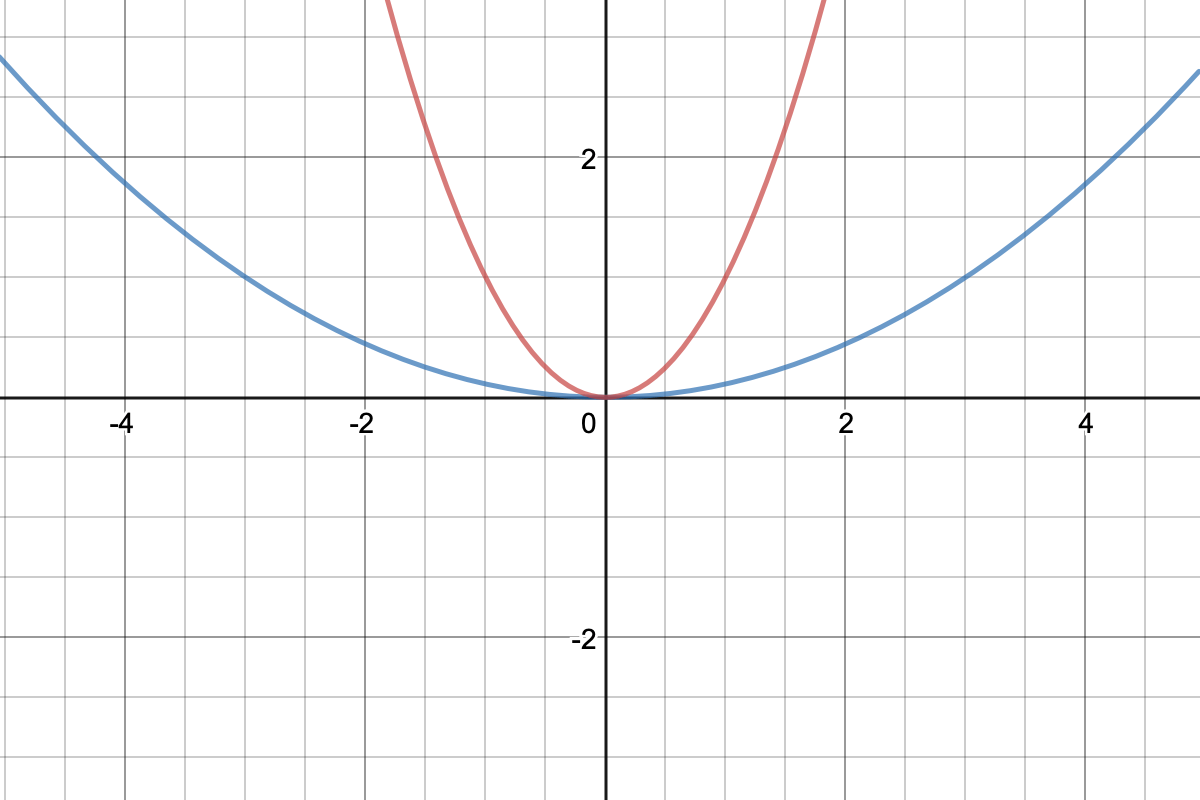
Graph of g(x)=(13x)2g(x)= (\dfrac{1}{3}x)^2 \\ The graph of g(x)=(13x)2g(x)= (\dfrac{1}{3}x)^2 will be a horizontal stretch of f(x)=x2f(x)=x^2 by 33 units. \\ The red graph is the graph of f(x)=x2f(x)=x^2 and the blue graph is the graph of g(x)=(13x)2g(x)=(\dfrac{1}{3}x)^2

Graph of y=x^2 and y=(1/3x)^2

Graphed with Desmos

Example 2

Graph of g(x)=(3x)2g(x)=(3x)^2 \\ The graph g(x)=(3x)2g(x)=(3x)^2 will be a horizontal compression of f(x)=x2f(x)=x^2 by 33 units. \\ The red graph is the graph of f(x)=x2f(x)=x^2 and the blue graph is the graph of g(x)=(3x)2g(x)=(3x)^2

Graph of y=x^2 and y=(3x)^2

Graphed with Desmos

Video · + 1 min read

(Video) Horizontal Stretches and Compressions

by mathlablady1

This video by mathlablady1 explains what happens with a horizontal stretch or compression.

Summary

When we are looking at a horizontal stretch or compression, what we are seeing is the result of a value being multiplied by the xx value.

f(ax)f(ax)

We are multiplying each xx-coordinate by aa. The function will stretch horizontally if 0<a<10<a<1, and the function will compress horizontally if a>1a>1.

Example

Let's look at the graphs of the parent function, f(x)=x2f(x)=x^2, which is in purple, and the transformed function, f(x)=(2x)2f(x)=(2x)^2, which is in green.

graphs of the parent function, $f(x)=x^2$, which is in purple, and the transformed function, $f(x)=(2x)^2$, which is in green

Made using Desmos

As we can see, the green (the transformed) graphed looks much skinner than the original parent function. That's because this is a horizontal compression! It kind of seems as though the two legs of the quadratic function are being pushed toward the yy-axis.

Now, let's look at the graph of f(x)=(12x)2f(x)=(\frac{1}{2} x)^2.

In purple, we have the graph of the parent function, $f(x)=x^2$, and in green we have the graph of the function $f(x)=(\frac{1}{2} x)^2$.

Made using Desmos

In purple, we have the graph of the parent function, f(x)=x2f(x)=x^2, and in green we have the graph of the function f(x)=(12x)2f(x)=(\frac{1}{2} x)^2.

Illustrated · 1 min

Horizontal Dilation

In context

In our series of function transformations, we learned about vertical translations, horizontal translations, vertical reflections, and horizontal reflections. In the last lesson, we learned about vertical stretches and compressions.

The next in the series of function transformations is the horizontal dilation! Think of it as a graph being stretch or compressed by a factor.

Horizontal dilation: horizontally stretching or compressing a function.

Image source: by Anusha Rahman

When we horizontally stretch or compress a function, we are essentially moving it closer or further from the yy-axis. Because we are changing the xx-values, we multiply the xx value in the equation by a constant. If the constant is a fraction, the function will be horizontally stretched. If the constant is >1>1, the function will be compressed.

f(cx)f(cx)

You are multiplying the inputs. As a result, you change the outputs of the function.

Let's look at the graph of the function of the parent quadratic equation. We know what that looks like.

Graph of y=x^2

Made using Desmos

Let's say we want to stretch the function. This is the graph of f(x)=(14x)2f(x)=\left(\frac{1}{4}x\right)^{2} in blue!

For some people, it may help you to understand this concept better if you choose a point on the parent graph and see what happens when you apply a horizontal dilation to it.

Graphs of y=x^2, y=\left(\frac{1}{4}x\right)^{2}

Made using Desmos

As we can see, multiplying the xx value inside the parentheses by a fraction will stretch the function graph.

Now, let's look at a horizontal compression in green.

Graphs of y=x^2, y=\left(\frac{1}{4}x\right)^{2}, f(x)=\left(4x\right)^{2}

Made using Desmos

In green, we have the graph of the function f(x)=(4x)2f(x)=\left(4x\right)^{2}. This is a horizontal compression.

We have finished both lessons on the stretching of the graphs! We're well on our way to master transforming more complex functions into each other.

Type a concept, like “slope” or “photosynthesis”.

↑ ↓ to choose · Enter to openSearch explanations and problems