Mengkonversi antara bentuk polar dan persegi panjang

Before this, knowBentuk polar dari bilangan kompleks

Read · 1 min

The distance from a number to 00 is call the absolute value, modulus, or magnitude of the number. Note that this definition is simply a generalization of the definition of absolute value of a real number. The previously described angle is called the argument of a number. For example, if z=1+iz = 1 + i, we would write ∣z∣=2|z| = \sqrt{2} and arg⁡(z)=π/4\arg(z) = \pi/4.

It should be relatively easy to see that, if a complex number zz has magnitude rr and argument θ\theta, then: z=r(cos⁡θ+isin⁡θ)z = r(\cos\theta + i\sin\theta) This is called the polar form of a complex number.

Thus, if you want to convert from polar form to rectangular form, remember that Re(z)=rcos⁡θRe(z) = r\cos\theta and Im(z)=rsin⁡θIm(z) = r\sin\theta.

If you want to convert a complex number z=a+biz = a+bi from rectangular from to polar form, then use the following conversions, which are also quite easy to show: r=a2+b2r = \sqrt{a^2+b^2} tan⁡θ=ba\tan\theta = \frac{b}{a}

There are two things of which to be cautious when calculating θ\theta:

First, if a=0a=0, then tan⁡θ\tan\theta is undefined. In this case, if b>0b>0, then θ=π/2\theta = \pi/2, and if b<0b<0, then θ=3π/2\theta = 3\pi/2. If a=b=0a=b=0, then the complex number is simply 00, which does not have a well-defined argument. In this case, you are free to choose any argument you want, since r=0r=0 anyway.

Second, θ\theta can lie anywhere in the range [0,2π)[0,2\pi), but tan⁡θ\tan\theta is periodic with period π\pi. Thus, when you compute tan⁡θ\tan\theta, there will be 22 possible values of θ\theta; in order to determine which is which, check the signs of aa and bb to determine which quadrant contains the complex number.

Read · 1 min

###Looking Back In the previous lesson, we talked about the polar form of a complex number. We saw that the horizontal axis is the real axis and the vertical axis is the imaginary axis. In this lesson, we will convert numbers in polar form to numbers in the rectangular form, and vice versa.

Converting between polar and rectangular form

Note: aa is the real part, and bb is the imaginary part of any complex number zz. In the polar form of zz, rr is the absolute value and θ\theta is the argument. Basically, z=a+bi=r(cos⁡θ+isin⁡θ)z=a+bi=r(\cos\theta+i\sin\theta).

Inside our definition of the polar form, we implicitly created a conversion formula from polar back to rectangular. The real part is rcos⁡θr\cos\theta, and the imaginary part is rsin⁡θr\sin\theta.

Polar → Rectangular\text{Polar }\rightarrow\text{ Rectangular} rcos⁡θ=arsin⁡θ=b\boxed{\begin{align}r\cos\theta &= a \\ r\sin\theta &= b\end{align}}

Let's use those formulas we just defined above to look at the other way around.

To get rr we can square aa and bb and add them; we exploit the Pythagorean Identity to eliminate θ\theta.

a2+b2=r2cos⁡2θ+r2sin⁡2θ=r2a^2+b^2=r^2\cos^2\theta+r^2\sin^2\theta=r^2 r=a2+b2r=\sqrt{a^2+b^2}

Getting θ\theta is somewhat easier: we can try to divide bb by aa to eliminate rr:

ba=rsin⁡θrcos⁡θ=tan⁡θ\frac{b}{a}=\frac{r\sin\theta}{r\cos\theta}=\tan{\theta} θ=arctan⁡ba.\theta=\arctan{\frac{b}{a}}.

So, Rectangular → Polar\text{Rectangular }\rightarrow\text{ Polar} a2+b2=rarctan⁡ba=θ\boxed{\begin{align} \sqrt{a^2+b^2} &= r\\ \arctan{\frac{b}{a}} &= \theta \end{align}}

Video

(Video) Converting Complex Numbers from Rectangular to Polar Form

by Centennial Math Drop-In

In this video by Centennial Math Drop-In, you will get a quick example of how to convert a complex number from rectangular to polar form.

Illustrated · 1 min

Convert Complex Numbers Between Polar and Rectangular Form

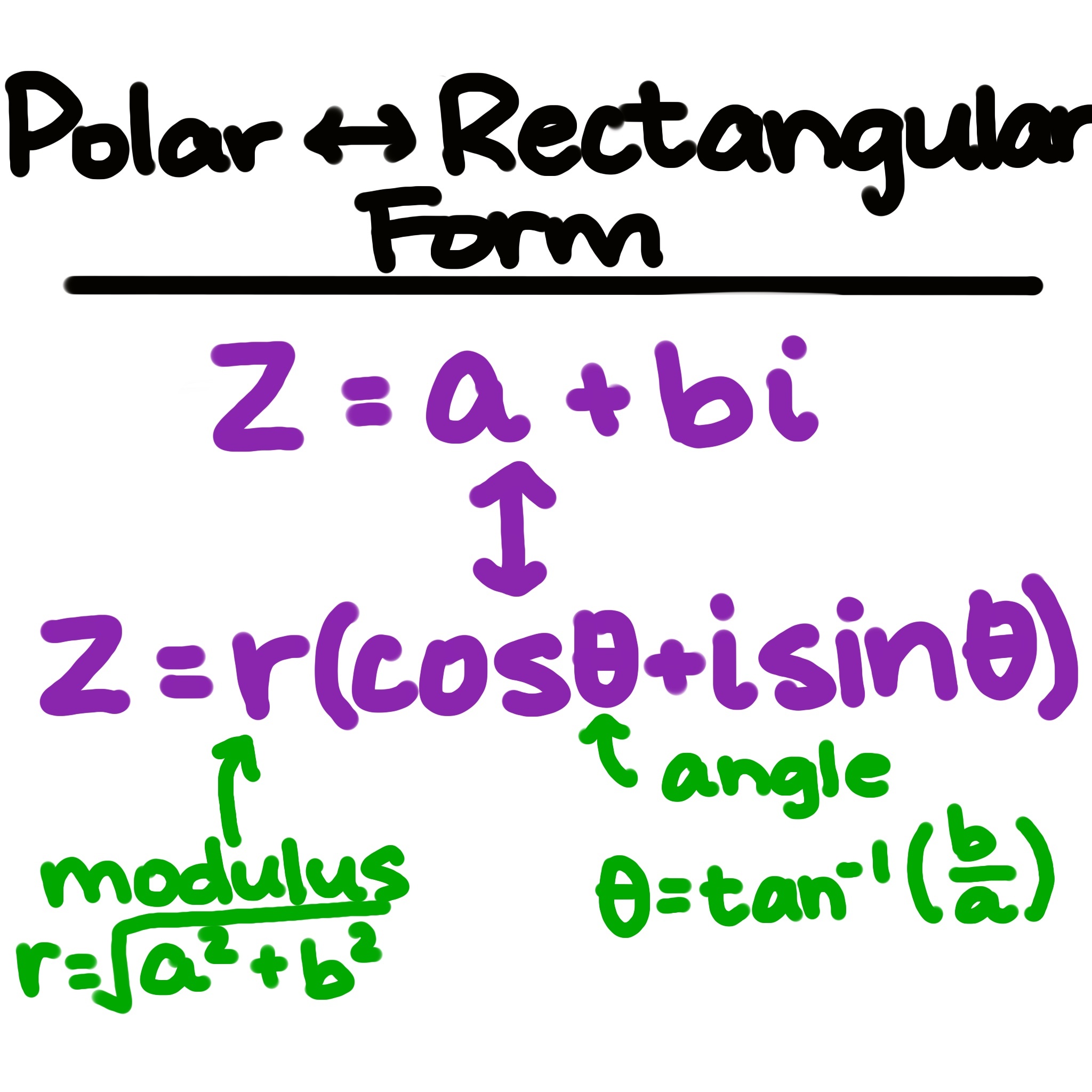
A complex number can be written in two different ways: rectangular form and polar form.

In rectangular form, aa is the real part and bb is the imaginary part: z=a+biz = a + bi

In polar form, rr is the modulus (distance from the origin) and θ\theta is the angle (direction from the positive xx-axis: z=r(cos⁡θ+isin⁡θ)z=r(\cos\theta + i \sin\theta)

Polar <--> Rectangular Form
z=a+bi
z=r(cos(theta)+isin(theta))
r=modulus
theta=angle

Image source: by Anusha Rahman

Converting from Rectangular to Polar Form

To find the modulus: r=a2+b2r= \sqrt{a^2 + b^2}

To find the angle (argument): θ=tan⁡−1ba\theta = \tan ^{-1} \frac{b}{a}

You'll then plug these values into polar form.

Converting from Polar to Rectangular Form

Use the following formulas: a=rcos⁡θa = r \cos \theta

b=rsin⁡θb = r \sin \theta

Then write: z=a+biz=a+bi

Type a concept, like “slope” or “photosynthesis”.

↑ ↓ to choose · Enter to openSearch explanations and problems