Multiplying and Dividing Complex Numbers in Polar Form
When you are multiplying and dividing complex numbers in rectangular form, there is a lot of FOILing and algebraic manipulation, which may lead you to wonder whether there is a more efficient way to go about solving these problems. Luckily, we are also able to multiply and divide complex numbers in polar form, which can be a lot easier!
Multiplying Complex Numbers in Polar Form
When you multiply two complex numbers in polar form, z1=r1(cos(θ1)+isin(θ1)) and z2=r2(cos(θ2)+isin(θ2)), you can use the following formula to solve for their product:
z1z2=r1r2(cos(θ1+θ2)+isin(θ1+θ2))
Let's do an example to practice using the formula!
Let z1=2(cos(6π)+isin(6π)) and z2=22(cos(2π)+isin(2π)). What is z1z2?
Let's use our formula, z1z2=r1r2(cos(θ1+θ2)+isin(θ1+θ2)), to solve this problem.
z1z2=(2(cos(6π)+isin(6π)))(22(cos(2π)+isin(2π)))=(2)(22)(cos(6π+2π)+isin(6π+2π)) by our formula=4(cos(122π+126π)+isin(122π+126π))=4(cos(128π)+isin(128π))=4(cos(32π)+isin(32π))=4(−21+i(23))=−24+i(243)=−2+2i3
This method is a lot easier than converting complex numbers in polar form to complex numbers in rectangular form, and then using FOILing to find their product! We can also use a similar formula when we are dividing complex numbers in polar form.
Dividing Complex Numbers in Polar Form
When you divide two complex numbers in polar form, z1=r1(cos(θ1)+isin(θ1)) and z2=r2(cos(θ2)+isin(θ2)), you can use the following formula so solve for their product, as long as z2=0:
z2z1=r2r1(cos(θ1−θ2)+isin(θ1−θ2))
Let's do another example to practice using this new formula!
Let z1=2(cos(6π)+isin(6π)) and z2=22(cos(2π)+isin(2π)). What is z2z1?
Let's use our formula, z2z1=r2r1(cos(θ1−θ2)+isin(θ1−θ2)), to solve this problem. (First, it's important to notice that z2=0, which is why we can use this formula. If z2 was 0, then r2 would be 0, and we would not be able to calculate r2r1.)z2z1=(22(cos(2π)+isin(2π)))(2(cos(6π)+isin(6π)))=222(cos(6π−2π)+isin(6π−2π)) by our formula=21(cos(122π−126π)+isin(122π−126π))=21(cos(12−4π)+isin(12−4π))=21(cos(3−π)+isin(3π))=21(21+i(−23))=21⋅21+i(21⋅−23)=41+4−3i
Like with multiplying complex numbers, this method is a lot easier than converting two complex numbers from polar form to rectangular form, and then using FOILing and complex conjugation to find their quotient!
Multiplying and Dividing Complex Numbers in Polar Form
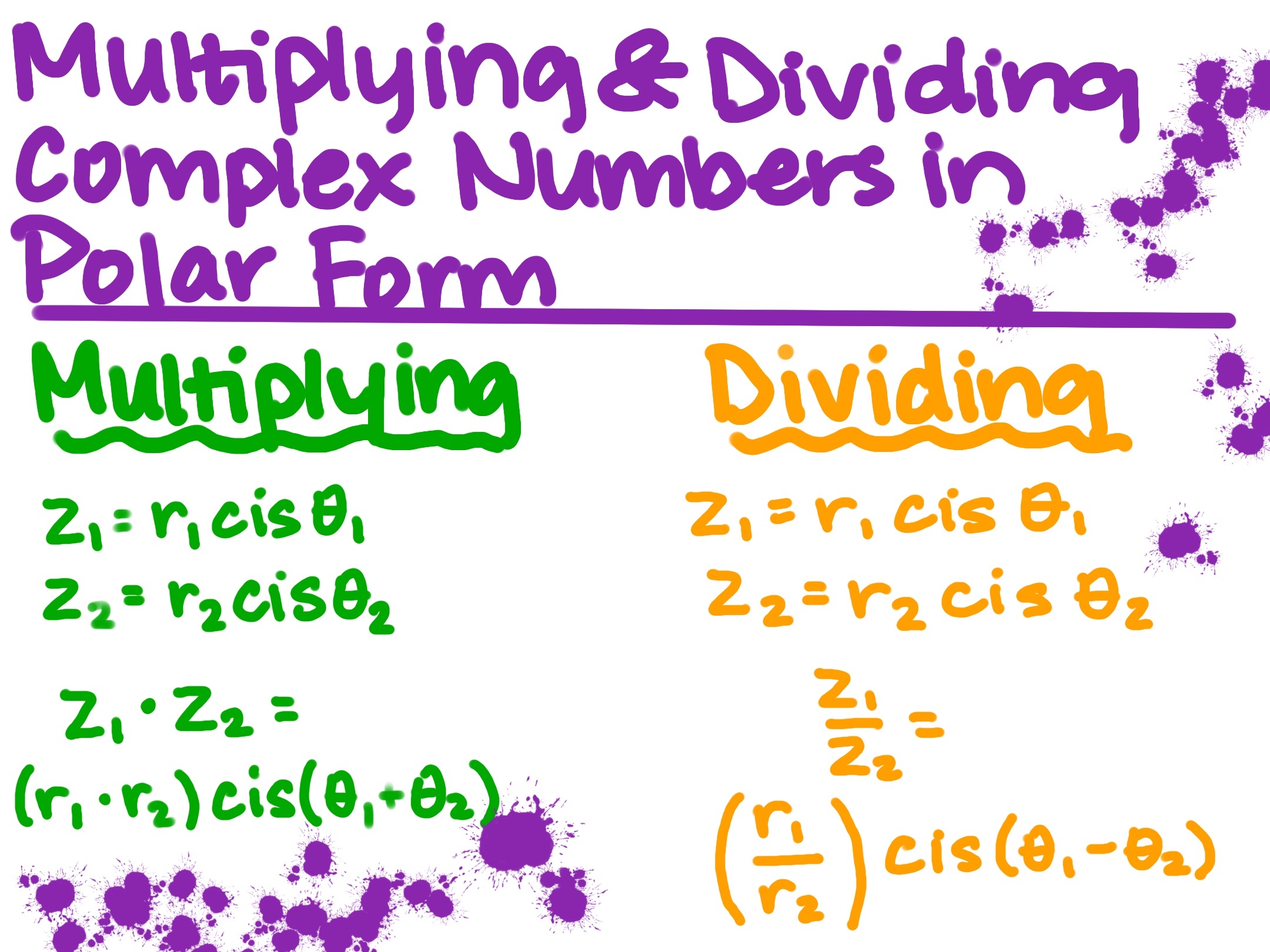
Multiplying and dividing complex numbers in polar form is much easier than doing it in rectangular form. In rectangular form, you have to distribute and simplify using i2=−1, but in polar form, you just have to work with the modulus and the angle.
Image source: by Anusha Rahman
A complex number in polar form looks like:
z=rcisθ
, which means:
z=r(cosθ+isinθ)
Let's talk through what this looks like. Let z1=r1cisθ1 and z2=r2cisθ2.
Multiplication
To multiply two complex numbers in polar form, you multiply the r values and add the angles.
z1⋅z1=(r1⋅r2)cis(θ1+θ2)
Division
To divide two complex numbers in polar form, you divide the r values and subtract the angles.
z2z1=r2r1cis(θ1−θ2)
This method makes it easier to work with rotations and magnitudes. You don't need to deal with real and imaginary parts! Multiplying stretches and rotates the complex number. Dividing shrinks and reverses the rotation.