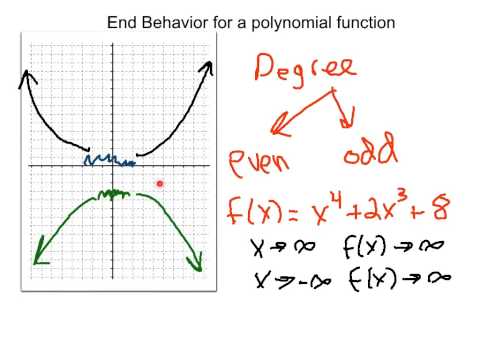
The end behavior of a polynomial is exactly what it sounds like: we want to know what happens to a polynomial function toward the "ends" of the x-axis. That means we want to describe the behavior of a polynomial as it reaches positive and negative infinity.
As we approach positive infinity on the x-axis, we the polynomial function can either increase or decrease. The same concept applies to a polynomial approaching negative infinity on the x-axis: it can either increase or decrease.
We will look at two ways to find the end behavior: graphically and algebraically.
####Graphically
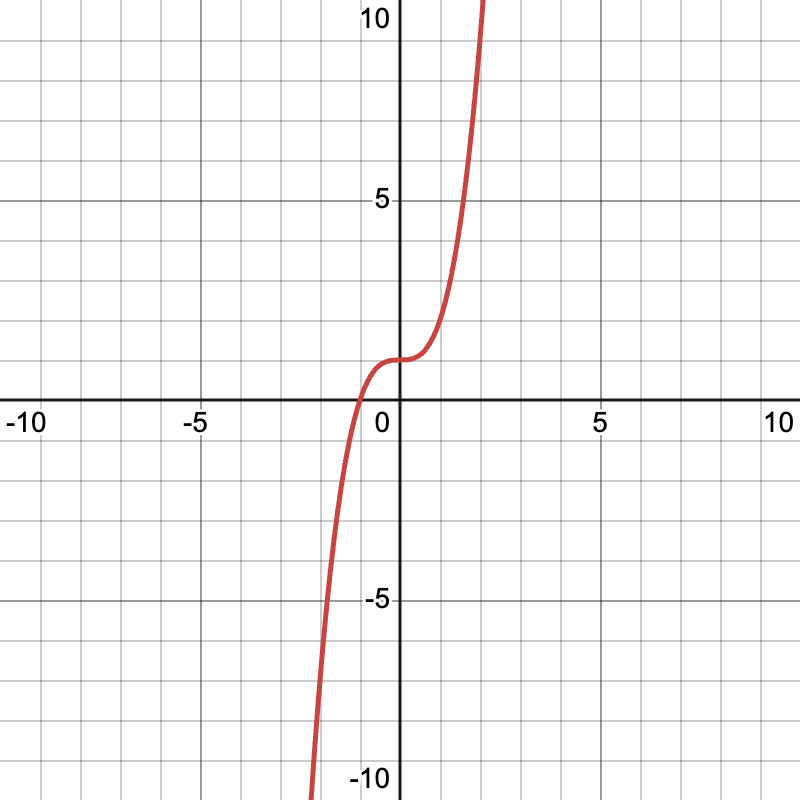
Let's look at the graph of y=x3+1.
Let's first look at the polynomial approaching positive infinity. As the values on the x axis get bigger, the values in the polynomial also get bigger. As x approaches positive infinity, f(x) approaches positive infinity. Mathematically, we write:
x→+∞,f(x)→+∞
We can do the same analysis for the other side of the y-axis. As the values on the x axis get smaller, the values in the polynomial also get smaller. As x approaches negative infinity, f(x) approaches negative infinity. Mathematially, we write:
x→−∞,f(x)→−∞
####Algebraically
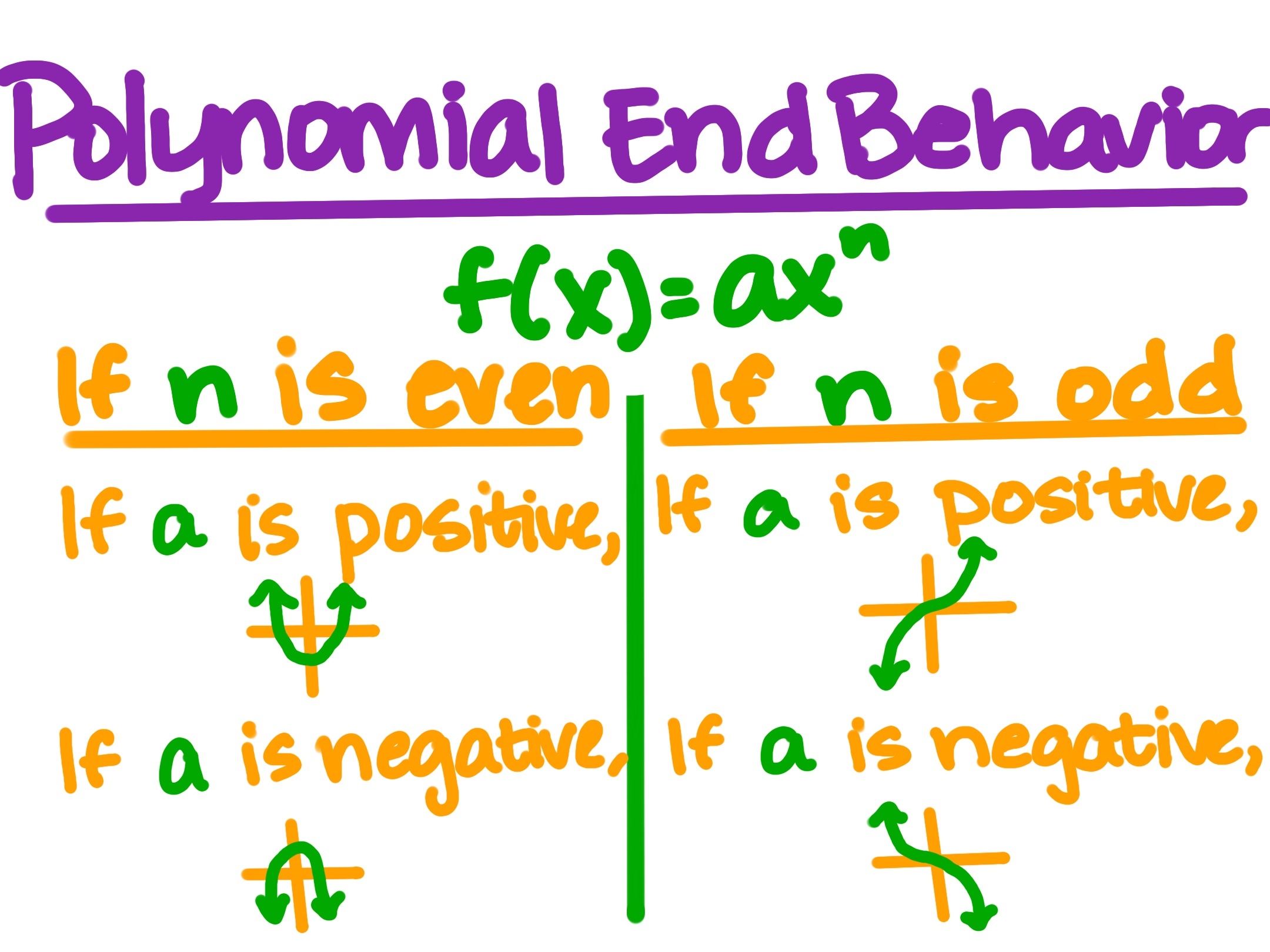
Sometimes, we don't have the graph of the polynomial available to us, but we still want to know the end behavior of a polynomial. We can use the degree of the monomial (n) and the leading coefficient (a) to help us.
f(x)=axn
If n is even: the behavior at both ends of the polynomial are the same.
- If a is positive: both ends will approach positive infinity.
- If a is negative: both ends will approach negative infinity.
If n is odd: the behavior at both ends of the polynomial are opposites.
- If a is positive: x→+∞,f(x)→+∞ and x→−∞,f(x)→−∞
- If a is negative: x→+∞,f(x)→−∞ and x→−∞,f(x)→+∞
####Connecting the Dots
We can see that in the above example, we looked at a continuous function that approaches infinity. It has one turning point, with no global minimum or global maximum. It intersects the x-axis once.