Menemukan derajat pangkat

Before this, knowOperasi-operasi

Interactive · 4 questions

The degree of a polynomial is guaranteed to be its largest exponent if it contains only one variable. If the polynomial in question contains more than one variable, its degree is the highest degree out of all the polynomial's terms, which is not necessarily the polynomial's greatest exponent. The highest degree is the highest power. This is easiest to figure out if the polynomial is in standard form.

For example, the degree of x2+3x^2 + 3 is 22 because the highest exponent of the variable xx is 22 (in the x2x^2 term).

The degree of x3y3+x2y2+5x^3y^3 + x^2y^2 + 5 is 66 (not 33) because the highest degree of any of its terms is 6:6:

The 55 term in the polynomial above does not have any variables in it. Thus, the degree is 0.0.

The x2y2x^2y^2 term has an xx raised to the 22 and a yy raised to the 2.2. Thus, the degree of this term is 2+2=4.2+2=4.

The x3y3x^3y^3 term has an xx raised to the 33 and a yy raised to the 3.3. Thus, the degree of this term is 3+3=6.3+3=6.

The term with the highest degree has degree 6,6, so 66 is the degree of the whole polynomial.

Scalar Multiplication

The degree of the product of a polynomial and a non-zero real number is the degree of the polynomial itself.

For example, the degree of the product of aa (some non-zero real number) and x3+x2+1x^3 + x^2 + 1 is 3.3. Because a⋅(x3+x2+1)=ax3+ax2+a.a\cdot (x^3 + x^2 + 1) = ax^3 + ax^2 + a. The highest degree of this polynomial is equal to the biggest exponent, which is 3.3.

Multiplication of Two or More Polynomials

The degree of the product of two or more polynomials with one variable is the sum of the degrees of each polynomial.

For example, the degree of the product of x2+1x^2 + 1 and 4x3+5x+14x^3 + 5x + 1 is 55. This is because the degree of x2+1x^2 + 1 is 2,2, and the degree of 4x3+5x+14x^3 + 5x + 1 is 3,3, so the total degree is 2+3=5.2+3=5.

The degree of a term in the product of two or more polynomials with two or more variables is the sum of the exponents of each variable in the term. The degree of the polynomial as a whole is equal to the highest degree of any of the terms.

For example, consider xy+x2y.xy + x^2y.

The term xyxy has degree 2,2, because xx is raised to the 11 and yy is raised to the 1,1, and 1+1=2.1+1=2.

The term x2yx^2y has degree 3,3, because xx is raised to the 22 and yy is raised to the 1,1, and 2+1=3.2+1=3.

The polynomial xy+x2yxy + x^2y has a degree of 33 because 33 is the highest degree of either of its terms!

The degree of a product (which will be a polynomial, itself) of two or more polynomials with multiple variables is equal to the sum of the degrees of each polynomial.

For example, consider the product of xy+x2yxy + x^2y and xy2+y3+xxy^2 + y^3 + x.

The degree of xy+x2yxy + x^2y is 3,3, as we have seen in the previous example. The degree of xy2+y3+xxy^2 + y^3 + x is 3.3. (This is because the degree of the term with the highest degree, xy2,xy^2, is 33.) Thus, the degree of the product of these two polynomials is 3+3=6.3+3=6.

When we multiply those two polynomials together and simplify the resulting expression, we get x2y3+xy4+x2y+x3y3+x2y4+x3yx^2y^3 + xy^4 + x^2y + x^3y^3 + x^2y^4 + x^3y. Note that there are two terms in this product that are tied for highest degree: x3y3x^3y^3 and x2y4x^2y^4. Both of these terms have a degree of 6,6, which means that the degree of the entire product is 6.6.

Test Yourself!

Consider the following expression: (a2b2+a)(a4+b+a)(b3+a)(a^2b^2 + a)(a^4 + b + a)(b^3 + a)

What is the degree of a2b2+aa^2b^2 + a (as seen in the polynomial product given above?)

Choose one answer

Read · 2 min

Note: the degree of a polynomial must be a non-negative integer.

When we multiply two terms with the same base such as x2x^{2} and x3x^{3}, our product is the base raised to the sum of the exponents, like so: x2+3=x5x^{2+3} = x^{5}

This is the highest power.

Now, let's see how we can apply this knowledge to products of polynomials.

Consider two generic polynomials of degree nn and mm: anxn+an−1xn−1...+a0a_n x^{n} + a_{n-1} x^{n-1}... + a_0 bmxm+bm−1xm−1...+b0b_m x^{m} + b_{m-1} x^{m-1}... + b_0 Let's think about how we go about finding the degree of the product of those two polynomials. Well, when we multiply polynomials, their terms are all multiplied out. With that in mind, consider the product that would result from multiplying the two polynomials above: which of its terms has the largest exponent (and therefore determines the product's degree)?

In order to find the greatest exponent of our product, we need to find the greatest exponents of our two polynomials, which are mm and nn, respectively. Therefore, the degree of our product is m+nm+n.

Now, you may think, what would happen if I multiplied many polynomials together. For the sake of ease, let's just multiply four polynomials together, with degrees k,l,mk,l,m and nn. Multiplying the first two polynomials results in a polynomial of degree k+lk+l. We then multiply this new polynomial by the polynomial of degree mm, and then multiply that product by the polynomial of degree nn. In the end, this results in a polynomial of degree k+l+n+mk+l+n+m. Note that multiplication of polynomials is commutative and associative, which is convenient.

Another way to look at this is through the lens of the fundamental theorem of algebra (FDA). Again, we refer back to our two polynomials of degree mm and nn. By the FDA, those polynomials have exactly mm and nn roots, respectively. Effectively, we've factored our polynomials. Multiplication of the polynomials is synonymous to multiplying their factored versions, which results in a polynomial with m+nm+n roots. Reversing what we previously did, we recognize that this product must have a degree of m+nm+n.

Video

(Video) Find the Degree of a Polynomial Product without Multiplying

by Anusha Rahman

In this video by Anusha Rahman, you will learn how to find the degree of a polynomial product without multiplying out the polynomial.

Summary

When you multiply two polynomials together, the degree of the resulting polynomial is the sum of the degrees of the individual polynomials.

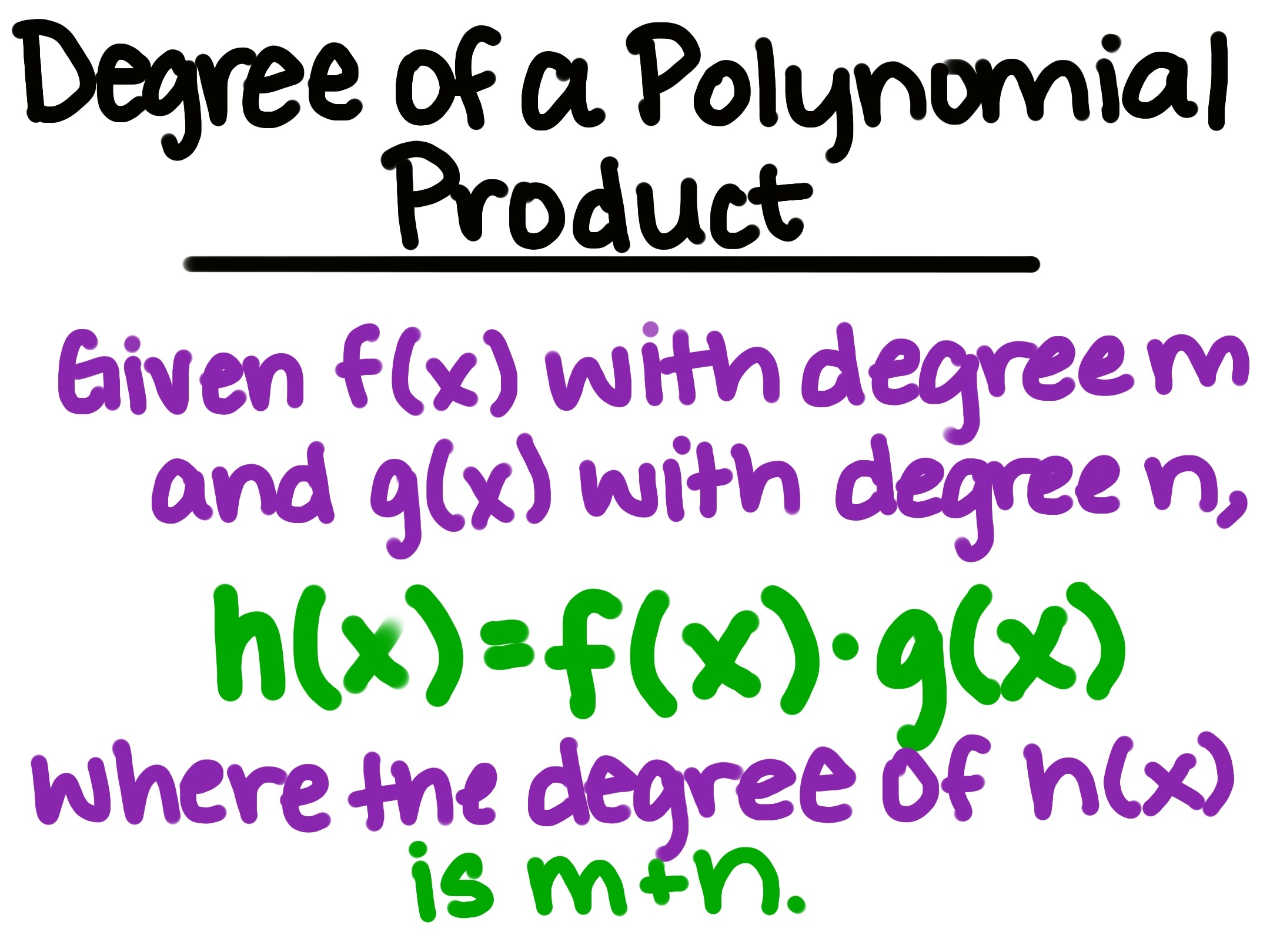
Given f(x)f(x) with degree mm and g(x)g(x) with degree nn,

h(x)=f(x)⋅g(x)h(x) = f(x) \cdot g(x)

The degree of h(x)h(x) is m+nm+n

Interactive · 1 question

Finding The Degree of a Polynomial Product

Now that we've covered the basics of polynomial operations, let's move into the degree. The degree of a polynomial determines both its end behavior and overall shape.

In this lesson, we will learn how to find the degree of a polynomial product. First, remember that the degree of a polynomial is the highest exponent of the variable (usually xx) in that polynomial when it is written in standard form.

Degree of a Polynomial Product
Given f(x) with degree m and g(x) with degree n, h(x) = f(x) x g(x), where the degree of h(x) is m+n

Image source: by Anusha Rahman

When we multiply two polynomials together, the degree of the resulting polynomial is the sum of the degrees of the polynomials being multiplied. For example, if you multiply a polynomial with degree 22 by a polynomial with degree 33, the degree of the product will be 2+3=52 + 3 = 5.

Let's look at an example.

Example

Suppose you have the polynomials (2x2+3x+1)(2x^2 + 3x+1) and (x3+4x−2)(x^3+4x-2). The degree of the first polynomial is 22, and the degree of the second polynomial is 33. When you multiply them, the degree of the product will be 2+3=52+3=5.

Let's think about the multiplication of the highest degree terms: (2x2)⋅(x3)=2x5(2x^2) \cdot (x^3) = 2x^5. The highest degree term is 2x52x^5, which confirms that the degree of the product is 55.

It's important to note that you do not need to actually multiply out every term to find the degree. Just focus on the highest degree terms in each polynomial. The product's degree is simply the sum of the degrees of these highest degree terms.

Try this next example on your own!

Example

What is the degree of the polynomial product?

(x4+2x2)⋅(x3−x+5)(x^4 + 2x^2) \cdot (x^3-x+5)

Once you've tried to solve the problem, click here to see the solution.

Choose one answer

Type a concept, like “slope” or “photosynthesis”.

↑ ↓ to choose · Enter to openSearch explanations and problems