Ekstensi: Bilangan Segitiga

Before this, knowPenjumlahan dan notasi pangkat

Illustrated · 1 min

The triangular numbers are a useful sequence of numbers, named after the fact that they can be arranged in a triangle as follows:
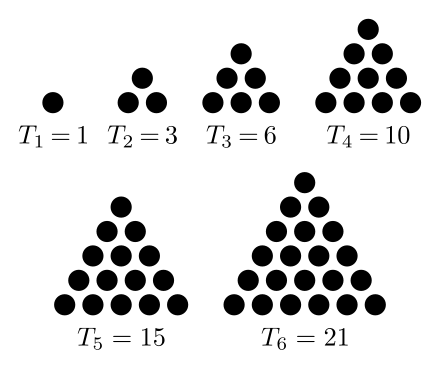
The first six triangular numbers, displayed visually.

One way to find the nthn^{th} triangular number is by using the following formula: Tn=n(n+1)2T_n = \frac{n(n+1)}{2} Triangular numbers have applications beyond arranging circles into triangles, of course; for example, consider the following identity: 1+2+⋯+n=∑i=1ni=Tn1 + 2 + \dots + n = \sum_{i=1}^n i = T_n This can be easily seen using the picture above, as each row of the triangle has ii circles in it, for i=1i = 1 to nn.

Here are a few more interesting identities involving the triangular numbers: ∑i=1ni3=Tn2\sum_{i=1}^n i^3 = T_n^2 (n+12)=Tn{n+1 \choose 2} = T_n Tn+12−Tn2=(n+1)3T_{n+1}^2 - T_n^2 = (n+1)^3

Find your level

The problems run from approachable to very hard, and each is rated by how often real students solve it, so you can pick your next step. These are real problems from the AMC 8, AMC 12 and AIME, the national math competitions for middle and high school students, each with a worked solution on LIVE by Po-Shen Loh.

Illustrated · 1 min

Triangular Numbers

We have learned about natural numbers and and perfect numbers. We've also learned about square numbers, like 44 and 1616. You may also be familiar with hexagonal numbers, like 11, 66, 1515, and 2828 (number of dots around a hexagon). The next lesson pertaining to figurate numbers is triangular numbers!

We previously learned about the finite arithmetic series. An extension of this principle is to calculate Triangular Numbers.

Triangular Numbers
T_n = [n(n+1)]/2

Image source: by Anusha Rahman

There are many uses for triangular numbers, specifically finding the binomial coefficient.

Video

(Video) Triangular Numbers Explained

by Minity Maths

In this video by Minity Maths, you will get an explanation for what triangular numbers are and the patterns associated with them.

Type a concept, like “slope” or “photosynthesis”.

↑ ↓ to choose · Enter to openSearch explanations and problems