Penjumlahan dan notasi pangkat

Before this, knowMengevaluasi dengan pertambahan

Interactive · 2 questions

Summations

A summation, or a sum for short, is the sum of a list of numbers. For example, the sum of 1,2,3,41,2,3,4 is 1+2+3+4=101+2+3+4=10. We can write these sums in a more condensed way, by using something called sigma notation. The above example can be written as ∑i=14i=10\sum_{i=1}^4 i=10

Let's break it down. First look at the bottom and top of the sigma. On the bottom we have something called the index, ii. It says that i=1i=1, which is where our index starts, and on the top there is a 44, the ending point for the index. This means that we sum what's after the sigma (in the above example this is simply ii) for all i=1→4i=1\to 4, or 1+2+3+41+2+3+4. Note that the index is incremented by one each time.

In general, ∑i=mnf(i)=f(m)+f(m+1)+⋯+f(n−1)+f(n)\sum_{i=m}^nf(i)=f(m)+f(m+1)+\cdots +f(n-1)+f(n)

for m≤nm\le n

What if m>nm> n? What would the value of ∑i=mnf(i)\displaystyle\sum_{i=m}^nf(i) be?

Choose one answer

Put ideas together

Contest problems often need this idea together with one or two others. That is where understanding goes deeper than memory. These are real problems from the AMC 8, AMC 12 and AIME, the national math competitions for middle and high school students, each with a worked solution on LIVE by Po-Shen Loh.

Interactive · 2 questions

A sum is the result of adding a sequence of values. For example, 1+4+9+161+4+9+16 is the sum of the first four squares. We can write this sum compactly using sigma notation: ∑i=14i2.\displaystyle\sum_{i=1}^4i^2. The ∑\sum used here indicates that we add the values of i2i^2 for i=1,2,3i=1,2,3 and 44. In general, we can use sigma notation to write the sum of a sequence am,am+1,am+2,⋯ ,ana_m,a_{m+1},a_{m+2},\cdots,a_n as ∑i=mnai=am+am+1+⋯+an.\displaystyle\sum_{i=m}^na_i = a_m + a_{m+1} + \cdots + a_n.

Can you find the value of the following sum? ∑i=252i−1\displaystyle\sum_{i=2}^52i-1

Choose one answer

Interactive · 2 questions

Summation notation

Sigma notation is a shorthand form used to denote a sum of many values. A summation is denoted by the capital Greek letter ∑\sum (sigma):

∑i=1nai=a1+a2+a3+...+an−1+an\begin{equation} \sum_{i=1}^{n} a_i = a_1 + a_2 + a_3 + ... + a_{n-1} + a_n \end{equation}

where ii is the index of summation, i=1i=1 is the lower limit of the summation (starting point), nn is the upper limit (stopping point), and aia_i is the element being summed.

How would you write this series in summation notation? Check all correct methods.1+3+5+⋯1+3+5+\cdots

Choose all correct answers

Interactive · 2 questions

Sums

A summation is simply a shorthand for summing terms given by a formula together. These "sums" are things like 2+4+6+82+4+6+8 or 1+12+14+⋯1 + \frac 12 + \frac 14 + \cdots and can be expressed with a shorthand known as sigma notation: ∑i=142i=2+4+6+8\displaystyle{\sum_{i=1}^4 2i = 2 + 4 + 6 + 8} ∑i=0∞12i=1+12+14+⋯\displaystyle{\sum_{i=0}^\infty \dfrac 1{2^i} = 1 + \dfrac 12 + \dfrac 14 + \cdots} This may appear confusing at first, but it's actually not that bad. Essentially, given a function f(x)f(x), we can express the sum: f(j)+f(j+1)+⋯+f(k)f(j) + f(j+1) + \cdots + f(k) As: ∑i=jkf(i)\displaystyle{\sum_{i=j}^kf(i)} (Note that jj and kk must be integers such that k≥jk \ge j, otherwise the sum is just 00)

You might still be confused about the "i=i=" at the bottom. The purpose of ii is just to be a "dummy variable" used in the expression; we could've just replaced ii with xx or zz or anything. However, i,j,ki, j, k are the standard dummy variables that are used.

You might still be confused about the "i=i=" at the bottom. The purpose of ii is just to be a "dummy variable" used in the expression; we could've just replaced ii with xx or zz or anything. However, i,j,ki, j, k are the standard dummy variables that are used.

Now, try evaluating the following sum: ∑j=15(2j−1)\displaystyle{\sum_{j=1}^5(2j-1)}

Choose one answer

Video · + 1 min read

(Video) Sigma Notation

by Eddie Woo

Here's a video by Eddie Woo where he explains what sigma notation is and how you use it.

To recap, there's three ways to define a series or sequence.

  1. Start listing them: 2,4,6,8,⋅⋅⋅2,4,6,8,\cdot\cdot\cdot
  2. Algebraic expression for the nthn^{\text{th}} term: Tn=2nT_n=2n
  3. Recursive definition: T1=2;  Tn=Tn+1+2T_1=2;\ \ T_n=T_{n+1}+2

Sigma Notation

Sigma notation relates to the second method above, algebraic expressions. Sigma is a Greek letter and we use the capital, Σ\Sigma. It is a symbol we use to denote summation.

Suppose we wanted to find the sum of the even numbers. We could use sigma notation as a sort of short hand way to express this. It would be: ∑2n\sum{2n}

Now, suppose we wanted to find the sum of the first ten even numbers. We have to define a starting point and an end point for our sigma. We want to start where nn is equal to 1. Since we want the first ten, we would end when nn equals 10. To denote this with sigma notation, it would look like: ∑n=1102n\sum_{n=1}^{10} 2n If you write this out, it becomes: ∑n=1102n=2+4+6+8+10+12+14+16+18+20\sum_{n=1}^{10} 2n=2+4+6+8+10+12+14+16+18+20 Since this is an arithmetic series we can easily figure out the sum. ∑n=1102n=n2(a+l)=102(2+22)=5∗22=110\begin{align} \sum_{n=1}^{10} 2n&=\frac{n}2(a+l)\\ &=\frac{10}{2}(2+22)\\ &=5*22\\ &=110 \end{align}

Illustrated · 1 min

Summation Notation

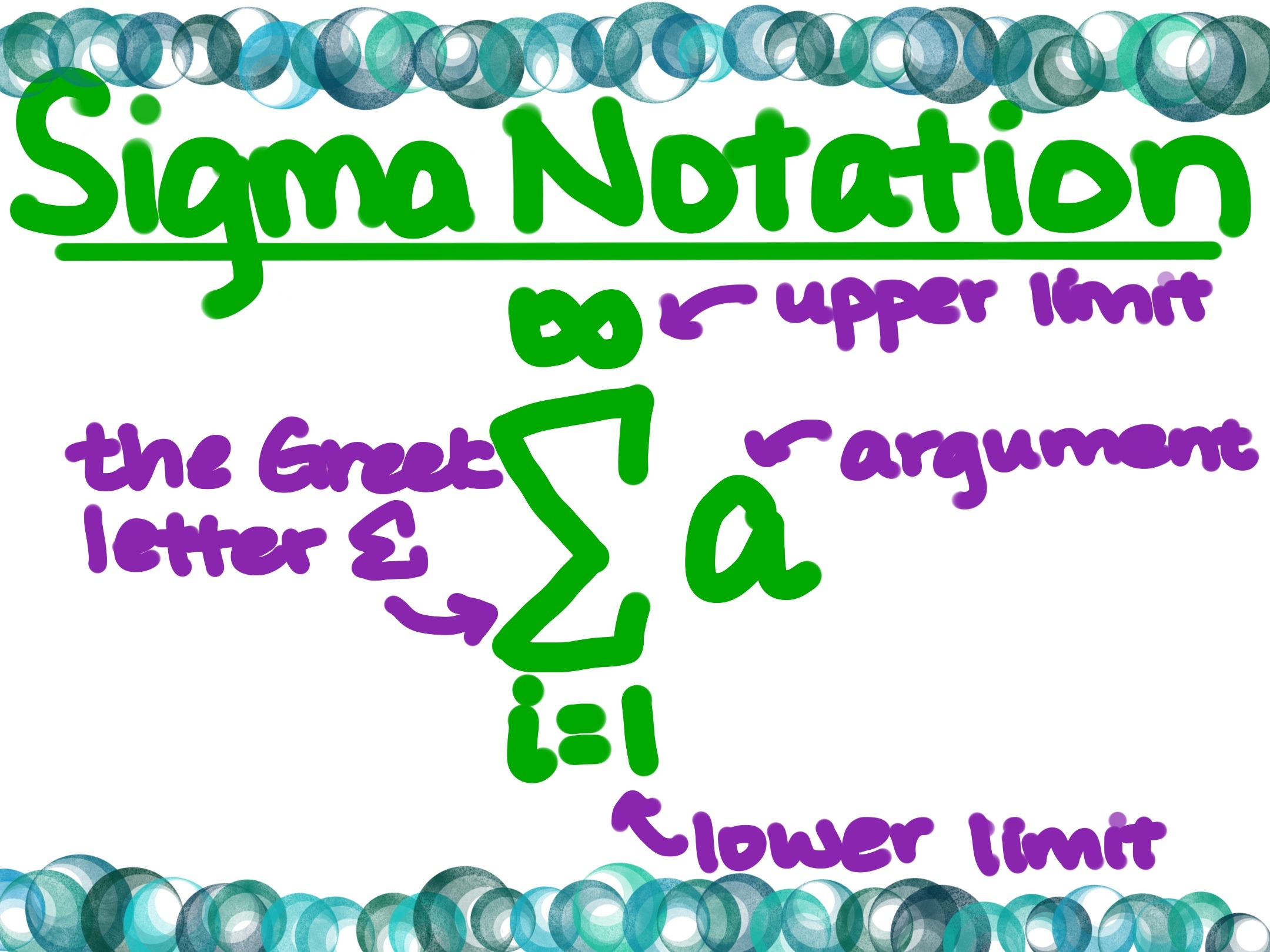
Summation notation helps us simplify how we write out sequences and series.

Sigma notation

Image source: by Anusha Rahman

Sigma notation or summation notation helps us quickly and efficiently write out the pattern, or argument, for a sequence. Under the sigma, we see the lower limit, and on top of the sigma, we see an upper limit. When writing out the sequence, we start at the lower limit and apply the argument to that lower limit. We keep going until we hit the upper limit. We saw this when we learned about evaluating series.

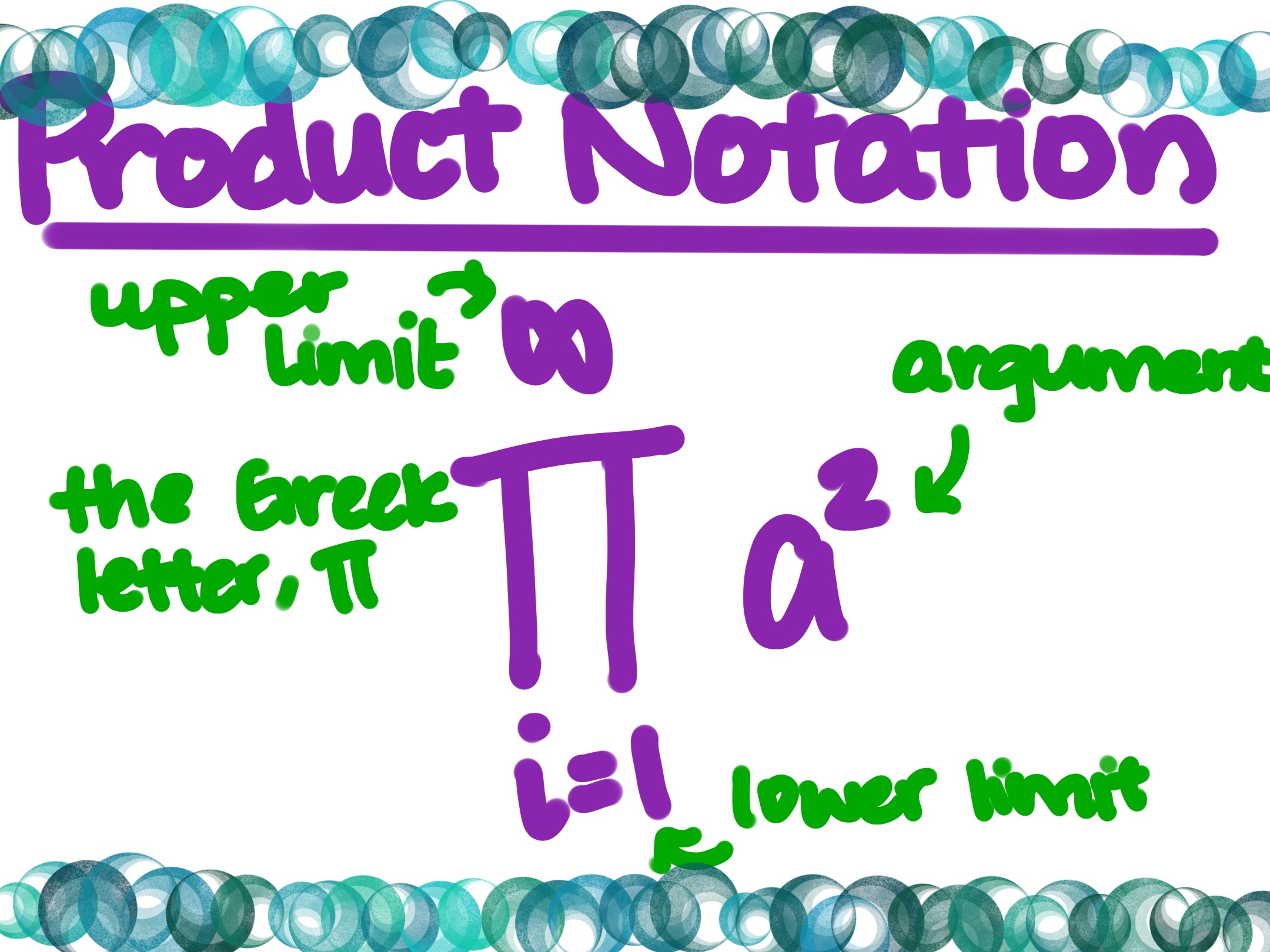
An extension is product notation, designated by pi, π\pi, instead of sigma, Σ\Sigma.

Product notation

Image source: by Anusha Rahman

Compared to summation notation, product notation is mainly used to express patterns in products. If there is some sort of pattern to a sequence of products, then we can use product notation.

Type a concept, like “slope” or “photosynthesis”.

↑ ↓ to choose · Enter to openSearch explanations and problems