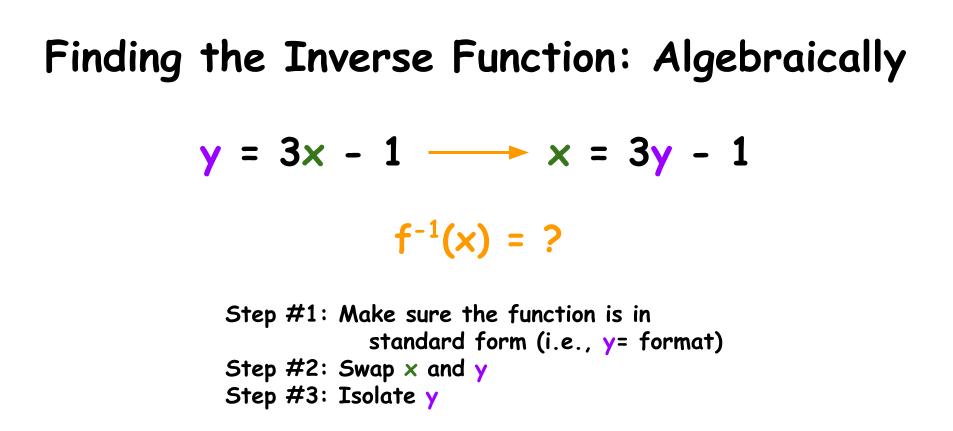
Finding the Inverse Function: Algebraically
In the last lesson, we learned how to find the inverse of a function by looking at its graph. In this lesson, we’re going to focus on how to find the inverse algebraically. To do this, we need to "switch" the x and y values in the equation of the function and solve for y again.
Let's say we have the function f(x)=3x−1. To find the inverse of this function, we first write it as y=3x−1. The function is now in standard form.
Now, swap the x and y. This gives us the equation x=3y−1.
Next, solve this equation for y to isolate y.
This means that f−1(x) "undoes" the work of f(x). If you input a value into f(x), you can use f−1(x) to get back the original value. You can always check if two functions are inverses by seeing if their compositions (like f(f−1(x)) or f−1(f(x)) give you back x.
Remember, not all functions have an inverse! A function must pass the horizontal line test to have an inverse, meaning that no horizontal line can touch the graph of the function more than once.
#####Algebraic vs. Graphical Methods
The algebraic method is best used when you have a clear function in equation form and need to find its inverse precisely. It works well for simple linear or polynomial functions where you can easily switch the x and y variables and solve for y.
On the other hand, the graphical method is helpful when you want to quickly visualize the inverse relationship, especially when the function is complicated or difficult to solve algebraically.