Menemukan invers secara grafik

Before this, knowApakah Fungsi Invers

Illustrated · 1 min

You can reflect a graph over the line y=xy=x to graph the inverse. Let's find the inverse of the function f(x)=xf(x)=x.

Wait, the function f(x)=xf(x)=x is it's own inverse! Another function that is its own inverse is f(x)=1xf(x)=\frac{1}{x}. Try graphing it yourself and then drawing the line y=xy=x. Here's another example. Try f(x)=x2f(x)=x^2, restricted to the domain x≥0x\ge0, graphed with its inverse.

It is clear that the two are reflections of each other through the line y=xy=x.

Video · + 1 min read

(Video) Inverse Functions

by mathman1024

Here's a video by mathman1024 showing you how to sketch the inverse of a function from a graph. The key piece of information when doing these is that if the function has a point (a,b)(a,b) then the inverse will have the point (b,a)(b,a).

The basic steps are:

  1. Define all clear points on the graph.
  2. Draw the line y=xy=x.
  3. Flip the coordinates of these points and plot them.
  4. Connect them to form the inverse.

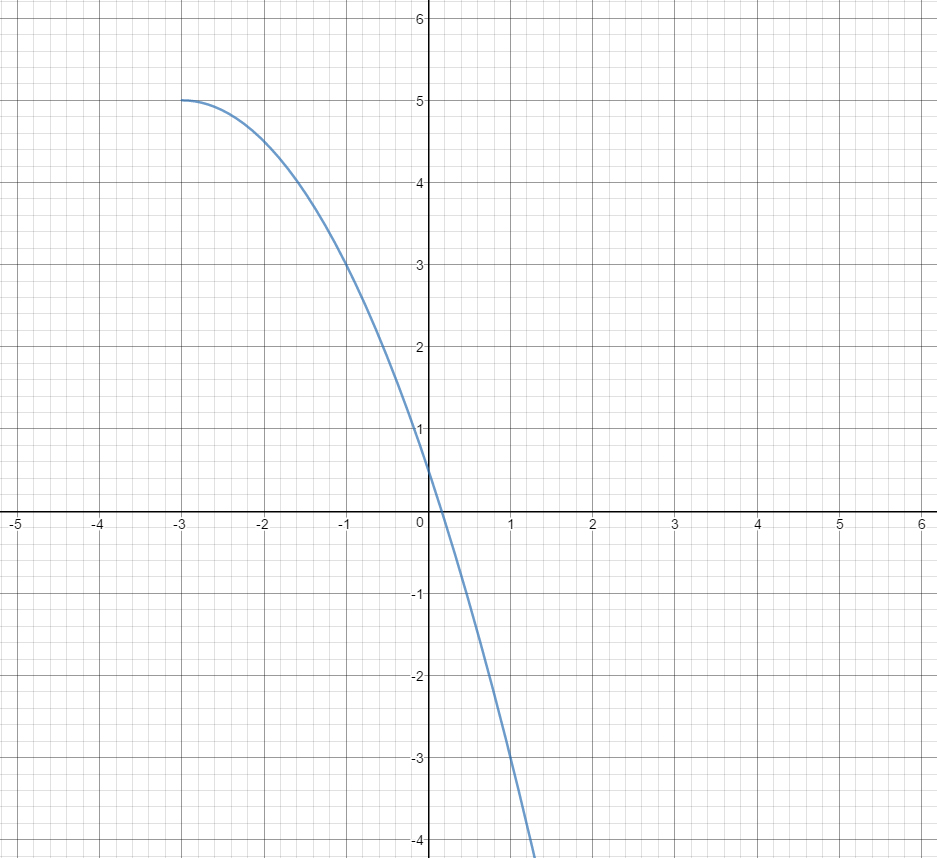
The first graph he looks at is:

Graph

Graph made using Desmos

Our first step is to pick some clear points on the graph. On this one we can see that (−3,5)(-3,5), (−1,3)(-1,3), and (1,−3)(1,-3) are clearly defined. Let's also put down the line of reflection, y=xy=x.

Graph with line y=x

Graph made using Desmos

Next, we flip these coordinates and plot them. These will be points on the inverse: (5,−3)(5,-3), (3,−1)(3,-1), and (−3,1)(-3,1).

Graph with points of the inverse

Graph made using Desmos

Finally, we connect these new points to form the graph that's the inverse of our first.

Graph with inverse graph, with line y=x

Graph made using Desmos

Try to graph the inverse of the next picture on your own.

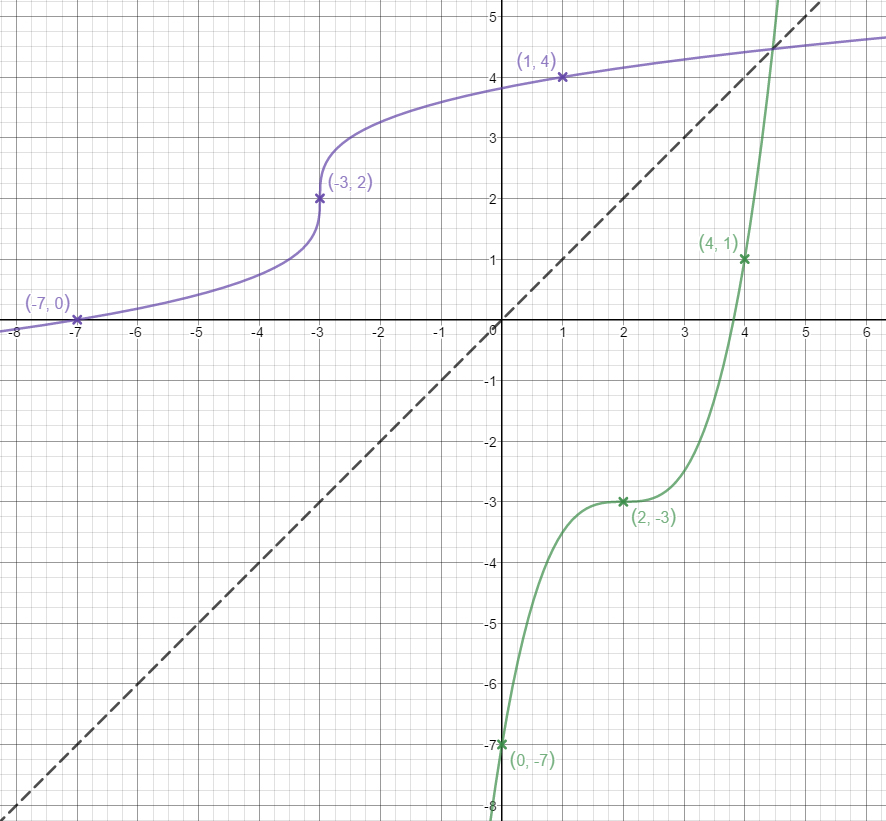
Cubic function example

Graph made using Desmos

To graph the inverse, reflect this function over the line y=xy=x.

Cubic example, line y=x, and inverse graph

Graph made using Desmos

Illustrated · 1 min

Finding the Function Inverse: Graphically

To understand the inverse of a function, we first need to know what an inverse does. The inverse of a function "undoes" what the original function does. For example, if a function takes an input and gives an output, the inverse function takes that output and gives you back the original input.

Finding the Function Inverse: Graphically
1. Plot the Original Function
2. Reflect the Function Across the 
Line y=x
3. Sketch the Reflected Graph

Made using Desmos

One way to find the inverse function is by looking at its graph. Here's a simple method: the graph of the inverse function is a reflection of the original function across the line y=xy=x. This line, y=xy=x is important because it represents all the points where the xx-coordinate equals the yy-coordinate.

Here is a step-by-step way to find the inverse graphically:

  1. Plot the original function: Begin by drawing the graph of the function you’re working with.

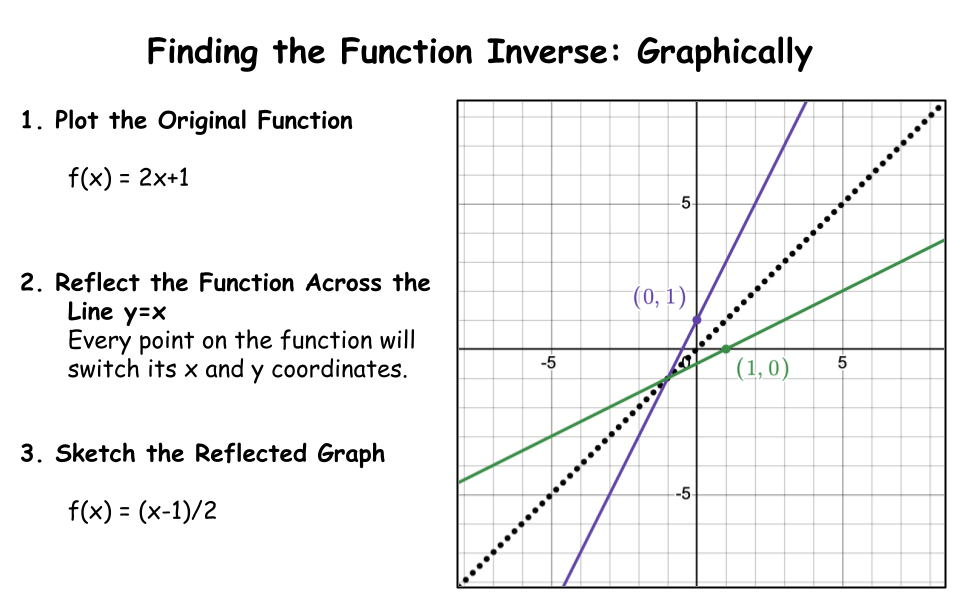
  2. Reflect the Graph Across the Line y=xy=x: To do this, every point on the original graph will switch its xx- and yy-coordinates. In the above example, the original function (purple) has the point (0,1)(0,1). The coordinates will switch - which is why you can see the point (1,0)(1,0) on the green inverse function.

  3. Sketch the Reflected Graph: After reflecting several points, draw the curve that connects them. This new graph represents the inverse function.

Remember, the inverse function only works for functions that are one-to-one, meaning each x-value has a unique y-value. If the original function isn't one-to-one, it won't have an inverse function.

With this method, you can visualize the relationship between a function and its inverse!

Example

In the above image, we see the original function in purple, f(x)=2x+1f(x) = 2x+1. This is a straight line with a slope of 22 and a yy-intercept of 11.

After we reflected the points, we found the green line, which is the inverse. The inverse function is f−1(x)=x−12f^{-1}(x) = \frac{x-1}{2}.

Type a concept, like “slope” or “photosynthesis”.

↑ ↓ to choose · Enter to openSearch explanations and problems