Read · 2 min
+2 contributors


###Learn how to graph rational functions!
Let's look at an example of a rational function:
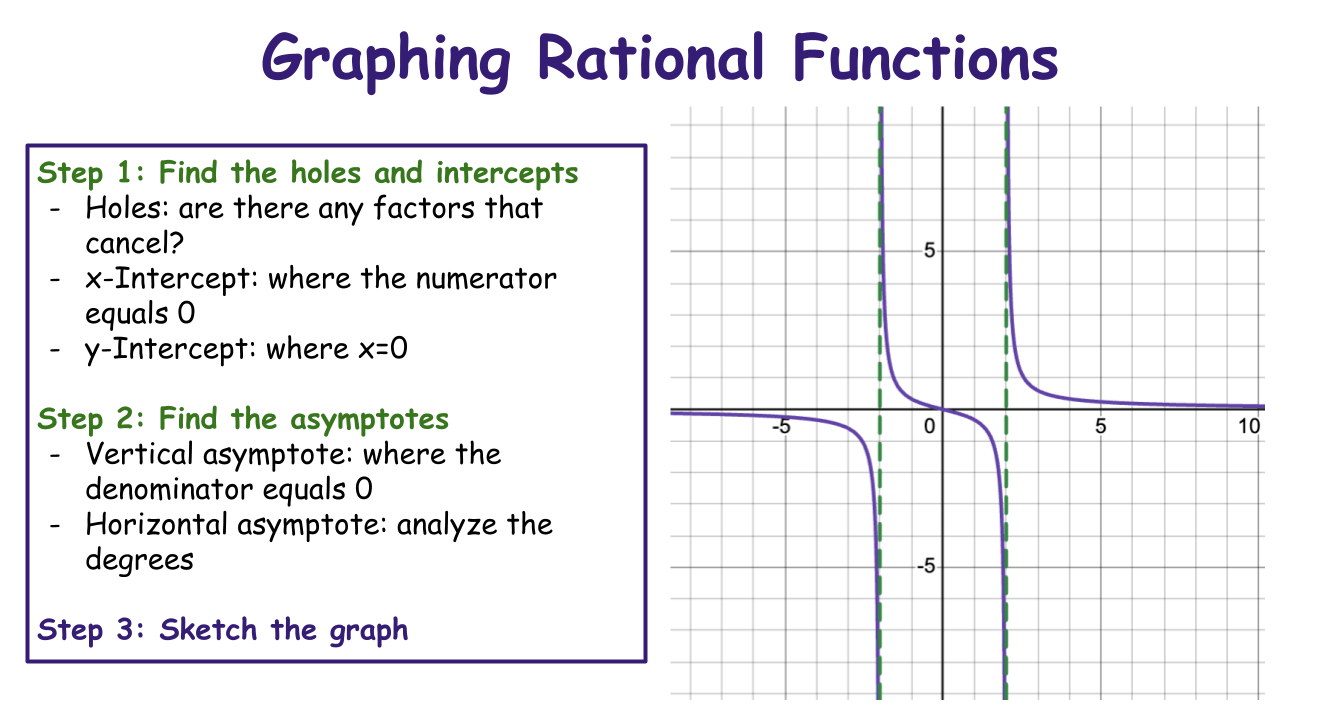
The steps to graphing a rational function are:
-
Factor the numerator and denominator if applicable.
-
Find any holes.
-
Find the and intercepts.
-
Solve for the vertical asymptote.
-
Solve for the horizontal asymptote. If applicable, solve for the oblique/slant asymptote.
-
Using the information you have solved for in the previous steps, graph the function!
While these steps may seem overwhelming, don't worry! We will be going through them step-by-step.
##Factor
Factor both the numerator and denominator. For example:
Therefore,
##Finding Holes
Holes are an value on the graph where both the numerator and denominator are zero.
To find the hole, simply see if there are any factors that cancel.
In the example above, we can see that the factor is in both the numerator and denominator. We can remove .
If we set , then we know . So, the -value of the hole is 1. We solve for the -value of the hole by plugging in the -value and solving.
The hole is (1, ).
##Finding Intercepts
To find the intercepts, set the numerator equal to zero.
For , there are no intercepts as there is no in the numerator.
To find the intercept, set equal to 0.
Therefore, the intercept is
###Solve for the Vertical Asymptote
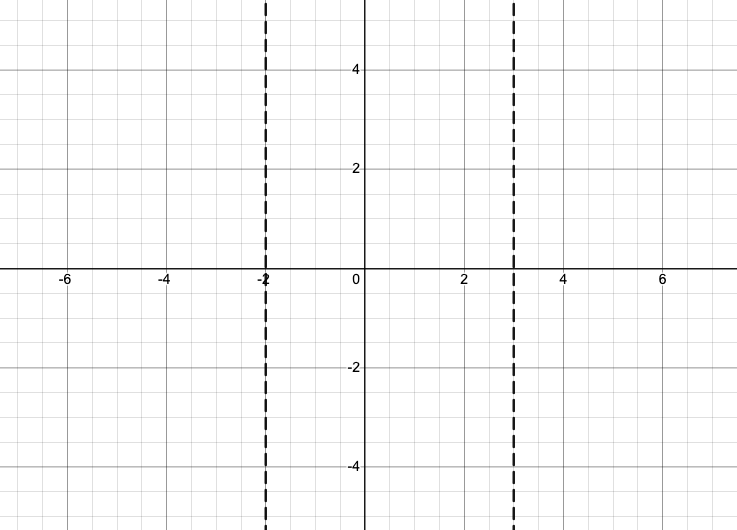
Solve for the vertical asymptote by setting the denominator equal to zero and solving for the variable. Remember, ignore the hole!
Denominator
Therefore, , which is the vertical asymptote!
###Solve for the Horizontal Asymptotes
To solve for the horizontal asymptote, there are rules.
-
If the degree of the numerator is less than the degree of the denominator, the horizontal asymptote is .
-
If the highest degree of the numerator and denominator are the same, divide the coefficients of the highest degree terms.
-
If the highest degree of the numerator is greater than the highest degree of the denominator, then there is no horizontal asymptote, there is a slant asymptote.
, so the horizontal asymptote is . This asymptote will go toward positive and negative infinity.
To find the slant asymptote, divide the numerator by the denominator. You will likely need to use polynomial long division!
Graph all these components together. Start by graphing the vertical and horizontal/slant asymptotes using dashed lines on the graph. Then draw the hole(s) and the intercepts on the graph. Finally, use the asymptotes, the hole(s), and intercepts as guidelines for drawing the function. Plugging in some sample coordinates can also help you graph!