Read · 1 min
+1 contributors

##Finding the domain and range of a rational function
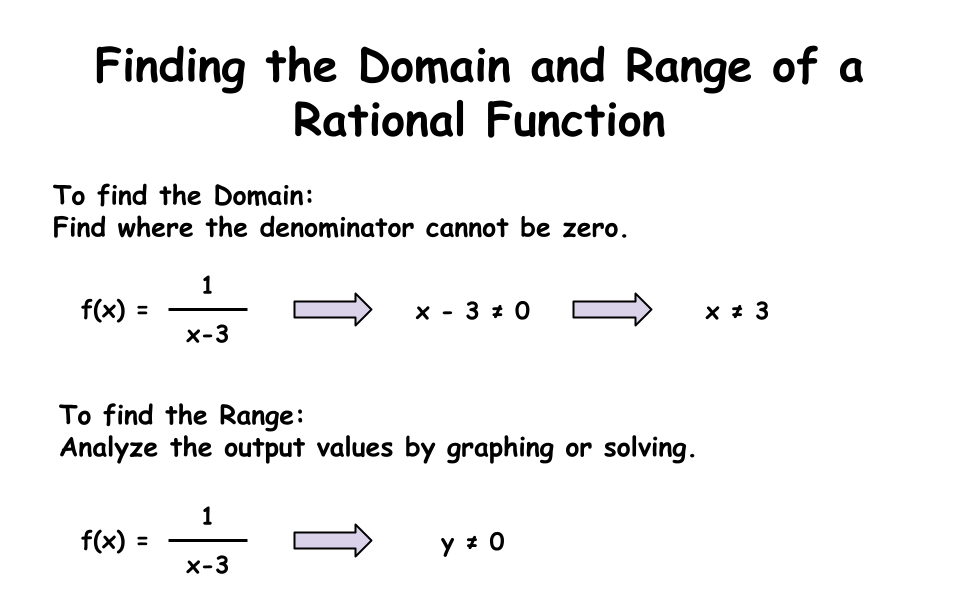
When you are trying to find the domain of a rational function, you first need to find what values are not included. The asymptotes and any holes tell us what 's aren't included.
The first step should always be to factor.
Given the rational function: .
We can factor to:
Recalling the factoring patterns for quadratic functions will help!
Now, we can check to see if there are any holes.
We can see that there is an in both the numerator and denominator.
We can set , so we know the value of the hole is -2. Therefore, we now know one value that is not included in the domain.
We can now rewrite the function as:
Solve for the vertical asymptote, which is .
Therefore, you know the domain of the function as all values, except the vertical asymptote and the hole.
We can write the domain in interval notation like: (-, -2) U (-2, ) U (, ). Remember, the "U" represents a union of sets!
To find the range of the function, we need to find the value of the hole and the horizontal asymptote.
Since we know the value of the hole is -2, we just need to solve for when .
Then, we need to solve for the horizontal asymptote, which is .
Therefore, the range of the function is all values except for when equals or . In interval notation, the range equals (-, -1) U (-1, ) U (, ).