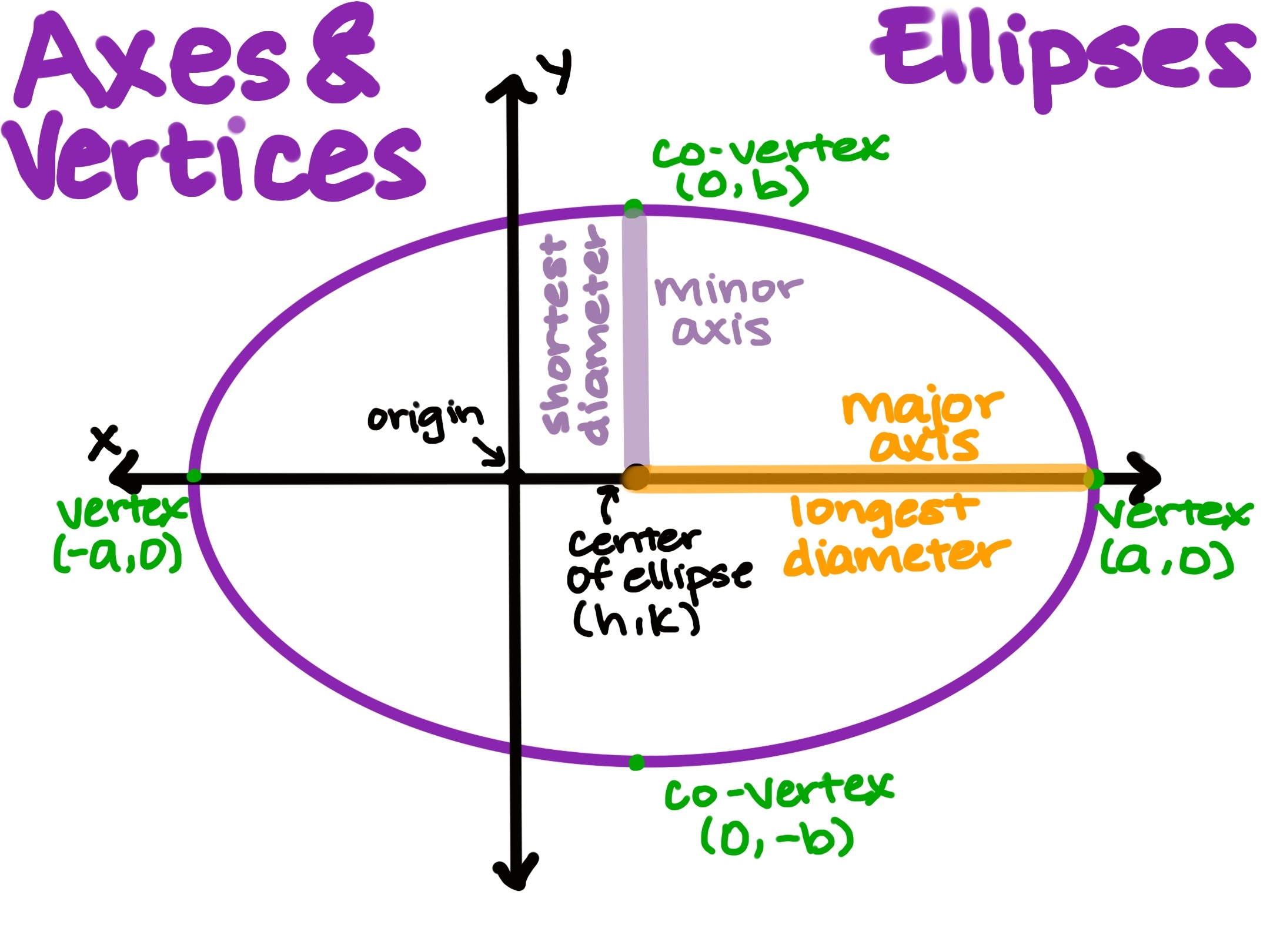
Sumbu-sumbu mayor dan minor

Illustrated · 1 min

Major Axis

The major axis of an ellipse is the line segment connecting the two vertices of the ellipse. If the vertices of the ellipse are at points (m,0)(m, 0) and (−m,0)(-m, 0), then the length of the major axis is 2m2m. The semi-major axis is the distance from the center to one of the vertices and is half the length of the major axis. The major axis spans the greatest possible distance between two points on the ellipse and contains both foci.

Minor Axis

The minor axis is the line segment connecting the two co-vertices of the ellipse. If the co-vertices are at points (n,0)(n, 0) and (−n,0)(-n, 0), then the length of the minor axis is 2n.2n. The semi-minor axis is the distance from the center to one of the co-vertices and is half the length of the minor axis. The minor axis runs perpendicular to the major axis.

In the equation of an ellipse, shown below, a is always half the length of the horizontal axis and b is the half the length of the vertical axis, irrespective of which way the major and minor axes run. (x−h)2a2+(y−k)2b2=1\frac{\left(x-h\right)^2}{a^2}+\frac{\left(y-k\right)^2}{b^2}=1

However, the lengths of the semi-major axis, semi-minor axis, and c (distance from center to focus) of an ellipse are related by the equation c2=a2−b2c^2=a^2-b^2.

The major and minor axes of a horizontal ellipse on a coordinate plane:

The major and minor axes of a horizontal ellipse on a coordinate plane.

Image source: by Tyler Berbert

The major and minor axes of a vertical ellipse on a coordinate plane:

The major and minor axes of a vertical ellipse on a coordinate plane.

Image source: by Tyler Berbert

Video

(Video) Major and Minor Axes, Vertices, and Co-Vertices

by Anusha Rahman

In this video by Anusha Rahman, you will learn about major and minor axes, vertices, and co-vertices of an ellipse.

Summary

An ellipse is the set of all points in a plane, such that the sum of their distances from two fixed points is a constant. An ellipse is like a circle in that regard.

  • Major axis: longest diameter that passes through the center, extends to both ends of the ellipse
  • Minor axis: shortest diameter perpendicular to the major axis, passes through the center
  • Vertices: the endpoints of the major axis
  • Co-Vertices: the endpoints of the minor axis

The sum of the distances to any point of the ellipse from the two foci is a constant.

Illustrated · 1 min

Axes, Vertices, and Co-Vertices of an Ellipse

An ellipse is a closed curve that is defined by its two axes: the major axis and the minor axis. The major axis is the longest diameter of the ellipse, extending horizontally or vertically, depending on the orientation of the ellipse. The vertices are at the endpoints of the major axis, which are the farthest points from the center along this axis.

In contrast, the minor axis is the shortest diameter, perpendicular to the major axis, and runs through the center of the ellipse. The co-vertices are the endpoints of the minor axis, which are the closest points to the center along this axis.

Axes & Vertices of Ellipses
Image of an ellipse with the major axis (longest diameter) and minor axis (shortest diameter) labeled. Also the vertex (a,o), (-a,0) and co-vertex (0,b), (0,-b) labeled.

Image source: by Anusha Rahman

Together, the major and minor axes help to define the shape and proportions of the ellipse. The distance from the center to a vertex or co-vertex is known as the semi-major or semi-minor axis, respectively. We need this information to properly graph and understand ellipses.

Type a concept, like “slope” or “photosynthesis”.

↑ ↓ to choose · Enter to openSearch explanations and problems