Elips degan pusat (h,k)

Illustrated · 1 min

Equation of an Ellipse

General Formula

In an ellipse, the general formula for an ellipse centered at the origin

Derivation

An ellipse is very similar two a circle. In fact, every ellipse is just a distorted circle. While a circle only has one radii, denoted rr, an ellipse has two radii, denoted aa and bb. The area of a circle is r2πr^2 \pi, and the area of and ellipse is abπab \pi. But back to the formula. Since an ellipse is so close to a circle, the derivation is too. We first start with the general formula, x2+y2=r2x^2 + y^2 = r^2. We divide both sides by r2r^2, giving us x2r2+y2r2=1\dfrac{x^2}{r^2} + \dfrac{y^2}{r^2} = 1 Since we have two radii, aa and bb, we have our final equation x2a2+y2b2=1\dfrac{x^2}{a^2} + \dfrac{y^2}{b^2} = 1

As you can see, we have our equation. Just like in a circle, to move the ellipse, we substitute xx with (x−h)(x - h) and yy with (y−k)(y - k). Another thing to note is that when we change the 11 on the right side of the equation, the ellipse dilates. If we change to 44, each side increased by a factor of 22, and if we increase it by 99, each side increases by a factor of 33.

Video · + 1 min read

(Video) Center of an Ellipse

by Anusha Rahman

In this video by Anusha Rahman, you will learn about the center of an ellipse.

Summary

In essence, an ellipse is a stretched or compressed circle. We've learned about an ellipse in standard form,

(x−h)2a2+(y−k)2b2=1\frac{(x-h)^2}{a^2} + \frac{(y-k)^2}{b^2} = 1

, where (h,k)(h,k) is the center of the ellipse, aa is the length of the semi-major axis, and bb is the length of the semi-minor axis. The parts of the equation are fairly comparable to other function equations we've seen in the past. You can use this equation to graph an ellipse.

The equation in standard form represents an ellipse centered at the point, (h,k)(h,k). There are two forms of the equation: standard form and general form.

To find the equation, we can plug in these values into the standard form. To derive the standard form equation, completing the square is often used.

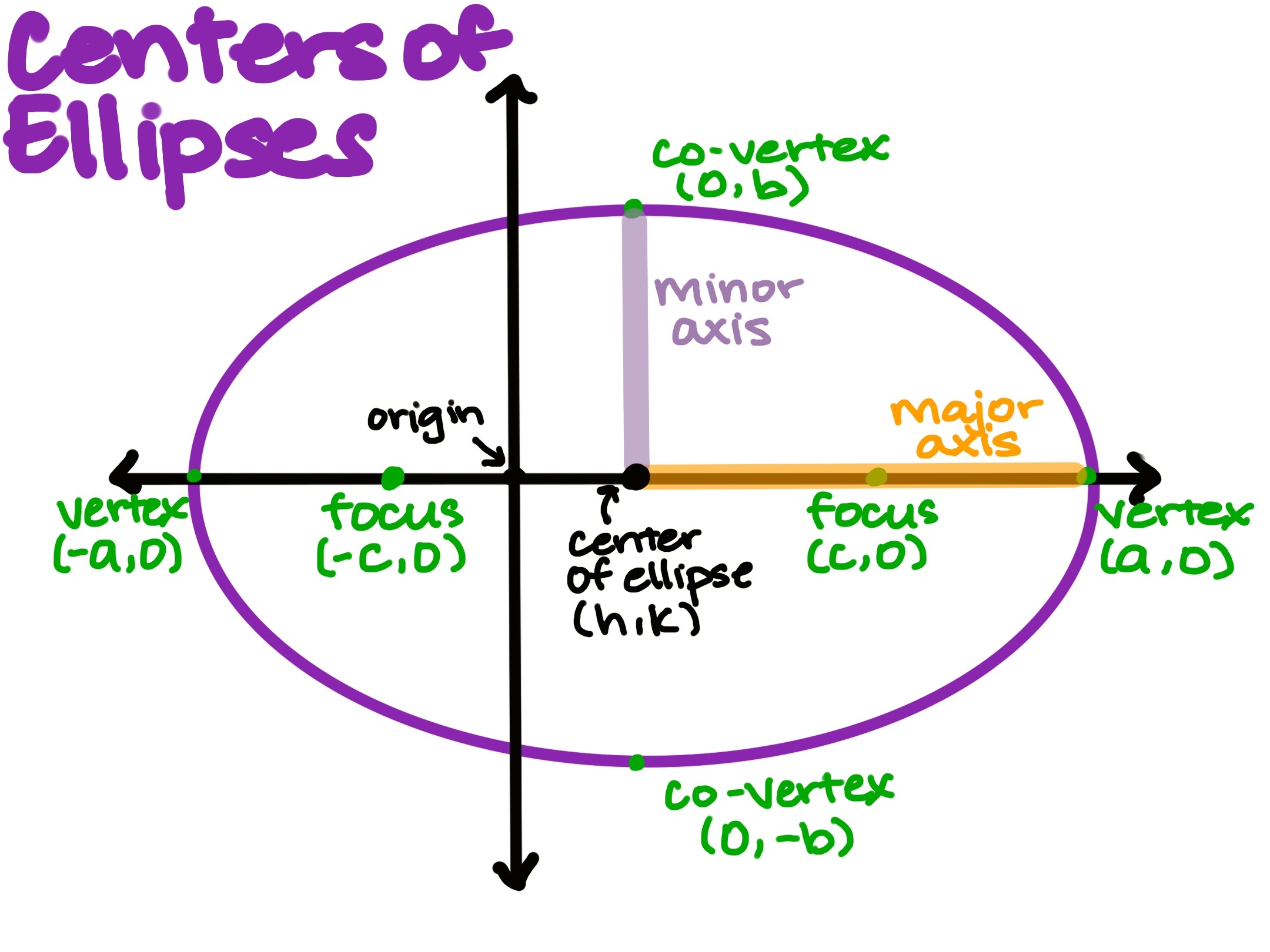
As a review, vertices are the endpoints of the major axis, co-vertices are the endpoints of the minor axis, and foci are two fixed points inside the ellipse that help to define its shape. The major axis is parallel to one of the coordinates axes (x- or y-axis).

Illustrated · 1 min

Centers of Ellipses

So far, we've learned about the standards of ellipses, where the center is at the origin. However, the ellipse is dynamic, and the center can be translated to (h,k)(h,k).

Centers of Ellipses
Ellipses labeled with vertex, center, focus, co-vertex, major axis, and minor axis. Center shifted to the right, (h,k), not at the origin.

Image source: by Anusha Rahman

The cartesian coordinate plane is in black, which is to the left of the major and minor axis of the ellipse. This image shows an ellipse with a center at (h,k)(h,k).

The equation of this ellipse is: (x−h)2a2+(y−k)2b2=1\frac{(x-h)^2}{a^2} + \frac{(y-k)^2}{b^2} = 1

We can apply transformations to this parent equation.

Type a concept, like “slope” or “photosynthesis”.

↑ ↓ to choose · Enter to openSearch explanations and problems