Multiplication and Division Properties of Radicals
The Multiplication and Division Properties of Radicals can help you simplify expressions!
Image by Caroline Kulczycky
We can have radicals of any integer root, known as the nth root. Most problems will have n=2 or n=3. In other words, you will mostly be dealing with square roots (9 or 29) and cube roots (39).
Let's do an example to practice!
Fully simplify 4827.
We use both the Multiplication and Division Properties of Radicals to solve this problem. First, we use the Division Property of Radicals since we are finding the square root of a fraction.
4827=4827, by the Division Property of Radicals
We can further break down the 27 and 48 using the Multiplication Property of Radicals.
4827=16⋅39⋅3=16⋅39⋅3, by the Multiplication Property of Radicals=4⋅33⋅3=4⋅33⋅3=43
So, our final answer is 43.
Find your level
The problems run from approachable to very hard, and each is rated by how often real students solve it, so you can pick your next step. These are real problems from the AMC 8, AMC 12 and AIME, the national math competitions for middle and high school students, each with a worked solution on LIVE by Po-Shen Loh.
Unlike adding and subtracting radicals, we can multiply two radicals and change the number underneath. Here's the rule:
a×b=a×b
Multiplying two separate radicals with numbers in them is the same as multiplying those numbers under one radical. For example:
16×94×312=16×9=144=12
Although this example used perfect squares, no matter what expression is under the radical, either way we solve the problem, the answer comes out the same.
Sometimes it's easier to keep difficult numbers in radical form. In this case, you can:
Multiply the numbers from within the radicals together
Place the product under one radical symbol.
If the radicals were already multiplied by something, multiply those together and place them in front of the radical.
Step 1: Multiply the numbers from within the radicals together
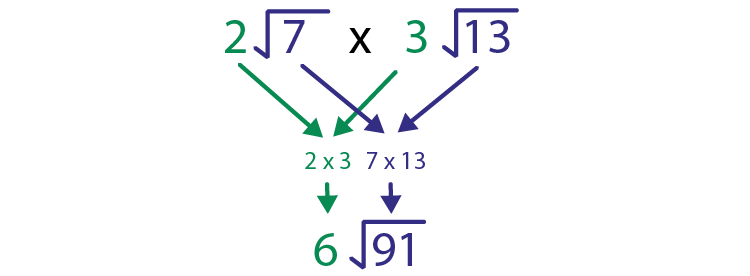
Let's work with the expression 27×313. We're going to multiply each part of each term together separately, then combine them again. Let's start with the numbers inside the radicals.
What is 7×13?
7×13=91
Awesome!
Step 2: Place the product under one radical symbol
We already know that our product is 91, so we need to place that under the radical.
91 becomes 91
Step 3: Multiply the multipliers
Both radicals in our problem, 27×313, have a coefficient. We multiplied the radicals, so now we need to multiply the coefficients.
Our multipliers here are 2 and 3. What is 2×3?
2×3=6. Great! Now we can place 6 in front of the radical so we get:
27×313=691
Radical division follows the same rule as radical multiplication. Dividing two radicals means we can instead divide the two numbers under one radical. For a≥0 and b>0:
ba=ba
So, for example, we could evaluate the expression 1664 in two ways.
1664482=1664=4=2
The left side of each equation shows that you can simplify the radicals before dividing. The right side shows you can divide before you simplify the radicals.
It's always important to be mindful of possible factors in the radicand that can help simplify expressions quicker.
The steps
It's good to keep messy numbers within their radicals for as long as possible. To do that while dividing, follow these steps:
Divide the numbers from within the radicals.
Place the result (fraction or not) under one radical symbol.
If the radicals were already multiplied by something (in other words, if they had a multiplier as part of their term), divide those numbers and place them in front of the radical. If only one radical has a multiplier, pretend the other is multiplied by 1.
Let's try it with the expression, 31122.
Step 1: Divide the numbers from within the radicals
The numbers in this expression won't have nice square roots at all. We're going to try to keep everything within the radicals for as long as possible.
First, let's divide the numbers within the radicals. What is 1122?
1122=2
Good!
Step 2: Place the result under a radical symbol
So 2 becomes 2.
Step 3: Divide the multipliers
In the original expression, 22 doesn't have a multiplier, but 11 is multiplied by 3. If something doesn't have a multiplier, we can just pretend it's being multiplied by 1, since that doesn't change anything.
So if our multipliers are 1 in the numerator and 3 in the denominator, what will we have to multiply 2 by?
Since our numerator is 1 and our denominator is 3, we get 31 as our new multiplier. So our new expression is:
31×2or32
Here is a more direct way to think about it:
31122=31⋅1122=31⋅1122=31⋅2=32
Sometimes, we may need to tackle a more complicated expression. There may be a funky radical expression in the numerator or denominator that may require more fancy footwork. Don't panic! You've got the skills to divide radical expressions, no matter how complicated they get.
If you've got a more complex-looking rational number in the denominator, you may need to rationalize the denominator by multiplying the fraction by the conjugate of the denominator. You'll learn more about this concept later, but something to keep in mind.
This video by mathgirl915 shows you how to multiply and divide radical terms.
Summary
When multiplying radicals, first make sure that the degree of the radical is the same. Then, unlike addition and subtraction, the terms underneath the radical do not need to be the same! You can multiply the outer numbers, then put the product of the inner radical terms underneath the radical.
Suppose we want to multiply two radicals: 3×12. All we have to do is multiply the two numbers and put them under one radical.
3×12=3×12=36=6
Let's work through one that has numbers both inside and outside a radical.
88×66
We're going to multiply each part separately.
8×88×6=48=48
We need to simplify 48
4816×343
Now we combine these two sections. Anything outside of the radical needs to be multiplied.