This video by Math Antics shows you how to solve equations in the form xn=c.
Summary
We solve any algebraic equation by isolating a variable. How do we isolate a variable being raised to a power?
x3=8
The answer is radicals! Just like addition can undo subtraction, radicals can undo exponents. If you have an exponent raised to the third power, you take the cube root of both sides.
x33x3xx=8=38=38=2
Right now, we are only worrying about the real solutions to an equation, like 2 was for the previous example. Actually, x3=8 also has two complex solutions, which you will learn about later.
Let's do another example!
x2=36
We solve this equation by taking the square root of both sides.
x2x=36=6
But, −6 is also an answer since (−6)⋅(−6)=36. So, when taking square roots, it's best to put a plus or minus sign, ±, in front.
x2x2x=36=±36=±6
In summary, some equations have multiple solutions. Variables raised to the second power have a positive and negative solution! Remember, every time you take a square root, put a ± in front!
Suppose c is a real number. We want to solve the equation and find the real solutions of
xn=c
If n is odd, then there is always a unique real solution for x:
x=nc
the nth root of c.
If n is even, we have to be more careful. First, there are no real solutions if c is negative. If c=0, there will just be the solution x=0. If c>0, there will be a positive real solution and a negative real solution.
x=±nc
To simplify the nth root further when c is an integer (or sometimes a fraction), it helps to further break down c. Write c in terms of its prime factorization, we can then simplify.
For example, say c=240. We can use a prime factorization method to find:
240=2⋅2⋅2⋅2⋅3⋅5
Depending on what n is, x will be different.
If n=2, then:
x2x2xxx=240=±240=±240=±2⋅2⋅2⋅2⋅3⋅5=±415
So, the solutions of x2=240 are x=415 and x=−415. Note that both of these are real, not complex, solutions.
If n=3, then:
x33x3xxx=240=3240=3240=32⋅2⋅2⋅2⋅3⋅5=2330
So, the real solution of x3=240 is x=2330. (If you're curious, you can learn more about complex solutions on our site.)
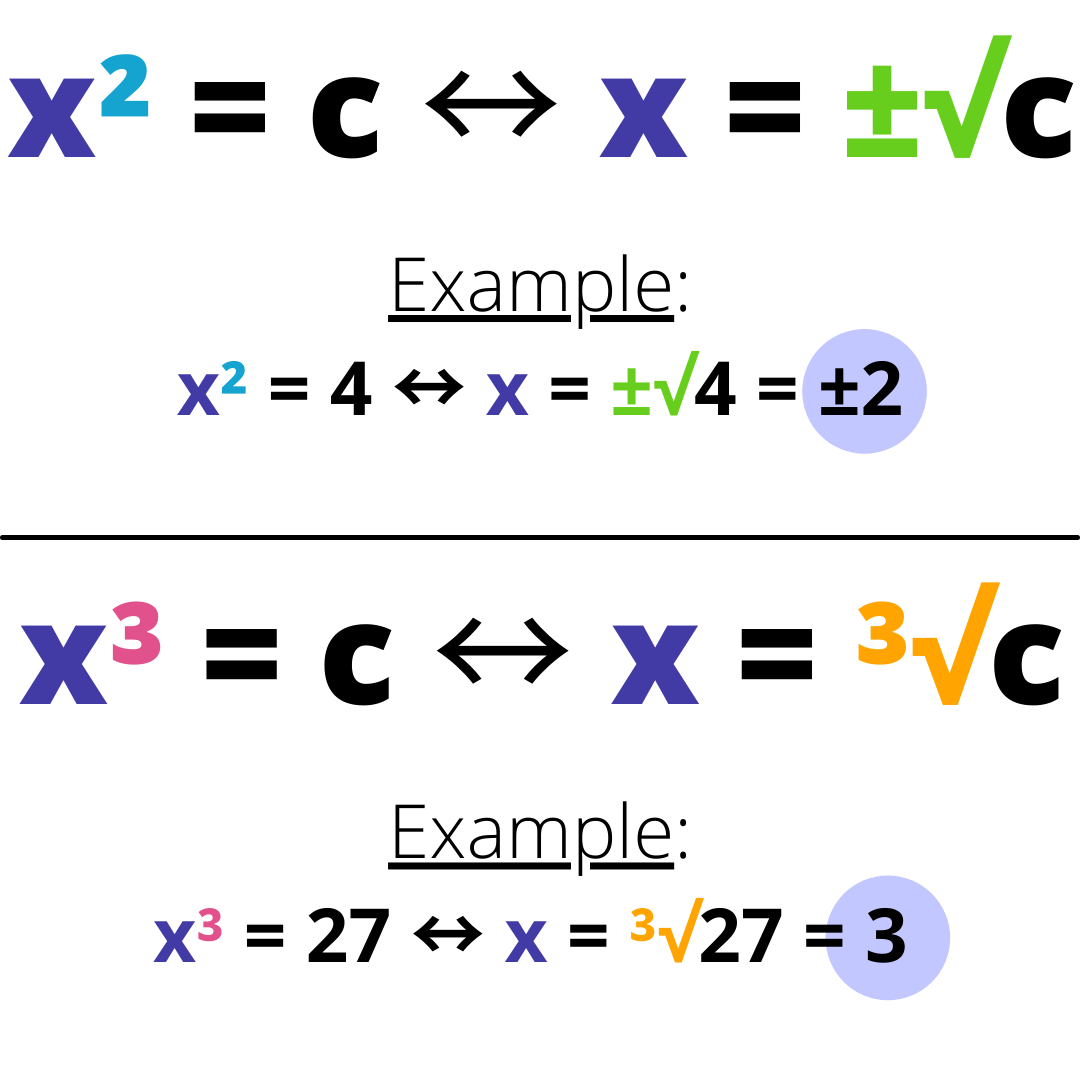
Here is a graphic with the general method of solving by square roots and cube roots.
Image source: By Caroline Kulczycky
Try the following problem to test your understanding.
x3=162
Solve for x. Assume x is real.
Solution
x33x3xxx=162=3162=3162=32⋅3⋅3⋅3⋅3=336
If you want to check your work, you can plug in the value for x that you solved for back into the original equation. Solve as normal to check your answer.
This concept can get kind of confusing, so let's think about how we could rewrite the following equation:
x=24
We would start by squaring both sides.
x2=4
All we did was isolate both sides and rewrite the equation to make it a little cleaner. This back-and-forth is how we will tackle this new way of solving radical expressions.
To solve an equation xn=c, we can take the n-th root of both sides of the equation. Assume that n is positive.
If n is odd, then there is only one real solution.
x=nc
If n is even, then there are two real solutions (positive and negative).
x=±nc
The right hand side looks really complex. Let’s take a look at x3=27.
To solve an equation in the form xn=c, we can take the n-th root of both sides of the equation. In this example, n=3 and c=27. Since n is odd, there is only one real solution.
x33x3xx=27=327=327=3
Let’s look at another example: x4=16.
We can take the n-th root of both sides of the equation. In this example, n=4 and c=16. Since n is even, there are two real solutions that are positive and negative.
x44x4x=16=±416=±2
Now, try an example.
Solve for x. Assume x is real.
x3=64
We can take the n-th root of both sides of the equation. Since n=3 and c=64 and n is odd, there is only one real solution. The other solutions are complex!
x33x3x=64=364=4
It's important to double check your work because you may come across extraneous solutions. When you plug the answer back into the original equation, if you have a true statement, the solution is valid. You'll learn more about this concept later!