Interactive · 4 questions
+2 contributors


Selection without Replacement
Just like it sounds, in selection without replacement, you are picking something out of a bag (bucket, hat, any type of container, etc.) and, without putting it back, you pick out a second something.
This means that the total number of objects decreases each time you select without replacement.
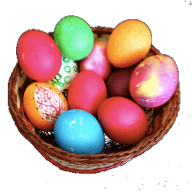
Imagine that you have a basket of colored Easter eggs. You pick out one randomly and it's green. Then, without putting it back, you pick out another. This is an example of selection without replacement.
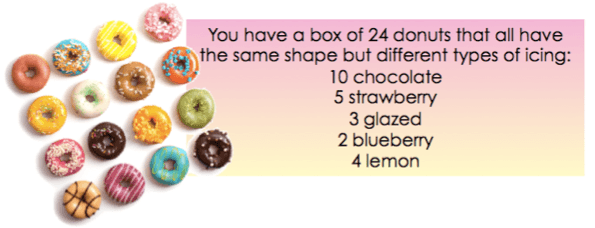
You pick out one donut at random. What is the probability that the donut will have lemon icing?

You eat a lemon donut (which means you can't put it back in the box). Then, you pick out another donut. What is the probability that the second donut will lemon?
You eat a second lemon donut (which means you can't put that one back in the box either). How many total donuts are left in the box?
After eating the two lemon donuts, what is the probability that we pick a chocolate donut?
Notice how, when we select without replacing, the denominator of the fractions we use to calculate probability change (and get smaller) every time.