Interactive · 4 questions
+3 contributors



Dependent events
In contrast to independent events, when events are dependent, the outcome of one has an effect on the outcome of the other.
Sometimes, the probabilities of dependent events are called conditional probabilities. To solve these problems, you'll be calculating the probability of one event given that the other has already happened.
The fancy math way to write this is:
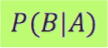
Here, represents the probability of event given event Let's look at an example.

If we don't put the marbles back into the bag, there's one less marble left when we draw the next one. This means that the probability of the second drawing is affected by (i.e., dependent on) the first one.
Let's say I want to determine the following conditional probability.

How many marbles did we start with in our bag?
What is the probability of the first event, pulling out a blue marble?
This can be written as
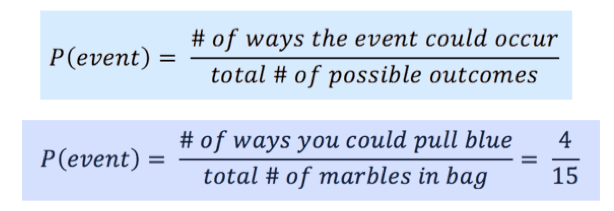
How did we get than answer? Check out the equation below. It's the standard equation for calculating the probability of one event.
After we draw the blue marble out of our bag, how many marbles are left?
So, finally, what's the probability that we pull a red marble given that we've already pulled a blue marble?
This conditional probability can be written as P(red|blue).