Teorema Akar Rasional

Interactive · 1 question

The Rational Root Theorem.

Consider the equation anxn+an−1xn−1+⋯+a0=0,a_n x^n + a_{n-1} x^{n-1} + \cdots + a_0 = 0, where aia_i is an integer for all 0≤i≤n0 \le i \le n.

If a0,an≠0a_0, a_n \ne 0, then each rational solution xx, when written as a fraction x=pqx = \frac {p}{q} in lowest terms, must satisfy which of the following? (Check all that apply.)

Choose all correct answers

Read · 1 min

The Rational Root Theorem, also known as the rational zoo theorem, is an important concept in finding the rational roots of polynomials. It states that for a polynomial

anxn+an−1xn−1+...+a0a_nx^n+a_{n-1}x^{n-1}+...+a_0,

and we denote F(n)F(n) as the set of all positive factors of nn, the rational root(s) of the polynomial lie in the set of all possible values of F(a0)F(an)\frac{F(a_0)}{F(a_n)}.

Here's the proof for it!

Suppose we again have a polynomial anxn+an−1xn−1+...+a0a_nx^n+a_{n-1}x^{n-1}+...+a_0. Let pq\frac{p}{q} (in simplest form) be a root of this polynomial . Because of this, an(pq)n+an−1(pq)n−1+...+a0=0a_n(\frac{p}{q})^n+a_{n-1}(\frac{p}{q})^{n-1}+...+a_0=0. Multiplying both sides by qnq^n, we have anpn+an−1pn−1q+...+a0qn=0a_np^n+a_{n-1}p^{n-1}q+...+a_0q^n=0. If we take this equation modulo pp, we have a0qn≡0(moda_0q^n \equiv 0(mod p)p), and since pp and qq are relatively prime, we have a0≡0(moda_0 \equiv 0(mod p)p), or p∣a0p|a_0. Taking the equation modulo qq and using the same logic, we get q∣anq|a_n. We conclude that pq\frac{p}{q} has to lie in the set of all possible values of F(a0)F(an)\frac{F(a_0)}{F(a_n)} and we are done.

After listing possible roots, Descartes’ Rule of Signs helps narrow them down.

Video · + 1 min read

(Video) Rational Root Theorem

by Mario's Math Tutoring

This video by Mario's Math Tutoring talks about how to use the Rational Root Theorem to narrow down the possible rational roots of a polynomial equation.

Summary

To understand what the Rational Root Theorem is, we need to understand what each aspect of the theorem means. From the word "Rational", we can think that the process will include ratios. From the word "Root" we know that we will be looking for solutions, which are the points where the function crosses the xx-axis.

To use the Rational Root Theorem, we are looking for,

pq,\frac{p}{q},

where pp is all of the factors of the constant term, and qq is all of the factors of the leading coefficient.

Looking at an example,

f(x)=2x3−12x2+22x−12f(x)=2x^3 -12x^2 +22x -12

All of the factors of −12-12 are: ±1,±2,±3,±4,±6,±12\pm 1, \pm2, \pm3, \pm4, \pm6, \pm12

All of the factors of 22 are: ±1,±2\pm1, \pm2

So, we can say that:

±1,±2,±3,±4,±6,±12±1,±2\frac{\pm 1, \pm2, \pm3, \pm4, \pm6, \pm12}{\pm1, \pm2}

Remember, this is a ratio, so we can simplify this further to all possible roots.

12,1,32,2,3,4,6,12\frac12, 1, \frac32, 2, 3, 4, 6, 12

To test these roots, we use synthetic division, looking for roots that have a remainder of 00. After trying each one, we find that x−1x-1 is a factor, +1+1 is a root.

(x+1)(2x2−10x+12)(x+1)(2x^2-10x+12)

We have a quadratic, which we are very familiar with! We can either factor or use the quadratic formula to find the rest of the zeroes.

Factoring out the common factor from the quadratic,

2(x2−5x+6)2(x^2-5x+6)

Which we can then simplify to,

2(x−3)(x−2)2(x-3)(x-2)

So, our zeroes are: 1,2,31, 2, 3.

In factored form,

2x3−12x2+22x−12=(2)(x−3)(x−2)(x−1)2x^3 -12x^2 +22x -12 = (2)(x-3)(x-2)(x-1)

Illustrated · 1 min

Rational Root Theorem

In this lesson, we are going to learn about a nifty new math trick, the Rational Root Theorem. It helps us find possible rational (fraction) solutions to a polynomial equation.

Rational Root Theorem
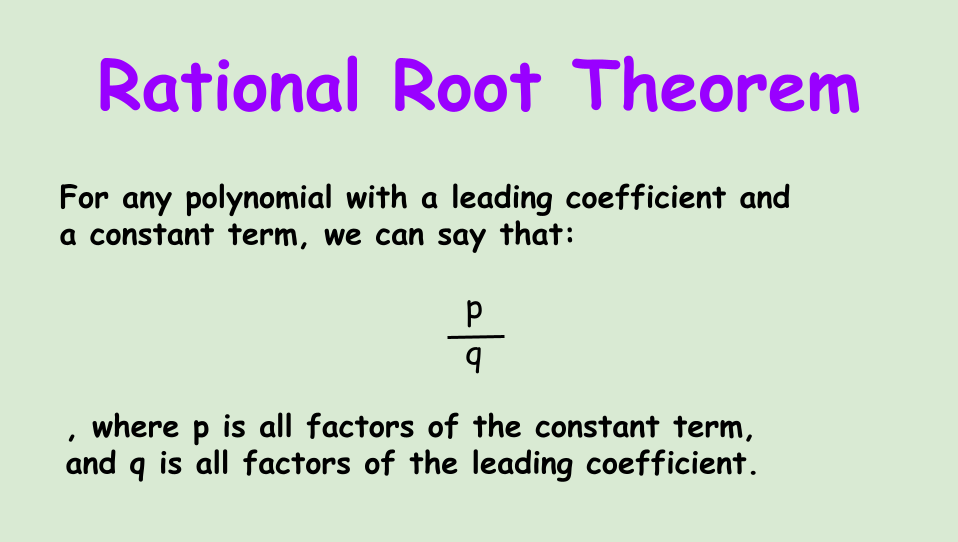
For any polynomial with a leading coefficient and a constant term, we can say that p/q, where p is all factors of the constant term, and q is all factors of the leading coefficient.

Image source: by Anusha Rahman

The Rational Root Theorem says that for any polynomial with a leading coefficient and a constant term, we can say that:

pq\frac{p}{q}

, where pp is all factors of the constant term, and qq is all factors of the leading coefficient.

We can also say: If a polynomial has a rational root, then it must be a fraction made from factors of the last number (the constant) over factors of the first number (the leading coefficient).

#####Example

Let's think of the rational roots of the following polynomial: 2x3−3x2+x−6=02x^3-3x^2+x-6=0.

The constant term, pp, is −6-6. Its factors are: ±1,±2,±3,±6\pm1, \pm2, \pm3, \pm6

The coefficient of the leading term, qq, is 22. Its factors are: ±1,±2\pm1, \pm2.

Since the Rational Root Theorem says that pq\frac{p}{q}, we can make fractions out of these factors, thinking through all possible combinations.

First, I am going to list out all possible combinations, including duplicates.

±11,±12,±21,±22,±31,±32,±61,±62\pm\frac{1}{1}, \pm\frac{1}{2},\pm\frac{2}{1},\pm\frac{2}{2},\pm\frac{3}{1},\pm\frac{3}{2},\pm\frac{6}{1},\pm\frac{6}{2}

When we simplify the fractions, we find that all possible rational roots are:

±1,±2,±3,±6,±12,±32\pm1, \pm2, \pm3, \pm6, \pm\frac12, \pm\frac32

Next, you can use substitution or synthetic division to check if any of these actually work. Remember, this trick doesn't tell you which roots are correct. They only narrows down your guesses.

Type a concept, like “slope” or “photosynthesis”.

↑ ↓ to choose · Enter to openSearch explanations and problems