Read · 1 min
Fun fact: the Binomial Theorem is a special case of Vieta's formulas when all of the roots are equal. Think about it, try expanding ! Use combinatorics to compute the th symmetric sum.

Before this, knowMenemukan akar dengan Uji Akar RasionalTeorema Akar Konjugat
Read · 1 min
Fun fact: the Binomial Theorem is a special case of Vieta's formulas when all of the roots are equal. Think about it, try expanding ! Use combinatorics to compute the th symmetric sum.
Twenty minutes on one hard problem can teach more than ten easy exercises. These problems are worth staying with. These are real problems from the AMC 10, AMC 12 and AIME, the national math competitions for middle and high school students, each with a worked solution on LIVE by Po-Shen Loh.
Interactive · 5 questions
The Binomial theorem is a theorem which is used to expand powers of a binomial expression (indicated as ). For example: . Notice that for each individual term, the sum of the powers of the variables is always equal to .
In general,
Notice that the coefficients of the terms in this expansion are the numbers in a row in Pascal's triangle where is the row number (Note: Pascal's triangle starts with row ).
Practice Problem: What is the coefficient of the fifth term in the expansion of ?
The first term is , the second term is ,...the fifth term should be . So ignoring the variables, the coefficient is .
Which is the coefficient of the third term in the expansion of ?
Vieta's formula(s) are used in polynomials when trying to solve for the roots. It relates an expression of the roots with the coefficients of the polynomial.
Quadratic:
Let's say and are the roots of a quadratic, we can write out the quadratic:
This equation is most often written as . We can see that since , . For the product of the roots, we see that . (This method of equating coefficients is sometimes called the method of undetermined coefficients.)
Let's try an example:
What is the sum of the roots and product of the roots in the quadratic, ?
Well, the sum of the roots is just which is . The product of the roots is just which is .
What is the sum of all the roots of ?
What is the product of all the roots of ?
Is that it for Vieta's?
Vieta's can be extended to higher degree polynomials, not just quadratics!
General Formula:
Given a polynomial where the roots are {}:
The sum of all the roots:
The sum of all the combinations of products between two roots:
The sum of all the combinations of products between three roots:
...
The product of all the roots:
Given that and are the roots to , find .
More information on Vieta's Formulas can be found [here].(http://artofproblemsolving.com/wiki/index.php/Vieta's_Formulas)
Interactive · 8 questions
Let .
Find the sum of the roots of .
Find the product of the roots of .
You may have noticed that the sum of the roots was . You may also have noticed that the product of the roots is . Lets try to prove our suspicions. For now, we will start with quadratics with a leading coefficient of .
Let and be the roots of the quadratic.
Express the quadratic as the product of two binomials in terms of and .
Expanding yields Simplifying further yields Aha! Our suspicions were indeed correct! We notice that which means that the sum of the roots is . We also see that the product of the roots is .
Warning: If the constant term of the quadratic is negative, the product will be negative as well.
Find the sum of the roots of the following quadratic: .
Find the product of the roots of the following quadratic: .
However, we are not done. We only covered what happens for quadratics with a leading coefficient of one. Lets see what happens when we alter the value of .
Again let our roots be and . But this time, let . Our factored form is Expanding yields
Thus so . Now in order to get our sum of , we must divide by to yield Therefore, the sum of the roots is .
In the same way, we see that . To get , we must divide by . Therefore, the product of the roots is .
Important: The sum of the roots of any quadratic is negative the quotient of the linear term and the squared term.
Important: The product of the roots of any quadratic is the quotient of the constant term and the squared term.
Find the sum and product of the roots of the following quadratic: .
Find the sum and product of the roots of the following quadratic:
Find the sum and product of the roots of the following quadratic:
Next we will take a look at cubics and beyond! (Coming soon).
Interactive · 1 question
Named after François Viète, Vieta's formulas are formulas that relate the coefficients of a polynomial to the sums and products of its roots. These formulas are especially helpful in algebra, in which it can often solve a problem more efficiently and quicker.
If we have a quadratic with solutions and ,
(For a full explanation, please click here.)
What is the sum of the roots of the polynomial \begin{equation} 3x^2-8x+1=0 ? \end{equation}
Similarly, the same procedure can be done with a polynomial of degree : \begin{equation} P(x)=a_nx^n+a_{n-1}x^{n-1}+...+a_2x^2+a_1x+a_0 \end{equation}
Try this problem!
Let , , and be the roots to the polynomial . Find .
You might recognize that . Using Vieta's formula for the sum of the roots, you get \begin{equation} (r+s+t)^2=(-\frac{-6}{3})^2=2^2=\boxed{4.} \end{equation}
Read · 1 min
If we have a quadratic with solutions and ,
(For a full explanation, please click here.)
Similarly, the same applies to a cubic polynomial. If we have a cubic \begin{equation} ax^3+bx^2+cx+d=0 \end{equation} with solutions , and ,
Video
by James Elliott

In this video by James Elliott, you will learn to write a polynomial function in standard form by its roots.
Given the four roots: , we can write the simplest polynomial.
We will take each root, , and write it in factor form, . Therefore, we can start writing our polynomial:
When we clean up this polynomial, we get:
Now that it's cleaner, we want to write it in standard form. The first two factors are simple to multiply together. The last two make up a difference of squares. So, we will end up with:
Lastly, we can simplify and make sure it's written in standard form.
Here is the simplest polynomial function possible, which we found my multiplying the roots.
Illustrated · 1 min
In this lesson, we're going to learn how to write a polynomial when you are given its roots. Roots are the values of that make a polynomial equal to zero. If you know the roots, you can work backwards to build the polynomial.
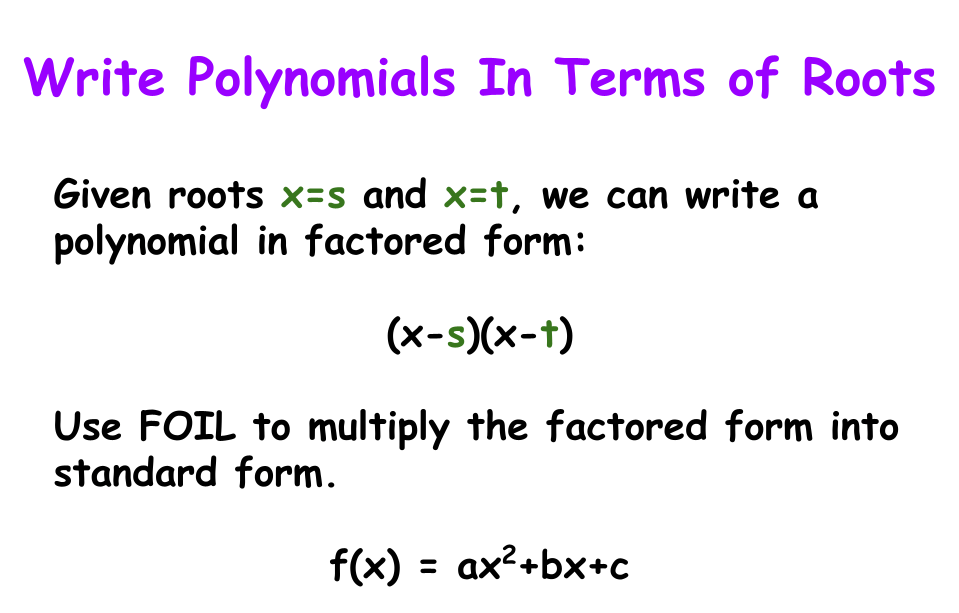
Image source: by Anusha Rahman
Let's say you're given the roots , , and . To write the polynomial, first turn each root into a factor. That means you write:
Watch your signs!
A polynomial is made from multiplying all factors together. So, you can write:
Now, we multiply the factors step by step. First, multiply the first two:
Next, multiply that result by the last factor:
Do the multiplication carefully (you can use distribution or box method), and you'll get:
That’s your polynomial!
If you had a complex root like , remember from the Conjugate Root Theorem that must also be a root. Always include the conjugate!

