Video

(Video) Solving Exponential Equations With Different Bases Using Logarithms - Algebra

by The Organic Chemistry Tutor

Check out this video by The Organic Chemistry Tutor to learn how to solve exponential equations with logs.

Let's go through the example The Organic Chemistry Tutor starts with in the video.

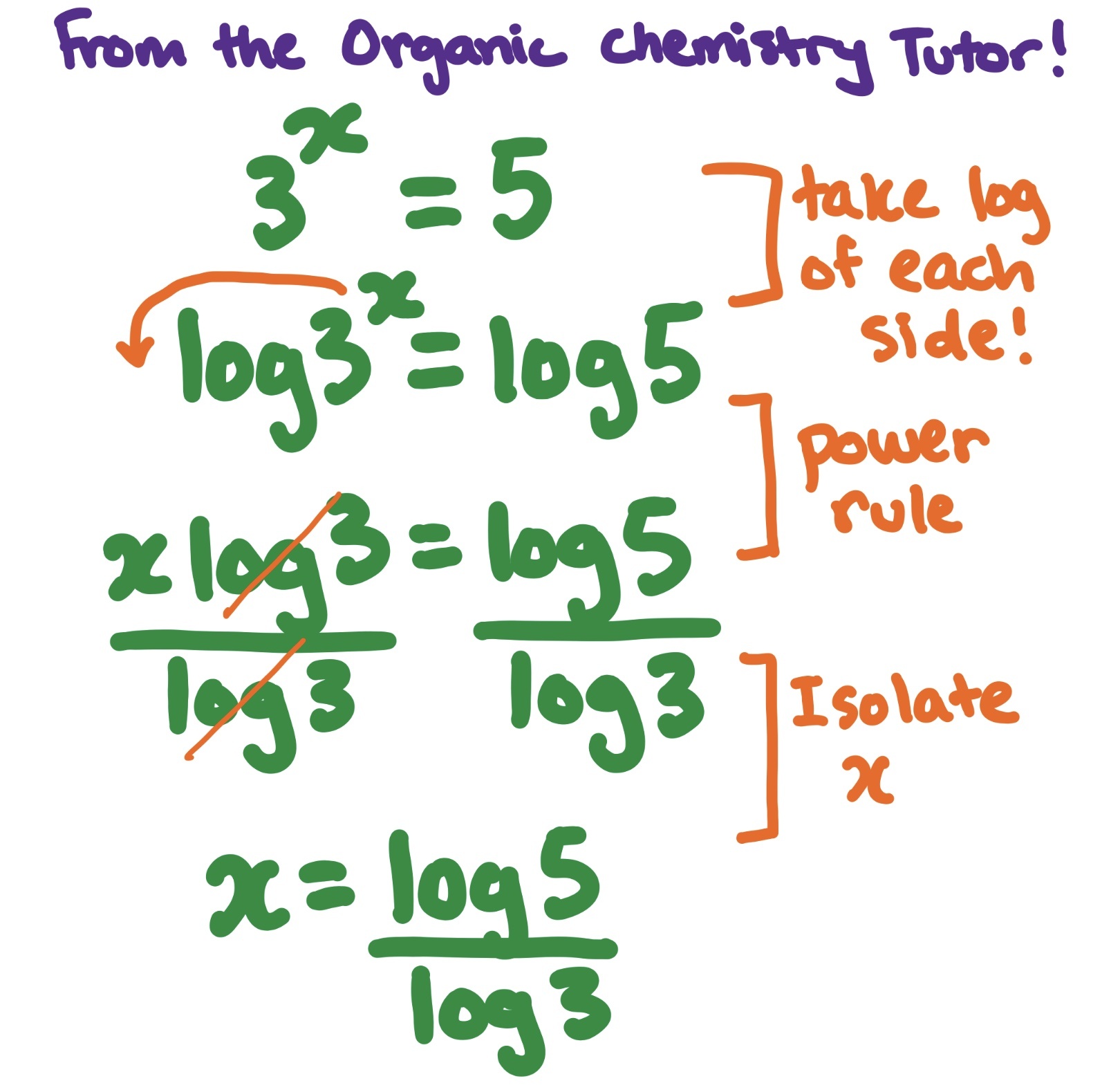
From the Organic Chemistry Tutor!

3^x = 5
[take the log of each side!]
log3^x = log5
[power rule]
fraction{xlog3}/{log3} = fraction{log5}/{log3}
[Isolate x]
x=fraction{log5}/{log3}

Image source: by Trisha

Try solving the second problem in the video! 52x+3=85^{2x+3} = 8

Choose one answer

Read · 1 min

Turns out, we can use logs to solve exponential equations!

Let's look at an example.

25x+3=63x−42^{5x+3} = 6^{3x-4}

We can solve this equation using logs!

We can start by taking the log of each side of the equation:

log(25x+3)=log(63x−4)log(2^{5x+3}) = log(6^{3x-4})

Then, we can use log properties to solve:

(5x+3)log(2)=(3x−4)log(6)(5x+3)log(2) = (3x-4)log(6)

Isolate the logarithms on one side of the equation:

5x+33x−4=log(6)log(2)\frac{5x+3}{3x-4} = \frac{log(6)}{log(2)}

Solve for log(6)log(2)\frac{log(6)}{log(2)} using a calculator:

log(6)log(2)=2.58\frac{log(6)}{log(2)}= 2.58

Therefore,

5x+33x−4=2.58\frac{5x+3}{3x-4} = 2.58

Finally, solve for xx:

5x+3=2.58(3x−4)5x+3 = 2.58(3x-4) 5x+3=7.74x−10.325x+3 = 7.74x-10.32 13.32=2.74x13.32= 2.74x x=4.86x=4.86

Illustrated · 1 min

Solving Exponential Equations with Logs

Sometimes, exponential equations can't be solved just by making the bases match. That’s when we use logarithms to help!

Many exponential equations can be solved by rewriting both sides with the same base. For example:

2x=322^x = 32

can be rewritten as:

2x=252^x = 2^5

However, not every exponential equation can be rewritten this way. When the bases do not match, we use logarithms to solve for the variable.

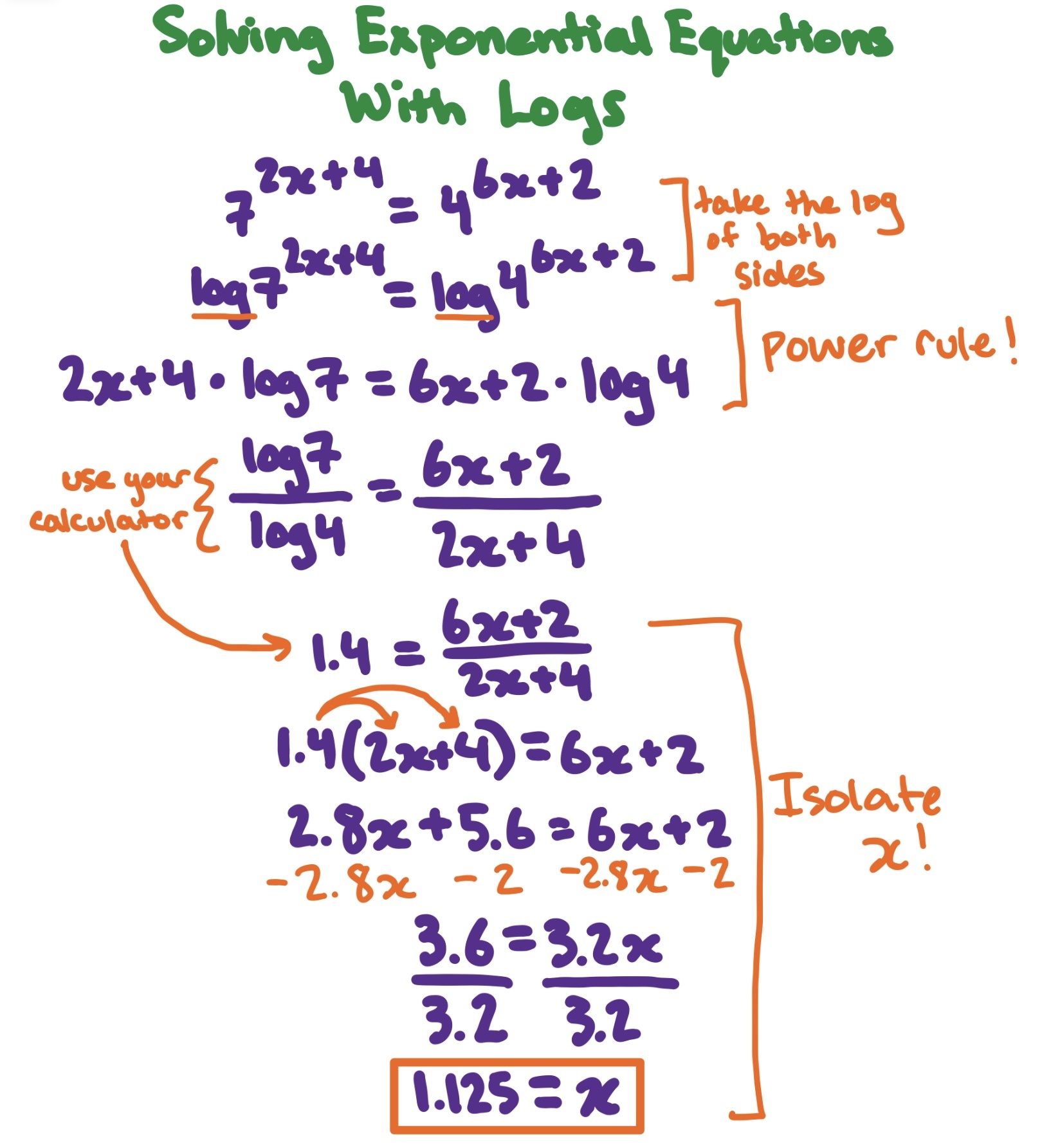
Solving Exponential Equations With Logs

$7^{2x+4} = 4^{6x+2}$
--> take the log of both sides
$log 7^{2x+4} = log 4^{6x+2}$
$(2x+4)*log 7 = (6x+2)*log4$
--> power rule
$\frac{log7}{log4}=\frac{6x+2}{2x+4}$
--> use your calculator
$1.4 = \frac{6x+2}{2x+4}$
$1.4(2x+4)=6x+2$
$\frac{3.6}{3.2} = \frac{3.2x}{3.2}$
$1.125 = x$
--> isolate $x$

Image source: by Trisha

An exponential equation has the variable in the exponent: 3x=203^x = 20

Since 2020 is not a power of 33, we can't solve this equation so easily. A logarithm allows us to "bring down" the exponent so that we can solve for xx.

There are some old concepts you may see when solving exponential equations with logarithms! You may recognize: the power rule, divide both sides, decimal approximations, and subtract both sides.

####The Logarithm Property

The most important property is:

log⁡(ab)=blog⁡(a)\log(a^b) = b \log (a)

This is called the power property of logarithms. It allows an exponent to become a coefficient.

Looking Further

Now that we've finished our lessons on logarithm properties, we can move onto applications of logarithm and exponential functions. Our next lesson is on logarithm scales.

Type a concept, like “slope” or “photosynthesis”.

↑ ↓ to choose · Enter to openSearch explanations and problems