Background
In the previous lessons, we learned how to simplify rational expressions, whether they're added/subtracted or multiplied/divided together. We can extend these concepts into solving rational equations. The main difference is that because these are equalities, we can solve for the value of a variable.
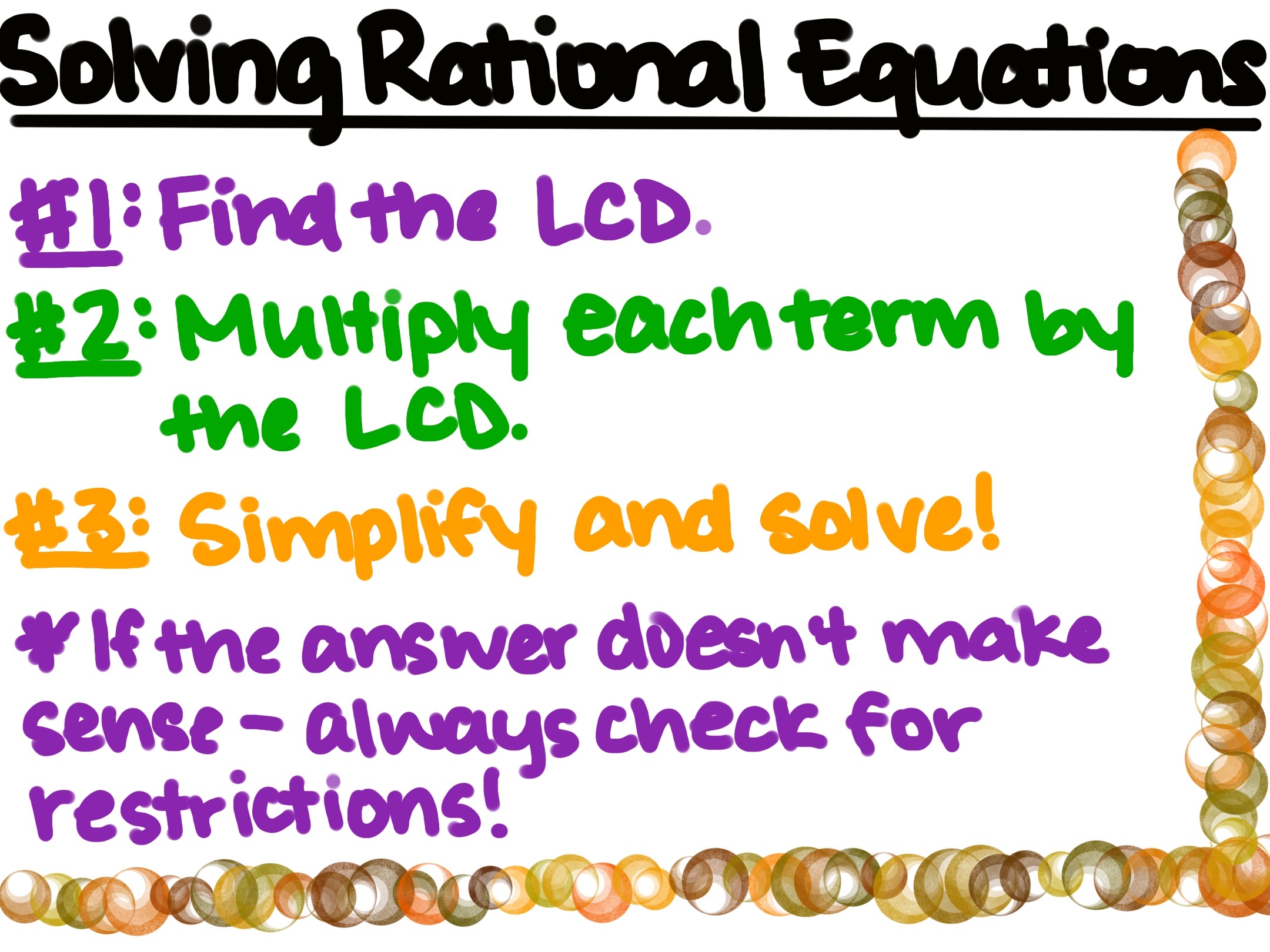
Solving Rational Equations
When solving a rational equation, our goal is the same as always. We want to find the value of the variable.
But rational equations are written as fractions, so we have to be careful. The denominator can never equal 0.
If the denominator were 0, the fraction would not make sense. You can’t divide by zero since there are no “parts of no whole.”
So before and after solving, always check your answers to make sure they do not make the denominator equal 0.
You've seen this concept before - think back to proportions, when we used the cross-product property to solve proportions!
3x−14x+1=2x−7x−5
That is an example of rational equations! We know how to solve this: with cross multiplication. We do some cross multiplying of both sides.
But let's take this a step further. Think about what would happen if we had some kind of operation on one side that required some extra work!
3x−14x+1+x+1x−2=2x−7x−5
We can use the techniques we learned in the previous lessons to add the two rational expressions on the left.
We'll start with finding a common denominator.
3x−14x+1⋅x+1x+1=(3x−1)⋅(x+1)(4x+1)⋅(x+1)=3x2+3x−x−14x2+4x+x+1=3x2+2x−14x2+5x+1
x+1x−2⋅3x−13x−1=(x+1)⋅(3x−1)(x−2)⋅(3x−1)=3x2−x+3x−13x2−x−6x+2=3x2+2x−13x2−7x+2
So, our new equation looks like:
3x2+2x−14x2+5x+1+3x2+2x−13x2−7x+2=2x−7x−5
This looks daunting! Let's simplify.
3x2+2x−1(4x2+5x+1)+(3x2−7x+2)=2x−7x−53x2+2x−17x2−2x+3=2x−7x−5
We can now use cross-multiplication to solve even more.
(7x2−2x+3)(2x−7)14x3−49x2−4x2+14x+6x−2114x3−53x2+20x−2111x3−40x2+31x−26=(3x2+2x−1)(x−5)=3x3−15x2+2x2−10x−x+5=3x3−13x2−11x+5=0
If we solve the resulting equation for x, we'll find that x=2.95.
After you solve the equation, it’s important to check your work.
To do this, plug your answer back into the original equation. If the equation is still true, your solution is correct. If it is not true, there was a mistake somewhere in your steps.
In more advanced math, you might get something called an extraneous solution. This is an answer that shows up during your work but does not actually solve the original equation.
Extraneous solutions happen more often with quadratic equations than with linear equations. That’s why it’s always a good idea to plug your answers back in and check them.