Menyelesaikan sistem persamaan rasional

Before this, knowMenyelesaikan persamaan rasional

Video

(Video) Solving Systems of Rational Equations

by MrHelpfulNotHurtful

This video by MrHelpfulNotHurtful walks through an example of solving systems of rational equations.

Summary

Solve the following system of equations:

y=1x−3y=\frac{1}{x-3}

y=x−3y=x-3

The first step is to make the fractions on both sides of the equation have the same denominator.

1x−3=x−311x−3=(x−3)(x−3)x−3\begin{align} \frac{1}{x-3} &= \frac{x-3}{1} \\ \frac{1}{x-3} &= \frac{(x-3)(x-3)}{x-3} \\ \end{align}

We know that the denominator cannot be 00, so the exclusionary value is x=3x=3. Since the denominators are the same, we can say that:

1=(x−3)(x−3)1=x2−3x−3x+91=x2−6x+90=x2−6x+80=(x−2)(x−4)\begin{align} 1 &= (x-3)(x-3) \\ 1 &= x^2 -3x -3x +9 \\ 1 &= x^2 -6x +9 \\ 0 &= x^2 -6x +8 \\ 0 &= (x-2)(x-4) \\ \end{align}

The solutions are: x=2,4x=2, 4. Neither of these solved values are the excluded value, 33.

Now that we've solved for the xx values, we need to find the corresponding yy values! We can plug in the xx values into either of the equations. Let's go with the second equation since it's easier.

For x=2x=2,

y=x−3y=2−3y=−1\begin{align} y &= x-3 \\ y &= 2-3 \\ y &= -1 \\ \end{align}

So our first point is: (2,−1)(2, -1).

For x=4x=4,

y=x−3y=4−3y=1\begin{align} y &= x-3 \\ y &= 4-3 \\ y &= 1 \\ \end{align}

Our second point is: (4,1)(4, 1).

The solution to our system of rational equations is: (2,−1)(2, -1) and (4,1)(4, 1)

Read · 1 min

Solving Systems of Rational Equations

Solving systems of rational equations looks really scary to begin with, because there are so many fractions and numbers everywhere. The good news is that there is a straightforward way to tackle these types of problems! We can use our previous skills with common denominators to solve these problems.

There are two key things to note for solving systems of rational equations:

  • Always remember your exclusionary values. You will find these values by setting the denominator equal to zero.

  • Aim to find a common denominator for both equations, that way you can simply work with the numerators. This is possible because of the cross product property.

This will probably make more sense if we walk through an example!

Example

Find the solution to the following system of equations:

{y=6x+2y=x−31\begin{cases} y= \frac{6}{x+2} \\ y= \frac{x-3}{1} \\ \end{cases}

Our first step is to find a common denominator. Because the denominator of the second equation is 11, it's easiest to multiply that fraction by x+2x+2\frac{x+2}{x+2}. So, our new system looks like:

{y=6x+2y=(x−3)(x+2)x+2\begin{cases} y= \frac{6}{x+2} \\ y= \frac{(x-3)(x+2)}{x+2} \\ \end{cases}

Now that our two equations have the same denominator, we can determine what the exclusionary value is! Because the denominator ≠0\neq 0, we can determine that our exclusionary value is x=−2x=-2.

Next, we can set our numerators equal to each other and solve!

6=(x−3)(x+2)6=x2+2x−3x−66=x2−x−60=x2−x−120=(x+3)(x−4)\begin{align} 6 &= (x-3)(x+2) \\ 6 &= x^2 +2x -3x -6 \\ 6 &= x^2 -x -6 \\ 0 &= x^2 -x -12 \\ 0 &= (x+3)(x-4) \\ \end{align}

Therefore, our zeroes are: x=−3x=-3 and x=4x=4. To find the corresponding yy-values, we can plug in these xx-values into one of our original equations. I chose the first one because it's easier, but the second equation should yield the same results.

For x=−3x=-3,

y=6−3+2y=6−1y=−6\begin{align} y &= \frac{6}{-3+2} \\ y &= \frac{6}{-1} \\ y &= -6 \\ \end{align}

Our first point is (−3,−6)(-3, -6).

For x=4x=4,

y=64+2y=66y=1\begin{align} y &= \frac{6}{4+2} \\ y &= \frac{6}{6} \\ y &= 1 \\ \end{align}

Our second point is (4,1)(4,1).

Illustrated · 1 min

Solving Systems of Rational Equations

In the previous lesson, we learned the basics of solving rational equations. In this lesson, we will learn how to solve systems of rational equations. As we've learned before a rational equation is a math sentence that has fractions with variables in both the numerator and the denominator. A system of rational equations has two or more of these equations, and we want to find the variable values that make both equations true.

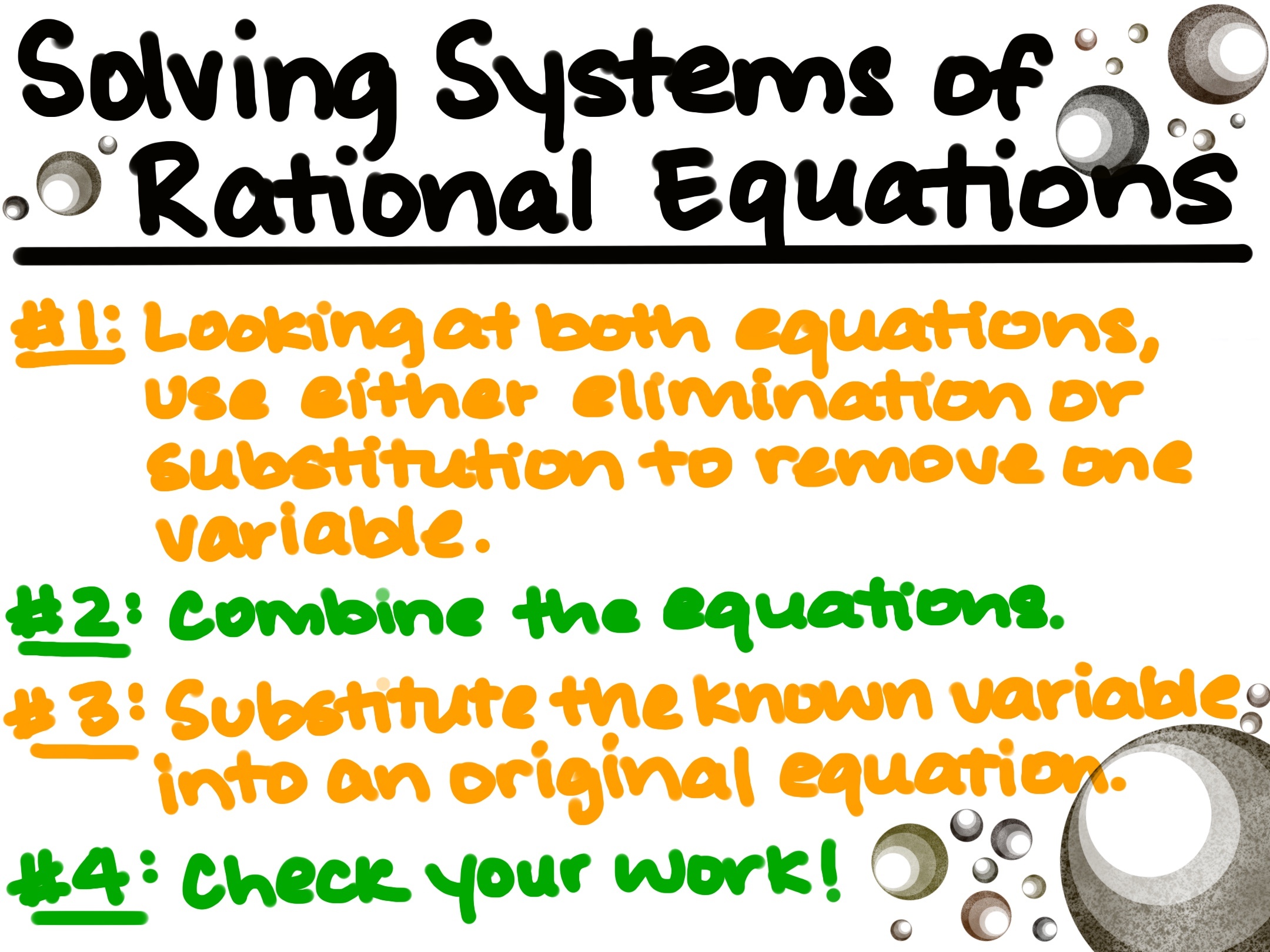
Solving Systems of Rational Equations
#1: Looking at both equations, use either elimination or substitution to remove one variable.
#2: Combine the equations.
#3: Substitute the known variable into an original equation.
#4: Check your work!

Image source: by Anusha Rahman

####Example

{2x+1+3y=54x+1−1y=3\begin{cases} \frac{2}{x+1} + \frac{3}{y} = 5 \\ \frac{4}{x+1} - \frac{1}{y} = 3 \\ \end{cases}

You may notice that both equations have the fraction 2x+1\frac{2}{x+1} or 4x+1\frac{4}{x+1}, and the variable yy in the denominators. So - let's first try elimination. Multiply the first equation by 22:

4x+1+6y=10\frac{4}{x+1} + \frac{6}{y} = 10

Now, we can subtract the second equation from this new equation.

[4/(x+1)+6/y]−[4/(x+1)−1/y]=10−3[4/(x + 1) + 6/y] - [4/(x + 1) - 1/y] = 10 - 3

After simplifying, we are left with:

y=1y=1

Now that we know a yy value, we can plug y=1y=1 into the first equation.

2/(x+1)+3/1=5→2/(x+1)+3=52/(x + 1) + 3/1 = 5 \rightarrow 2/(x + 1) + 3 = 5

After simplifying, we get:

2=2(x+1)→x=02 = 2(x + 1) \rightarrow x=0

Therefore, the final solution is x=0x=0 and y=1y=1. Don't forget to check your work!

20+1+31=5→2+3=5→5=5✓\frac{2}{0+1} + \frac{3}{1} = 5 \rightarrow 2+3=5 \rightarrow 5=5 \checkmark 40+1−11=3→4−1=3→3=3✓\frac{4}{0+1} - \frac{1}{1} = 3 \rightarrow 4-1=3 \rightarrow 3=3 \checkmark

Looking Further

In the next lesson, you will learn how to solve rational inequalities, which is going to use many of the same principles as those you learned in this lesson. You will then learn about partial fraction decomposition, an exciting math topic!

Type a concept, like “slope” or “photosynthesis”.

↑ ↓ to choose · Enter to openSearch explanations and problems