Menyelesaikan dengan akar kuadrat

Before this, knowPendahuluan Persamaan Kuadratik

Video

(Video) The Square Root Property

by mathman1024

This video by mathman1024 explains the square root property.

Summary\large{\text{Summary}}

The square root property states: if x2=athen x=±a\begin{align} \text{if }x^2&=a\\ \text{then }x&=\pm\sqrt{a} \end{align} This is because both positive and negative numbers can be squared and result in a positive number. He then shows you with a concrete example, x2=18x^2=18. x2=18x=±18x=±32\begin{align} x^2&=18\\ x&=\pm\sqrt{18}\\ x&=\pm3\sqrt2 \end{align}

This next video covers some problems that use the square root property. We'll walk through one together.

(Video) The Square Root Property

by mathman1024

There are 33 steps in these solutions

  1. Isolate the square.
  2. Apply the square root property.
  3. Solve.

He works through x2−5=45x^2-5=45. Let's run through these steps.

First, we're going to isolate the square. x2−5=45x2=50\begin{align}x^2-5&=45\\ x^2&=50 \end{align}

Now, we'll apply the square root property. x2=50x2=±50x=±50\begin{align}x^2&=50\\ \sqrt{x^2}&= \pm\sqrt{50}\\ x &= \pm \sqrt{50} \end{align}

This is almost correct, but we need to simplify 50\sqrt{50} x=±50x=±25⋅2x=±52\begin{align}x&= \pm \sqrt{50}\\ x&=\pm \sqrt{25} \cdot \sqrt{2}\\ x&=\pm 5\sqrt{2}\end{align}

There are a few more problems in the video that you can try on your own!

Read · 1 min

There are several way to approach quadratic equations. Before discussing how to solve them, let's review quadratic equations.

A quadratic equation is an equation that takes the form ax2+bx+c=yax^2+bx+c=y and creates a parabola when graphed. The left hand side is the quintessential form of the quadratic equation.

We've seen many ways to solve quadratic equations. We've seen different factoring patterns, like completing the square, and the quadratic formula to solve. We've learned how to use the discriminant, b2−4acb^2 - 4ac, to graph the equation, which we can also use to solve the original equation.

The equation below is an example of a quadratic equation.

7x2+7=707x^2+7=70

While this equation may not look like the one above, it is still a quadratic equation. It can be written as follows:

7x2+0x+7=707x^2+0x+7=70

Quadratics with b=0b=0 can be solved by taking the square root of each side.

Begin by subtracting the constant from both sides. In this case we will subtract 77 from both sides.

7x2+7−7=70−77x2=637x^2+7 {\color{#8925AE}{-7}}= 70 {\color{#8925AE}{-7}} \\ 7x^2=63

Next, divide each side by the coefficient on the x2x^2 term. In this equation, its 77.

7x2÷7=63÷7x2=97x^2 {\color{#8925AE}{\div 7}} = 63 {\color{#8925AE}{\div 7}} \\ x^2=9

Finally, in order to get rid of the power on xx we can take the square root of each side.

x2=9\color{#8925AE}{\sqrt{\color{black}{x^2}}}=\color{#8925AE}{\sqrt{\color{black}{9}}} x=±3x= \pm 3

Notice the plus or minus symbol before the three, this symbol tells us that there are two possible values for xx, positive 33 and negative 33.

Interactive · 1 question

Solve Quadratic Equations by Square Root

There are a few important things to remember when you need to solve a quadratic equation using a square root.

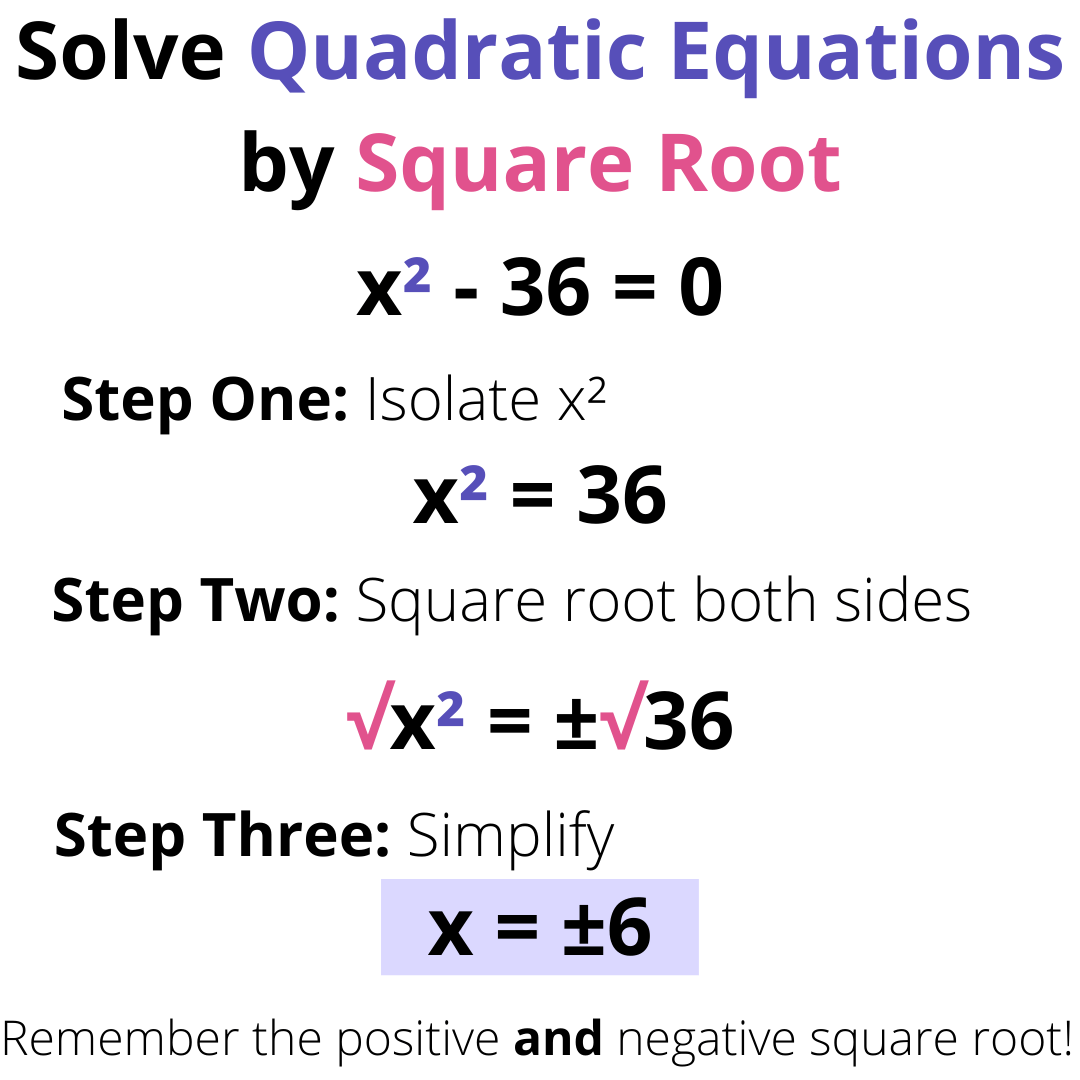
For one, when you take the square root of both sides of an equation in the form x2=ax^2=a there will be two solutions, and these solutions will be the same except for that they will have opposite signs. In other words: x2=ax^2=a x2=±a\sqrt{x^2}=\pm \sqrt{a} x=±ax=\pm \sqrt{a}

Additionally, if aa is a positive number, there will be two real solutions (both a positive version and a negative version). If aa is a negative number, there will be two imaginary solutions (both a positive version and a negative version). If a=0,a=0, then your solution is just 0.0.

Here is a graphic with an example:

Solve Quadratic Equations by Square Root. Example equation is x^2-36=0. Step One: Isolate x^2 (x^2=36). Step Two: Square root both sides (sqrt{x^2}=plus/minus sqrt{36}). Step Three: Simplify (x=plus\minus 6).

Image source: By Expii

Let's do another example!

Solve x2+6=15.x^2+6=15.

Choose one answer

Type a concept, like “slope” or “photosynthesis”.

↑ ↓ to choose · Enter to openSearch explanations and problems