The Fraction Method for Factoring
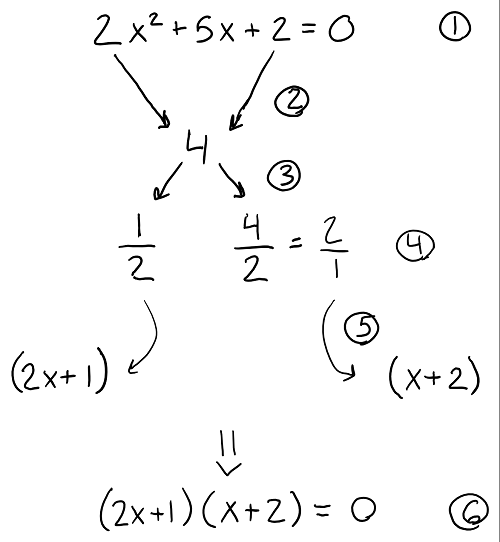
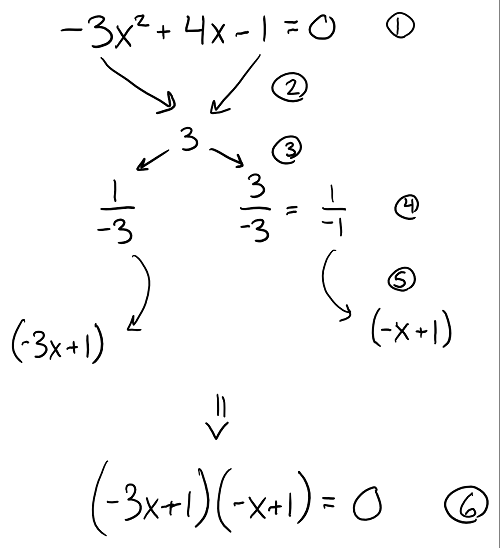
We can use the Fraction Method, based on Vieta's Theorem, to factor more efficiently than using guess-and-check.
- Move everything to one side and identify your coefficients
===
For example, if you were given:
x2+2x=−1
You would want to add 1 to both sides in order to make the equation look like this:
x2+2x+1=0
And then identify your coefficients:
abc=1=2=1
Your next step is:
- Multiply the a value and the c value together
===
So, for the equation we used in the last step, we would do this:
a×c=(1)×(1)=1
We'll call this m. You want to to find two values that multiply to equal m and add to equal b. So your third step is:
- Find two values that multiply to get m and add them to equal b
===
We need to find two values that multiply to get 1 and add to get 2, so:
j+kj×k=2and=1
With this, we can see that j an
d k both must be 1 since 1+1=2 and 1×1=1.
Now that we have these two values, we will "divide" both of them by a.
- Divide j and k by a
===
ajak
⇓⇓
1111
The next step is very important to correctly factoring this equation.
- Let the denominator of each fraction be the coefficient of the x value. Let the numerator be what you add to that x value
===
For the first fraction, the denominator=1 and the numerator=1 so,
11⟹(1x+1)
For the second fraction, the denominator=1 and the numerator=1 so,
11⟹(1x+1)
You have both components of the equation in factored form. Next,
- Multiply the two components together and set it equal to 0
===
(1x+1)×(1x+1)=0
Below are examples of different problems to help you understand them more.