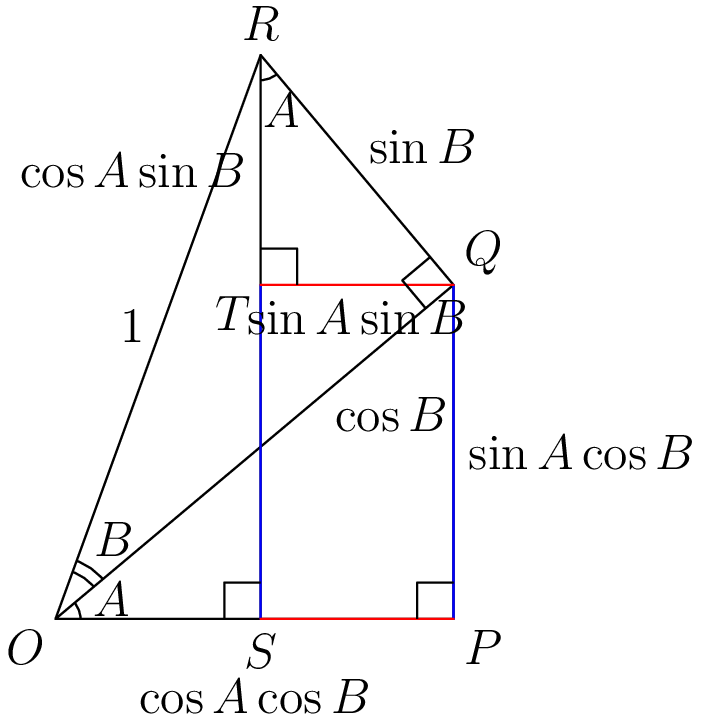
Identitas penjumlahan sudut

Illustrated · 2 min

Continuing our discussion on these trigonometric function identities, let's now find a formula for sin⁡(A+B)\sin{(A+B)}.

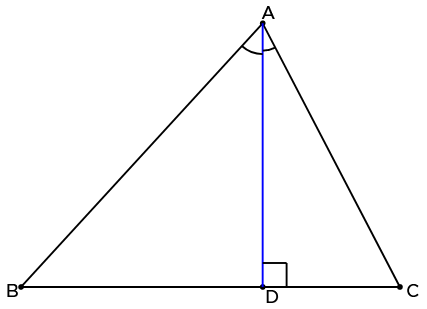
The sine area formula for a triangle is:

A=12⋅absin⁡CA = \frac{1}{2} \cdot ab\sin{C}

Triangle ABC.

Image source: by Brandon Lin

Let α=∠BAD\alpha = \angle{BAD} and β=∠DAC\beta = \angle{DAC}.

Provided this formula, we can use the sum of areas to find the best way to find the formula for sin⁡(α+β)\sin{(\alpha+\beta)} in terms of trig functions of α\alpha and β\beta.

It is obvious to see that [ABC]=[BAD]+[DAC][ABC] = [BAD] + [DAC]. Following from the sine area formula, we get that 12⋅AB⋅AC⋅sin⁡(α+β)=12⋅AB⋅AD⋅sin⁡α+12⋅AC⋅AD⋅sin⁡β\frac{1}{2} \cdot AB \cdot AC \cdot \sin{(\alpha + \beta)}= \frac{1}{2} \cdot AB \cdot AD \cdot \sin{\alpha} + \frac{1}{2} \cdot AC \cdot AD \cdot \sin{\beta} AB⋅AC⋅sin⁡(α+β)=AB⋅AD⋅sin⁡α+AC⋅AD⋅sin⁡βAB \cdot AC \cdot \sin{(\alpha + \beta)}= AB \cdot AD \cdot \sin{\alpha} + AC \cdot AD \cdot \sin{\beta} Now divide by AB⋅ACAB \cdot AC: sin⁡(α+β)=ADACsin⁡α+ADABsin⁡β\sin{(\alpha + \beta)} = \frac{AD}{AC}\sin{\alpha} + \frac{AD}{AB}\sin{\beta}

But since ADAC=cos⁡β\frac{AD}{AC} = \cos{\beta} and ADAB=cos⁡α\frac{AD}{AB} = \cos{\alpha}, we can substitute this in to get our closed form:

sin⁡(α+β)=sin⁡αcos⁡β+sin⁡βcos⁡α\boxed{\sin{(\alpha + \beta)} = \sin{\alpha}\cos{\beta} + \sin{\beta}\cos{\alpha}}

This is a very great formula to remember. To derive a formula for sin⁡(α−β)\sin{(\alpha - \beta)}, just use the formula for: sin⁡(α−β)=sin⁡[α+(−β)]=sin⁡αcos⁡(−β)+sin⁡(−β)cos⁡α=sin⁡αcos⁡β−sin⁡βcos⁡α\sin{(\alpha - \beta)} = \sin{[\alpha + (-\beta)]} = \sin{\alpha}\cos{(-\beta)} + \sin{(-\beta)}\cos{\alpha} \\ = \sin{\alpha}\cos{\beta} - \sin{\beta}\cos{\alpha}

Now, let's think about cosine. Well, since cos⁡A=sin⁡(90∘−A)\cos{A} = \sin{(90^{\circ} - A)}, we have cos⁡(α+β)=sin⁡(90∘−(α+β))\cos{(\alpha + \beta)} = \sin{(90^{\circ} - (\alpha + \beta))}

I will leave it to you to come up with the derivations for addition and subtraction for cosine.

cos⁡(α+β)=cos⁡αcos⁡β−sin⁡αsin⁡βcos⁡(α−β)=cos⁡αcos⁡β+sin⁡αsin⁡β\cos{(\alpha + \beta)} = \cos{\alpha}\cos{\beta} - \sin{\alpha}\sin{\beta} \\ \cos{(\alpha - \beta)} = \cos{\alpha}\cos{\beta} + \sin{\alpha}\sin{\beta}

Now let's move on to tangent. tan⁡(α+β)=sin⁡(α+β)cos⁡(α+β)=sin⁡αcos⁡β+sin⁡βcos⁡αcos⁡αcos⁡β−sin⁡αsin⁡β\tan{(\alpha + \beta)} = \dfrac{\sin{(\alpha + \beta)}}{\cos{(\alpha +\beta)}} = \dfrac{\sin{\alpha}\cos{\beta} + \sin{\beta}\cos{\alpha}}{\cos{\alpha}\cos{\beta} - \sin{\alpha}\sin{\beta}}

Now divide numerator and denominator by cos⁡αcos⁡β\cos{\alpha}\cos{\beta}: sin⁡αcos⁡β+sin⁡βcos⁡αcos⁡αcos⁡β−sin⁡αsin⁡β=sin⁡αcos⁡βcos⁡αcos⁡β+sin⁡βcos⁡αcos⁡αcos⁡βcos⁡αcos⁡βcos⁡αcos⁡β−sin⁡αsin⁡βcos⁡αcos⁡β=tan⁡α+tan⁡β1−tan⁡αtan⁡β\dfrac{\sin{\alpha}\cos{\beta} + \sin{\beta}\cos{\alpha}}{\cos{\alpha}\cos{\beta} - \sin{\alpha}\sin{\beta}} = \dfrac{\frac{\sin{\alpha}\cos{\beta}}{\cos{\alpha}\cos{\beta}} + \frac{\sin{\beta}\cos{\alpha}}{\cos{\alpha}\cos{\beta}}}{\frac{\cos{\alpha}\cos{\beta}}{\cos{\alpha}\cos{\beta}} - \frac{\sin{\alpha}\sin{\beta}}{\cos{\alpha}\cos{\beta}}} \\ =\dfrac{\tan{\alpha} + \tan{\beta}}{1 - \tan{\alpha}\tan{\beta}}

You can do the same for α−β\alpha - \beta.

So to recap:

sin⁡(α+β)=sin⁡αcos⁡β+sin⁡βcos⁡αsin⁡(α−β)=sin⁡αcos⁡β−sin⁡βcos⁡αcos⁡(α+β)=cos⁡αcos⁡β−sin⁡αsin⁡βcos⁡(α−β)=cos⁡αcos⁡β+sin⁡αsin⁡βtan⁡(α+β)=tan⁡α+tan⁡β1−tan⁡αtan⁡βtan⁡(α−β)=tan⁡α−tan⁡β1+tan⁡αtan⁡β\sin{(\alpha + \beta)} = \sin{\alpha}\cos{\beta} + \sin{\beta}\cos{\alpha} \\ \sin{(\alpha - \beta)} = \sin{\alpha}\cos{\beta} - \sin{\beta}\cos{\alpha} \\ \cos{(\alpha + \beta)} = \cos{\alpha}\cos{\beta} - \sin{\alpha}\sin{\beta} \\ \cos{(\alpha - \beta)} = \cos{\alpha}\cos{\beta} + \sin{\alpha}\sin{\beta} \\ \tan{(\alpha + \beta)} = \dfrac{\tan{\alpha} + \tan{\beta}}{1 - \tan{\alpha}\tan{\beta}} \\ \tan{(\alpha - \beta)} = \dfrac{\tan{\alpha} - \tan{\beta}}{1 + \tan{\alpha}\tan{\beta}}

Learn a clever approach

Every problem comes with a worked solution, so even one you cannot crack shows you a new way to think. These are real problems from the AMC 12 and AIME, the national math competitions for middle and high school students, each with a worked solution on LIVE by Po-Shen Loh.

Interactive · 9 questions

If an angle AA is a "special angle" like 30∘30^{\circ} or 45∘45^{\circ}, or AA is an angle in a right triangle whose side lengths we know, then we can evaluate trig functions of the angle.

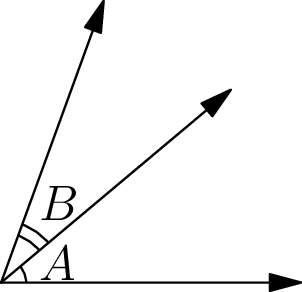
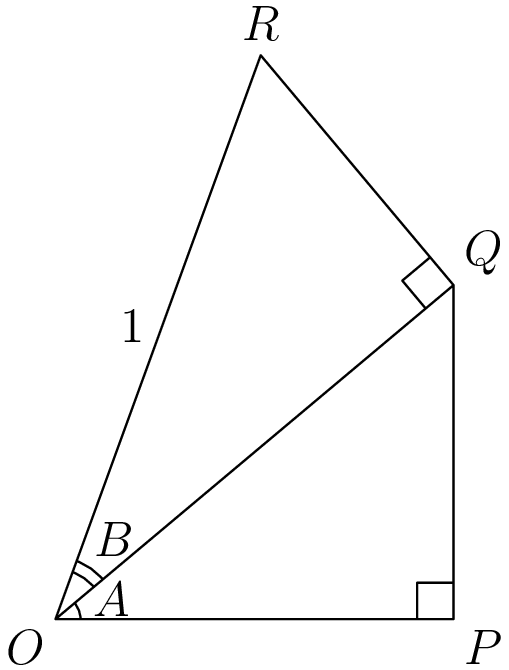
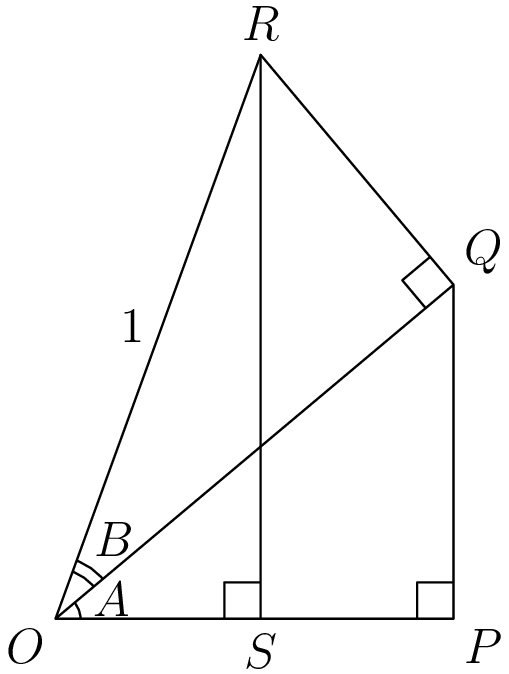
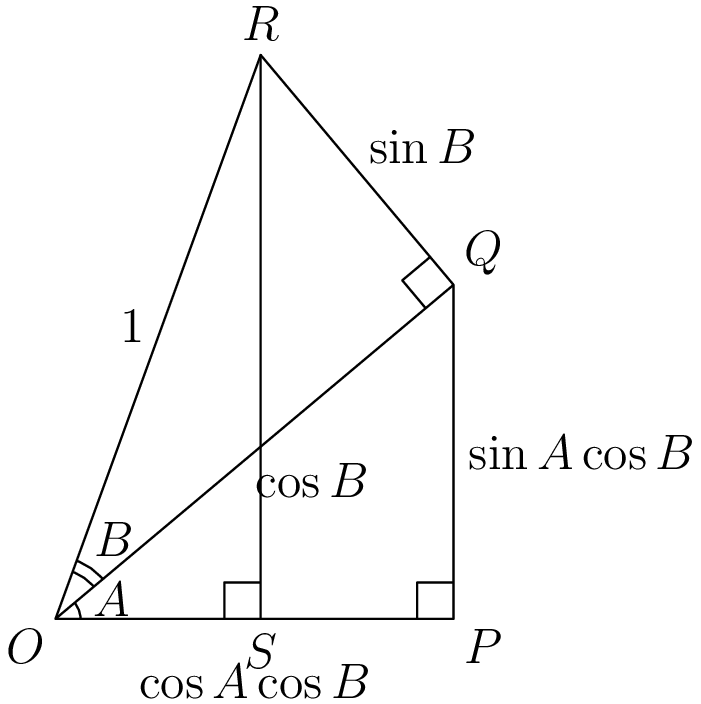
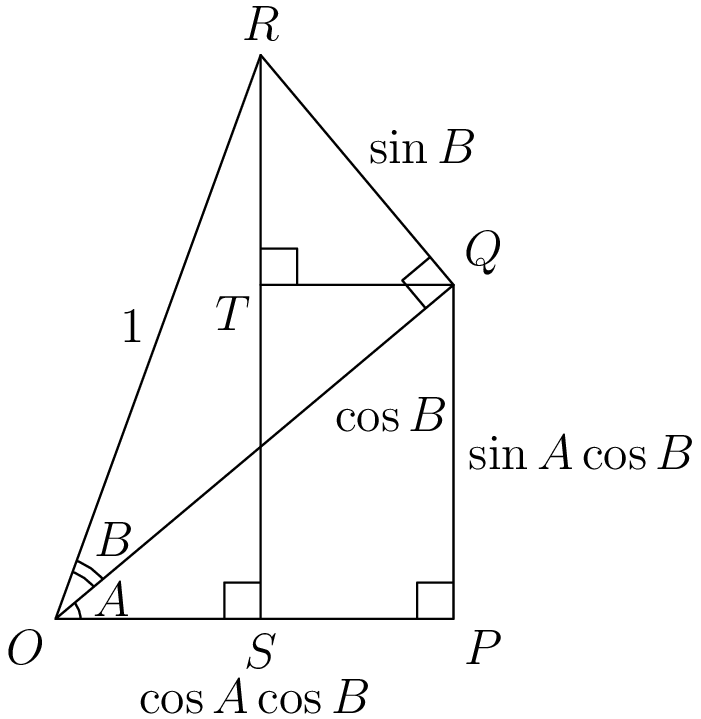
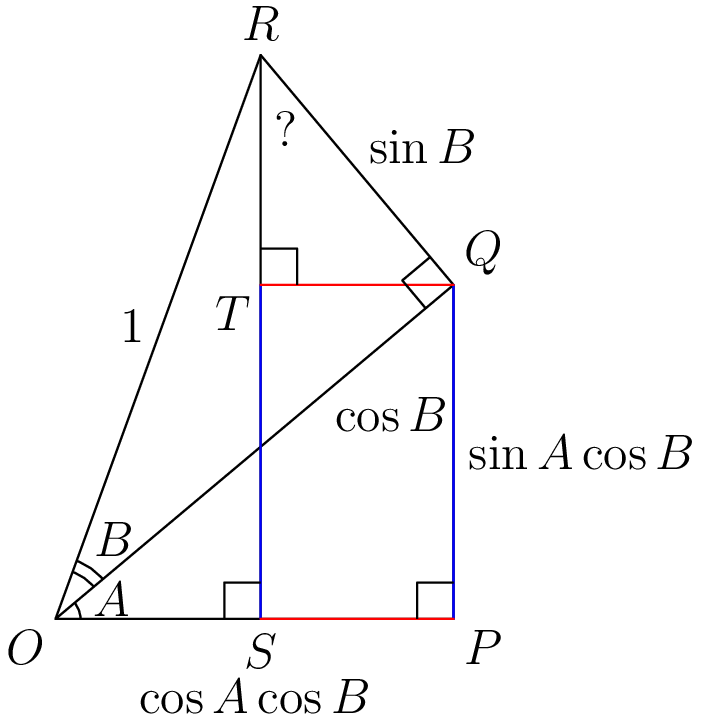
Let's think about how we can evaluate trig functions of combinations angles we know. For example, if we know the cos⁡A,sin⁡A,cos⁡B,sin⁡B\cos A, \sin A, \cos B, \sin B, we can find cos⁡(A+B)\cos (A+B) and sin⁡(A+B)\sin (A+B). In this lesson we will learn the addition and subtraction identities (via a geometric approach), and later we will use these identities to derive other useful identities such as the double and half angle identities.

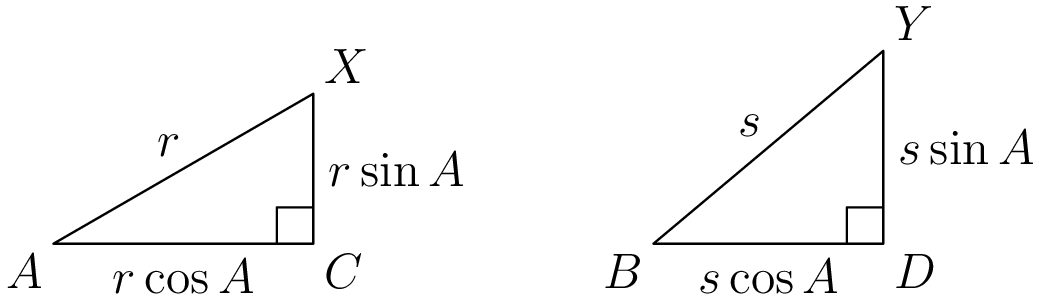
Right angle with hypotenuse labeled r

Image source: by Holden Lee

Recall the rules of the game. If we have a right triangle with hypotenuse rr and angle AA as below, what are ACAC and XCXC, respectively?

Choose one answer

Read · 1 min

A set of helpful identities when working with sines and cosines:

sin⁡(α+β)=sin⁡(α)cos⁡(β)+sin⁡(β)cos⁡(α)\sin(\alpha + \beta) = \sin(\alpha)\cos(\beta) + \sin(\beta)\cos(\alpha)

sin⁡(α−β)=sin⁡(α)cos⁡(β)−sin⁡(β)cos⁡(α)\sin(\alpha - \beta) = \sin(\alpha)\cos(\beta) - \sin(\beta)\cos(\alpha)

cos⁡(α+β)=cos⁡(α)cos⁡(β)−sin⁡(α)sin⁡(β)\cos(\alpha + \beta) = \cos(\alpha)\cos(\beta) - \sin(\alpha)\sin(\beta)

cos⁡(α−β)=cos⁡(α)cos⁡(β)+sin⁡(α)sin⁡(β)\cos(\alpha - \beta) = \cos(\alpha)\cos(\beta) + \sin(\alpha)\sin(\beta)

The first two are the formulas for sine, and the second two are the formulas for cosine.

One can prove another important identity: sin⁡(2θ)=2sin⁡(θ)cos⁡(θ)\sin(2\theta) = 2\sin(\theta)\cos(\theta).

sin⁡(2θ)=sin⁡(θ+θ)=sin⁡(θ)cos⁡(θ)+sin⁡(θ)cos⁡(θ)=2sin⁡(θ)cos⁡(θ)\begin {align*} \sin(2\theta) &= \sin(\theta + \theta) \\&= \sin(\theta)\cos(\theta) + \sin(\theta)\cos(\theta) \\&= 2\sin(\theta)\cos(\theta) \end {align*}

This uses the angle addition formula for sine.

In addition, one can also prove the identity cos⁡(2θ)=2cos⁡2θ−1=1−2sin⁡2θ\cos(2\theta)=2\cos^2\theta-1=1-2\sin^2\theta.

cos⁡(2θ)=cos⁡(θ+θ)=cos⁡θcos⁡θ−sin⁡θsin⁡θ=cos⁡2θ−sin⁡2θ=2cos⁡2θ−1=1−2sin⁡2θ\begin{align*}\cos(2\theta)&= \cos(\theta+\theta)\\ &= \cos\theta\cos\theta-\sin\theta\sin\theta \\ &=\cos^2\theta-\sin^2\theta\\ &= 2\cos^2\theta-1\tag{By $\sin^2\theta+\cos^2\theta=1$} \\ &= 1-2\sin^2\theta\end{align*}

Read · 1 min

Here are some useful identities pertaining to sums of angles:

sin⁡(x+y)=sin⁡(x)cos⁡(y)+cos⁡(x)sin⁡(y)\sin(x + y) = \sin(x)\cos(y) + \cos(x)\sin(y)

cos⁡(x+y)=cos⁡(x)cos⁡(y)−sin⁡(x)sin⁡(y)\cos(x + y) = \cos(x)\cos(y) - \sin(x)\sin(y)

Using these two, we can prove other identities.

Proof 1:

tan⁡(x+y)=sin⁡(x+y)cos⁡(x+y)=sin⁡(x)cos⁡(y)+cos⁡(x)sin⁡(y)cos⁡(x)cos⁡(y)−sin⁡(x)sin⁡(y)\tan(x + y) = \frac{\sin(x + y)}{\cos(x + y)} = \frac{\sin(x)\cos(y) + \cos(x)\sin(y)}{\cos(x)\cos(y) - \sin(x)\sin(y)}

Divide the numerator and denominator of the fraction by cos⁡(x)cos⁡(y)\cos(x)\cos(y):

tan⁡(x+y)=tan⁡(x)+tan⁡(y)1−tan⁡(x)tan⁡(y)\tan(x + y) = \frac{\tan(x) + \tan(y)}{1 - \tan(x)\tan(y)}

Proof 2:

sin⁡(x−y)=sin⁡(x)cos⁡(−y)+cos⁡(x)sin⁡(−y)=sin⁡(x)cos⁡(y)−cos⁡(x)sin⁡(y)\sin(x - y) = \sin(x)\cos(-y) + \cos(x)\sin(-y) = \sin(x)\cos(y) - \cos(x)\sin(y)

Here it is important to remember that sine is an odd function and cosine is an even function.

Proof 3:

cos⁡(x−y)=cos⁡(x)cos⁡(−y)−sin⁡(x)sin⁡(−y)=cos⁡(x)cos⁡(y)+sin⁡(x)sin⁡(y)\cos(x - y) = \cos(x)\cos(-y) - \sin(x)\sin(-y) = \cos(x)\cos(y) + \sin(x)\sin(y)

Proof 4:

tan⁡(x−y)=tan⁡(x)+tan⁡(−y)1−tan⁡(x)tan⁡(−y)\tan(x - y) = \frac{\tan(x) + \tan(-y)}{1 - \tan(x)\tan(-y)}

Remembering that tangent is an odd function is important here--tan⁡(−y)=−tan⁡(y)\tan(-y) = -\tan(y):

tan⁡(x−y)=tan⁡(x)−tan⁡(y)1+tan⁡(x)tan⁡(y)\tan(x - y) = \frac{\tan(x) - \tan(y)}{1 + \tan(x)\tan(y)}

These six identities are very useful for the wide variety of problems involving sums and differences of angles.

Illustrated · 1 min

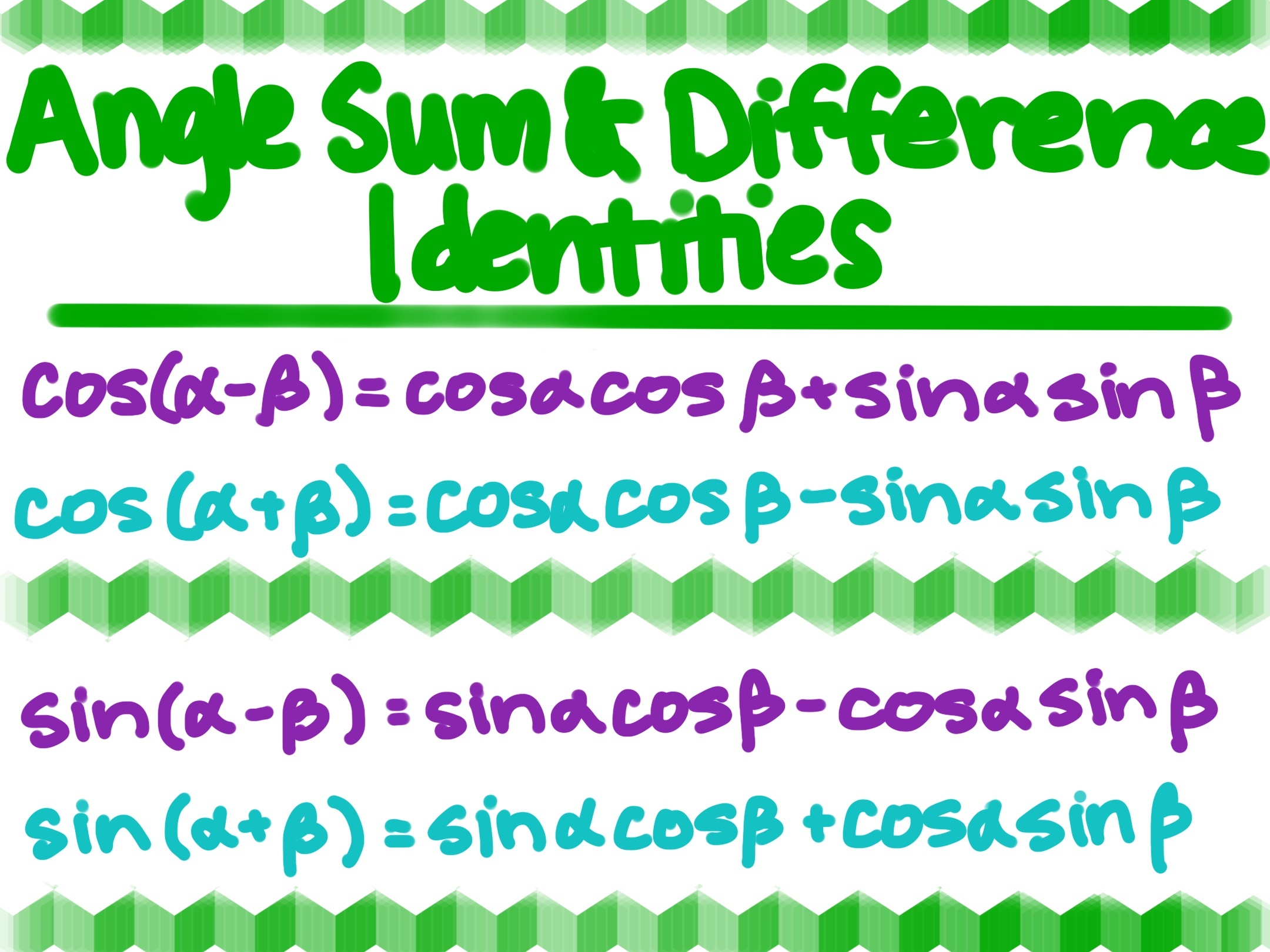
Angle Sum & Difference Identities

There are six negative angle identities you need to memorize!

Angle Sum and Difference Identities
$\sin(\alpha + \beta) = \sin(\alpha)\cos(\beta) + \sin(\beta)\cos(\alpha)$

$\sin(\alpha - \beta) = \sin(\alpha)\cos(\beta) - \sin(\beta)\cos(\alpha)$

$\cos(\alpha + \beta) = \cos(\alpha)\cos(\beta) - \sin(\alpha)\sin(\beta)$

$\cos(\alpha - \beta) = \cos(\alpha)\cos(\beta) + \sin(\alpha)\sin(\beta)$

Image source: by Anusha Rahman

The identities are as follows:

sin⁡(α+β)=sin⁡(α)cos⁡(β)+sin⁡(β)cos⁡(α)\sin(\alpha + \beta) = \sin(\alpha)\cos(\beta) + \sin(\beta)\cos(\alpha) sin⁡(α−β)=sin⁡(α)cos⁡(β)−sin⁡(β)cos⁡(α)\sin(\alpha - \beta) = \sin(\alpha)\cos(\beta) - \sin(\beta)\cos(\alpha) cos⁡(α+β)=cos⁡(α)cos⁡(β)−sin⁡(α)sin⁡(β)\cos(\alpha + \beta) = \cos(\alpha)\cos(\beta) - \sin(\alpha)\sin(\beta) cos⁡(α−β)=cos⁡(α)cos⁡(β)+sin⁡(α)sin⁡(β)\cos(\alpha - \beta) = \cos(\alpha)\cos(\beta) + \sin(\alpha)\sin(\beta)

Video

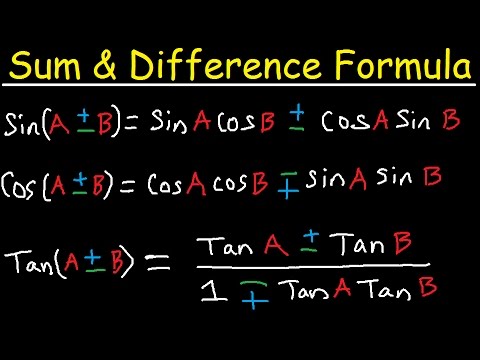
(Video) Sum and Difference Identities

The Organic Chemistry Tutor

In this video by The Organic Chemistry Tutor, you will learn about sum and difference identities in trigonometry.

Type a concept, like “slope” or “photosynthesis”.

↑ ↓ to choose · Enter to openSearch explanations and problems