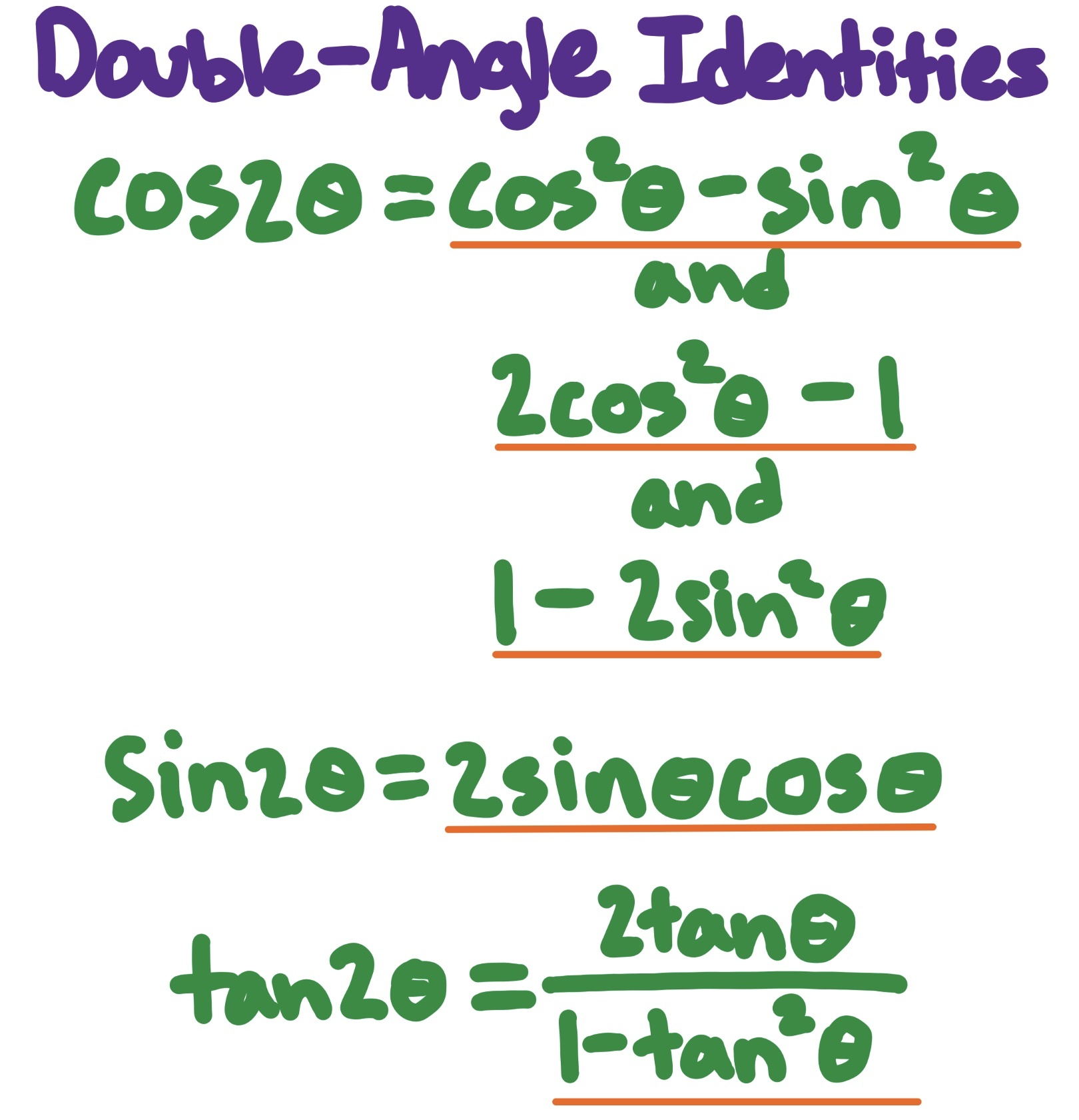
The double angle formulas for the trig functions can often come in handy. I will present two proofs of them: a geometric one, and a purely algebraic one.
First I will present a geometric proof.
Consider the following diagram:
Let ∠HAC=θ,AC=1,BC=b. Note then that ∠HCA=90∘−θ and HC=2b. So, sinθ=2b⟹b=2sinθ. Looking at the entire triangle, the Law of Sines tells us that bsin∠BAC=1sin∠HCA ⟹bsin2θ=sin(90∘−θ)=cosθ. Plugging in b=2sinθ gives 2sinθsin2θ=cosθ⟹sin2θ=2sinθcosθ.
Using the same diagram, we will prove formula for cos2θ. Now, however, we will let ∠ACH=α.
This time, try to come up with an idea of the proof on your own.
We find that cosα=2b.
What's next?
Now, we use the Law of Cosines:
b2=2−2cos(180−2α)
We know that cos(180−x)=−cosx, so we getb2=2+2cos2α
Substituting in b=2cosα gives 4cos2α=2+2cos2α cos2α=2cos2α−1=cos2α−sin2α=1−2sin2α
It's harder to find tan2α geometrically, but we can get it by dividing sin2α by cos2α anyways.
Now, the algebraic proof:
We know that sin(x+y)=sinxcosy+sinycosx. We want sin2θ. Do you see how we can find the double angle formulas now?
If you figured it out, just continue. If you haven't gotten it yet, think harder--it's really simple!
Here's a hint: 2θ=θ+θ.
All we have to do is use the angle addition formula, where x=y=θ. So, we have sin(2θ)=sin(θ+θ)=sinθcosθ+sinθcosθ=2sinθcosθ.
Similarly, we know that cos(x+y)=cosxcosy−sinxsiny. Substituting in x=y=θ, we get cos(2θ)=cos(θ+θ)=cos2θ−sin2θ=2cos2θ−1=1−2sin2θ.
Finally, tan(x+y)=1−tanxtanytanx+tany, so we get tan(2θ)=1−tan2θ2tanθ.
So we're done. Whichever proof you prefer, the double angle identities are great to have in mind in a lot of trig problems. Therefore, it's good to memorize them, especially since it isn't particularly hard to.