Dua atau lebih variabel yang menggunakan matriks

Before this, knowMenyelesaikan sistem dengan menggunakan operasi barisMenyelesaikan sistem dengan menggunakan invers matriks

Read · 1 min

Let's say we have the system of equations:

{x+y+z=62y+5z=−42x+5y−z=27\begin{cases} x + y + z &= 6 \\ 2y + 5z &= -4 \\ 2x + 5y - z &= 27 \\ \end{cases}

You can certainly solve this through elimination, but let's try a different way! Let's rewrite these equations using matrices.

We can split the coefficients on the left side of the equation into their own nice 3x3 matrix like so:

[11102525−1]\begin{bmatrix} 1&1&1 \\ 0&2&5 \\ 2&5&-1 \\ \end{bmatrix}

This may not make much sense yet, and that’s okay.

If you think about it, there must be a matrix operation that uses the coefficients and the values xx, yy, and zz to find the solution. The math is there. We just need the right tool.

The big question is this: which matrix operation gives us the correct values for xx, yy, and zz?

That’s what we’re about to figure out.

For now, let's write the entire equation in matrix form:

[11102525−1]⋅[6−427]\begin{bmatrix} 1&1&1 \\ 0&2&5 \\ 2&5&-1 \\ \end{bmatrix} \cdot \begin{bmatrix} 6\\-4\\27\\ \end{bmatrix}

If you know how matrix multiplication works, then you'll see why this works out the way it does!

We can write this equation as AX=BAX = B, where AA is the 3x3 matrix, XX is the variable matrix, and BB is the solution matrix.

We are trying to solve for XX. If this was a normal equation with normal variables, we would divide both sides by AA to solve for XX. Unfortunately, we can't really divide with matrices! Instead, we have to use something called the inverse of a matrix. An inverse matrix A−1A^{-1} satisfies the identity:

AA−1=A−1A=IAA^{-1} = A^{-1}A = I

where I is the identity matrix.

So going back to solving for our X matrix:

X=A−1BX = A^{-1}B

(Look up how to find the inverse of a matrix! Or just use a calculator...)

This expands to: X=−121[−276310−3−5−4−32]×[6−427]X = \frac{-1}{21} \begin{bmatrix} -27&6&3\\10&-3&-5\\-4&-3&2 \\ \end{bmatrix} \times \begin{bmatrix} 6\\-4\\27 \\ \end{bmatrix}

which by matrix multiplication yields:

X=−121[−105−6342]=[53−2]X = \frac{-1}{21} \begin{bmatrix} -105\\-63\\42 \end{bmatrix} = \begin{bmatrix} 5\\3\\-2 \\ \end{bmatrix}

And we're done! We can see that x=5x = 5, y=3y = 3, and z=−2z = -2 is the solution!

Video

(Video) How to Write an Augmented Matrix

by IntFinder

Here's a video by IntFinder on how you write a system of equations as an augmented matrix. An augmented matrix is just a matrix with a dashed line inside it.

Summary

Given the following system of equations: 4x−5y+z=0−2x−y+6=−19x+5y−5z=10\begin{align} 4x-5y+z &= 0 \\ -2x-y+6 &= -19 \\ x+5y-5z &=10 \\ \end{align}

Now that we have our augmented matrix, we need to make sure the system is in standard form.

In standard form, the variables go on the left side of the equation. The constant goes on the right side.

Right now, one equation is not set up that way. So we will rewrite the system a little bit to fix the second equation.

4x−5y+z=0−2x−y=−25x+5y−5z=10\begin{align} 4x-5y+z &= 0 \\ -2x-y &= -25 \\ x+5y-5z &=10 \\ \end{align}

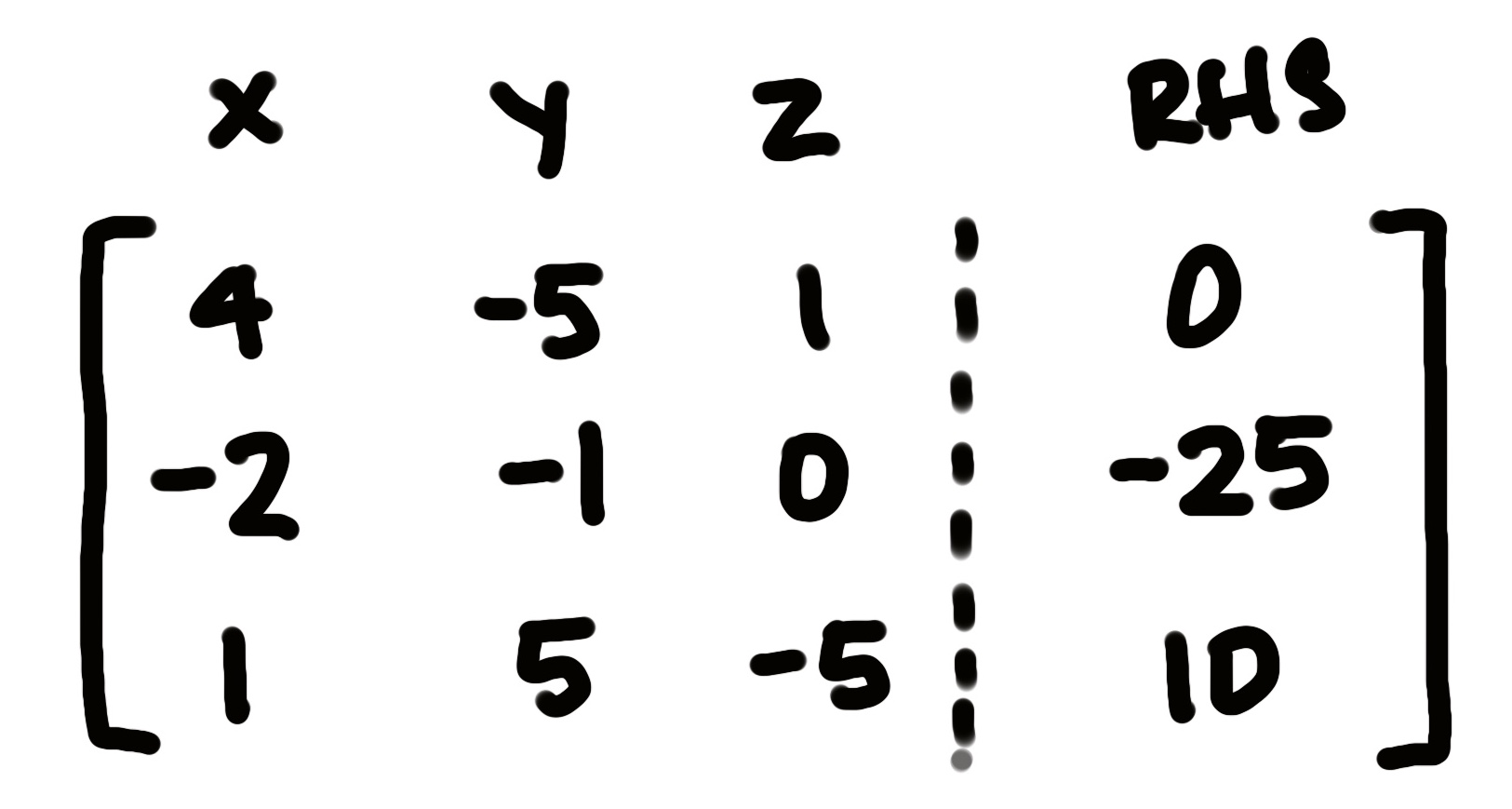
Now, we can write our augmented matrix. The augmented matrix contains two parts: one part has the coefficient of the variables, while the second part has the constants.

The augmented matrix:
x y z RHS
4 -5 1 0
-2 -1 0 -25
1 5 -5 10

Image source: by Anusha Rahman

This is our final augmented matrix.

Type a concept, like “slope” or “photosynthesis”.

↑ ↓ to choose · Enter to openSearch explanations and problems