Axis of Symmetry
One important thing to notice about parabolas is that they are symmetrical.
When a shape is symmetrical, one side is a mirror image of the other side.
If you draw a straight line down the middle of a parabola, the left and right sides will match. They reflect each other across that line.
This middle line is called the axis of symmetry.
In the above graph of y=x2, we can see that the axis of symmetry is at x=0, as that is where the parabola is mirrored. This is how we can graphically determine what the axis of symmetry is.
However, we can also algebraically figure out the axis of symmetry by using the following formula:
x=2a−b
This formula only works if the quadratic equation is in standard form.
Say we have the quadratic equation, y=2x2+2x−3. If we want to find the axis of symmetry, we can plug in a=2 and b=2.
xxxx=2a−b=2⋅2−2=4−2=2−1
So, for the quadratic equation, y=2x2+2x−3, the axis of symmetry is x=2−1.
Vertex
The vertex is the point where the axis of symmetry meets the parabola.
It is the point where the quadratic function changes direction. The graph stops going down and starts going up, or stops going up and starts going down.
If the parabola opens upward (like a “U”), the vertex is the minimum point. This means it is the lowest point on the graph.
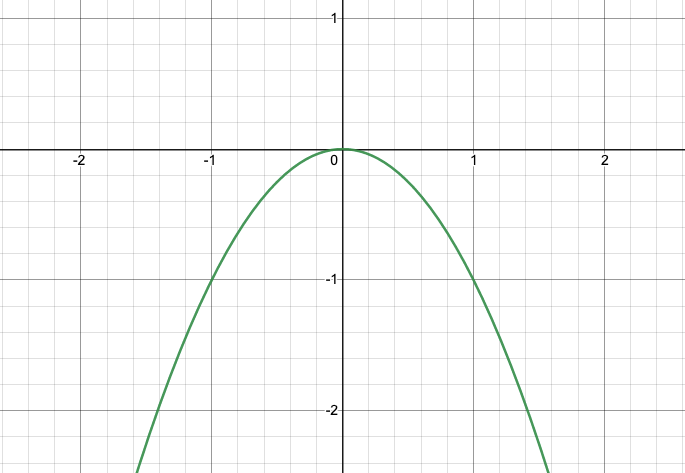
If the parabola opens downward, the vertex would be the maximum point.
In this graph, the vertex is at the minimum, (0,0).
In this next graph, the quadratic equation is upside-down, so the vertex is at the maximum.
We know the formula to find the axis of symmetry, and that gives us an x-coordinate. To find the y-coordinate, we can plug in the solved x-value into the original quadratic equation.
If we go back to our original example from the beginning of this lesson, we found that for the quadratic equation, y=2x2+2x−3, the axis of symmetry is at x=−21.
yyyyy=2x2+2x−3=2(−21)2+2(−21)−3=2(41)−1−3=21−1−3=−27
So, our vertex is at the point (−21,−27).