Soal Cerita

Before this, knowFokus dan direktris

Video

(Video) Parabola Word Problems

by Ms. Feeley

Here's a video by Ms. Feeley going over some word problems involving parabolas.

Summary

The equation x2=32yx^2=32y models cross section of parabolic mirrors that are used for solar energy. There is a heating tube located at the focus of each parabola. How high is this tube located above the vertex of the parabola?

Try the problem on your own, then play the video to check your work!

Read · 2 min

Word Problem: Example

You are a contractor for the city, and you have been asked to find the quadratic equation of an arch in one of the city parks. You only know the width of the base and the height. The base width is 40m40m, and the height is 30m30m.

Find the equation of this arch.

There are two main steps to tackle this type of problem. First, you are going to set the coordinates of the arch. Second, you will plug in the known values into an equation to solve for the missing values.

Let's first establish what we know. We know that since this is an arch, it will follow a parabolic shape. That means that we will use a form of the quadratic equation. Since the arch is parabolic, we also know that it has a vertex and is symmetrical.

Step 1: Set Coordinates

To make this problem easy to handle, we will set the vertex of the parabola. Since the vertex is at the parabola, we know that the yy-intercept is dissecting the parabola (cutting it in half).

Therefore, the vertex is at the coordinates (0,30)(0,30).

The base of the entire arch is 40m40m, and we know that the yy-axis splits the parabola in half. Therefore, the distance between each leg of the arch and its axis of symmetry is 20m20m.

We can conclude that the xx-intercepts are: (20,0)(20,0) and (−20,0)(-20,0).

That's a lot more information that we had before!

Step 2: Find the Quadratic Equation

Now that we have all of this information, we can plug in what we know into the quadratic equation. We will use intercept form. We know the xx-intercepts, so let's see what our equation looks like.

y=a(x−20)(x+20)y=a(x-20)(x+20)

Because the parabola is upside down (it's an arch!), we know that aa will also be negative. We can plug in the vertex as our point in order to solve for aa.

30=a(0−20)(0+20)30=a(−20)(20)30=a(−400)−340=a\begin{align} 30 &= a(0-20)(0+20) \\ 30 &= a(-20)(20) \\ 30 &= a(-400) \\ \frac{-3}{40} &= a\\ \end{align}

We have confirmed that aa is negative! Let's look at what our simplified quadratic equation for the city's arch is:

y=−340(x2−400)y = \frac{-3}{40}(x^2 -400)

Illustrated · 1 min

Parabola Word Problems

A parabola is a U-shaped curve that often appears in real-life word problems, like the path of a thrown ball or the shape of a satellite dish. Many word problems involving parabolas use the quadratic equation in the form y=ax2+bx+cy=ax^2+bx+c. In these problems, xx usually represents time or horizontal distance, and yy represents height or position.

Parabola Word Problems
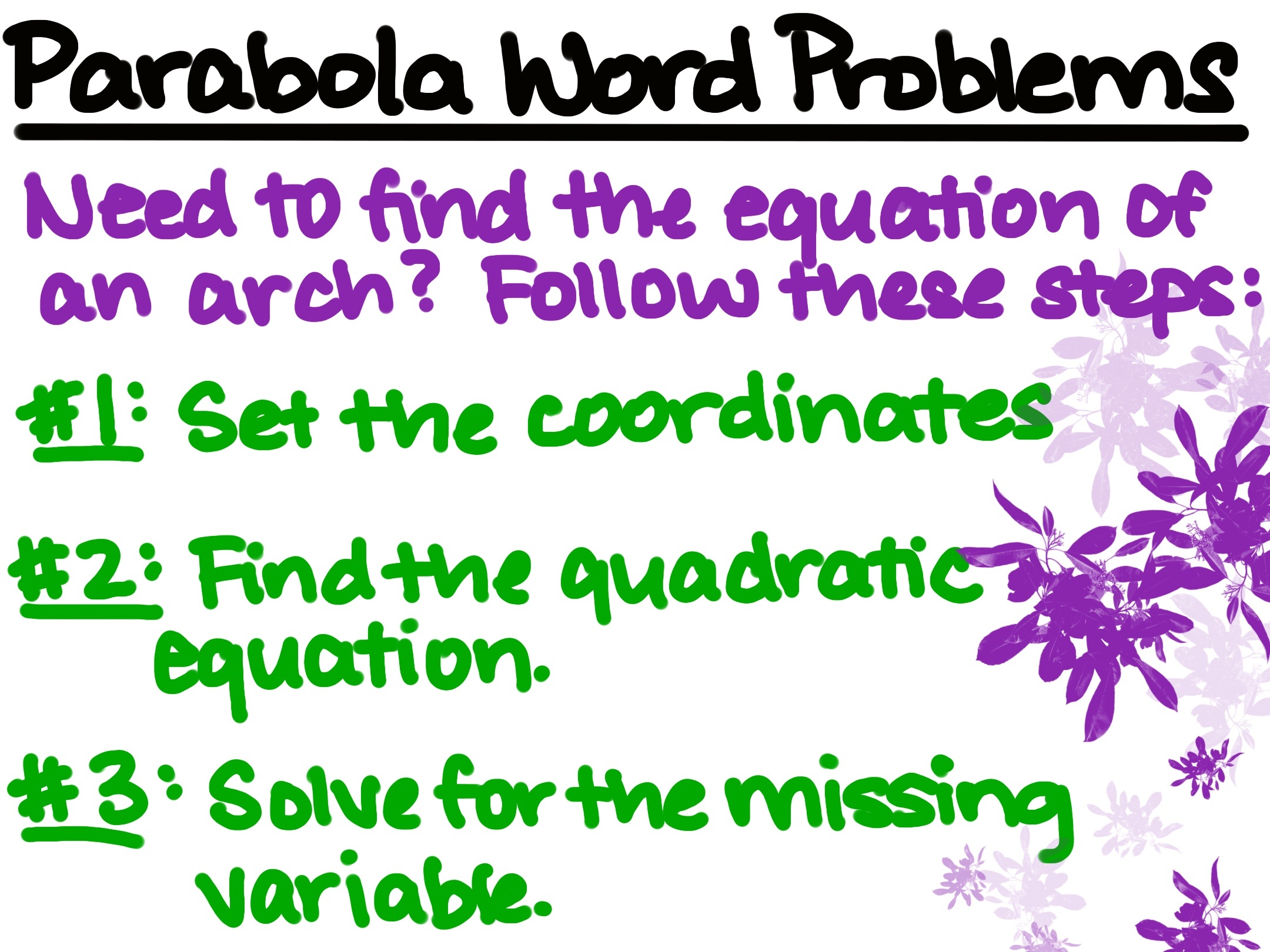
Need to find the equation of an arch? Follow these steps:
#1: Set the coordinates
#2: Find the quadratic equation
#3: Solve for the missing variable

Image source: by Anusha Rahman

The first step to solve these problems is to understand the question and set the coordinates. If you need to find the highest or lowest point, you will be solving for the vertex. If you know that the parabola will pass through certain points, you can set up equations to find aa, bb, and cc. The problem may describe distances from the focus or directrix, which you can use the distance formula to build the equation.

Once you have your equation, you can solve for the missing variable, which will answer the question you're asked to solve. Watch our for your units - keep them the same throughout the problem.

When solving real-world problems, it's always a good idea to gut check the answer you got. For example, if you solved for someone's height, and you got eight feet, you likely made an error somewhere.

Type a concept, like “slope” or “photosynthesis”.

↑ ↓ to choose · Enter to openSearch explanations and problems