Verteka, sumbu melintang dan sumbu simetri

Illustrated · 1 min

Parts of a Hyperbola

###Vertices

The vertices of a hyperbola are two distinct points on the hyperbola's axis, specifically the endpoints of the transverse axis.

If a hyperbola has a horizontal transverse axis, then the vertices lie horizontally. Likewise, if a hyperbola has a vertical transverse axis, then the vertices like vertically.

###Transverse Axis

The transverse axis is the segment that passes through the center and has the vertices as its endpoints, as the hyperbola's longest axis.

If the hyperbola is horizontal, then the transverse axis lies along the xx-axis. The equation of the transverse axis is: (x−h)2a2−(y−k)2b2=1\frac{(x-h)^2}{a^2} - \frac{(y-k)^2}{b^2} = 1

If the hyperbola is vertical, then the transverse axis lies along the yy-axis. The equation of the transverse axis is: (y−k)2a2−(x−h)2b2=1\frac{(y-k)^2}{a^2} - \frac{(x-h)^2}{b^2} = 1

(h,k)(h,k) is the center of the hyperbola. aa is the distance from the center to the vertices along the transverse axis, the semi-major axis. bb is the distance from the center to a point on the hyperbola along the conjugate axis, the semi-minor axis.

###Conjugate Axis

You might've guessed it already, but the conjugate axis is perpendicular to the transverse axis. It passes through the center of the hyperbola and is the shortest axis of the hyperbola.

Therefore, if the transverse axis is horizontal, then the conjugate axis is vertical. Likewise, if the transverse axis is vertical, then the conjugate axis is horizontal.

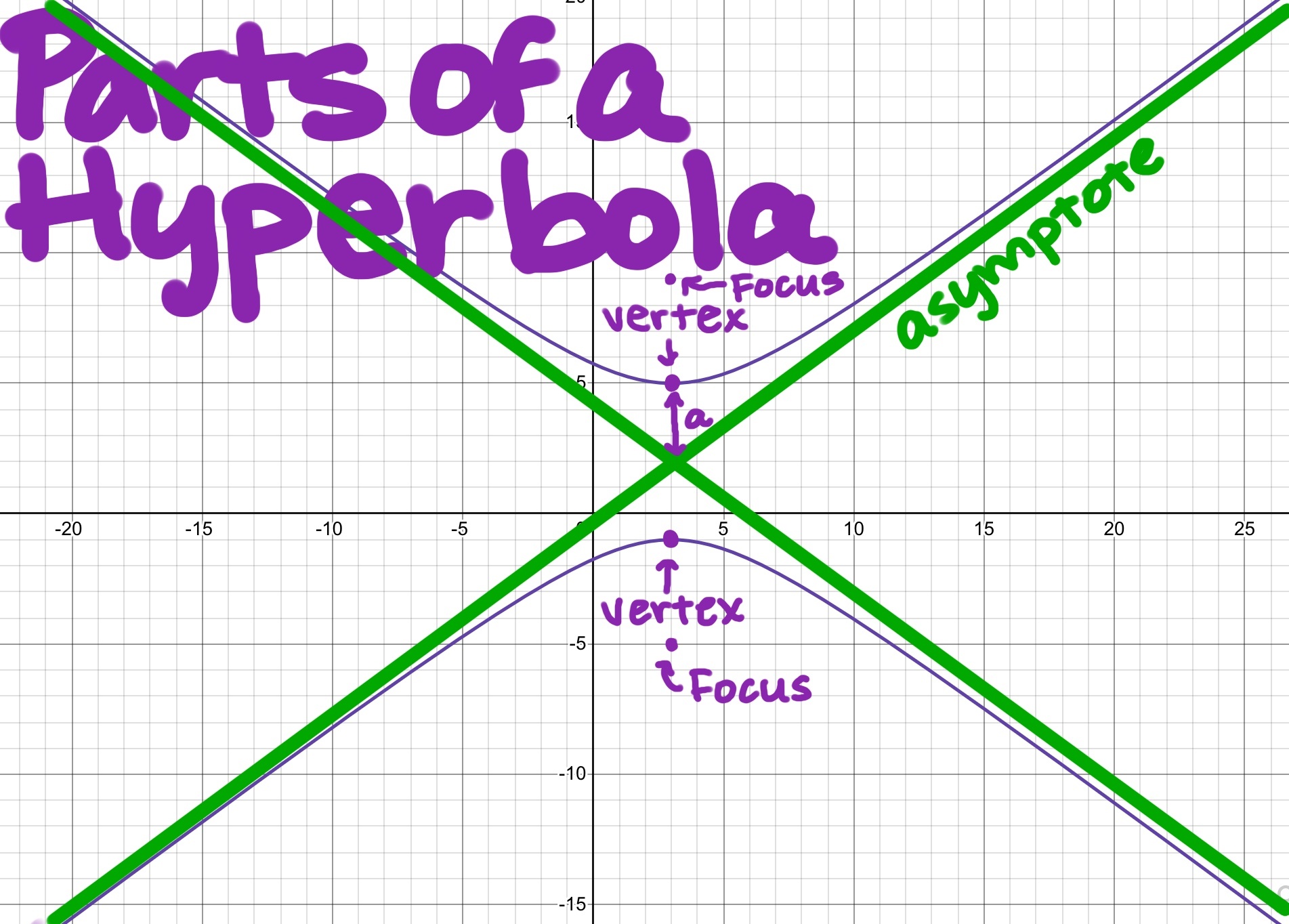
Parts of a hyperbola, including the center focus, major axis, minor axis, and asymptotes

Image source: by Anusha Rahman

The main points to remember:

  • The transverse axis is the longest axis, containing the vertices.
  • The conjugate axis is the shortest axis, and is perpendicular to the transverse axis.

Video

(Video) Parts of a Hyperbola

by Anusha Rahman

In this video by Anusha Rahman, you will learn about the vertices, transverse axis, and conjugate axis of a hyperbola.

Summary

Vertices are the endpoints of the transverse axis of a hyperbola. The transverse axis is the major axis of a hyperbola, and it gives us the width of the hyperbola. Perpendicular to the transverse axis is the conjugate axis, which gives us the height of the hyperbola.

Illustrated · 2 min

Parts of a Hyperbola

A hyperbola is a type of conic section that can be visualized as the intersection of a double cone with a plane that cuts through both cones.

Parts of a Hyperbola
Vertex, focus, asymptote

Image source: by Anusha Rahman

The Individual Components

The center of the hyperbola is the midpoint of the line segment that joins the vertices. It is also the midpoint of the line segment that connects the foci of the hyperbola. This central point is crucial as it serves as the origin of the hyperbola's coordinate system in its standard form.

The vertices of a hyperbola are the fixed points where the hyperbola intersects its transverse axis. The coordinates of the vertices are determined based on the hyperbola’s equation and its center. For a hyperbola centered at the origin with a transverse axis along the x-axis, the vertices will be at (±a,0)(\pm a,0), where a is the distance from the center to each vertex.

The transverse axis of a hyperbola is the line segment that passes through the center of the hyperbola and connects the vertices. This axis is crucial because it determines the orientation and length of the hyperbola along its main direction. It is perpendicular to the conjugate axis.

The conjugate axis is the line segment that is perpendicular to the transverse axis and also passes through the center of the hyperbola. It has a length that is related to the distance from the center to the hyperbola's asymptotes but does not intersect the hyperbola itself.

Let's Put It Together

The hyperbola is the set of all points where the difference of the distances to the two foci is a positive constant. This constant is equal to 2a2a, where aa is the distance between the center and a vertex.

The transverse axis and conjugate axis are essential for understanding the geometry of a hyperbola. The vertices and foci help in determining the exact position and shape of the hyperbola on a coordinate plane.

Type a concept, like “slope” or “photosynthesis”.

↑ ↓ to choose · Enter to openSearch explanations and problems