Statistics
Statistics is a science that studies and develops methods for collecting, analyzing, interpreting and presenting data. So, let’s say for example, that we want to know the average height of everyone in a class. We would have to gather data of every student’s height, then we can find the average through some mathematical processes!
There are two fundamental ideas in statistics: uncertainty and variation. There are many situations in life, science, or math where the outcome is not certain. This may be because the outcome in the question is not determined yet (i.e. whether it it will be sunny tomorrow) or other cases are uncertain because although the outcome is already determined, we are not aware of the results (i.e. not knowing whether you passed an exam or not). This is a cousin of statistics called probability. Now, statistics and probability go hand in hand. With these uncertain events, we can use probability to discuss what the results could probably be, or what the results are most likely.
Variation in data is how spread out, or clustered, the data is. So if you study the ages of a group of people, the youngest may be 12 and the oldest may be 87. There will be a variation in the data since not every person in the group is the same age.
Population vs. Sample
A population is a complete set of observations that can be made. For example, if you are studying the lengths (in pages) of books, the population would be the set of lengths of all books in the world. Now, that is a lot of books and there’s a very slim chance you would be able to collect all this data. In fact, populations are generally difficult to study since they usually include extremely large numbers of subjects that may be unavailable to you (i.e. books in museums, books that someone wrote on their own and did not publish).
A sample is a set of observations drawn from a population. Samples are used when it isn’t exactly possible to study entire populations due to sheer size or lack of availability of subjects. If you wanted to study the hair color of 25-year-old women, it would be impossible to survey EVERY 25-year-old woman. However, you could survey a sample of 50 25-year-old women to get data for your study.
Parameter vs. Statistic
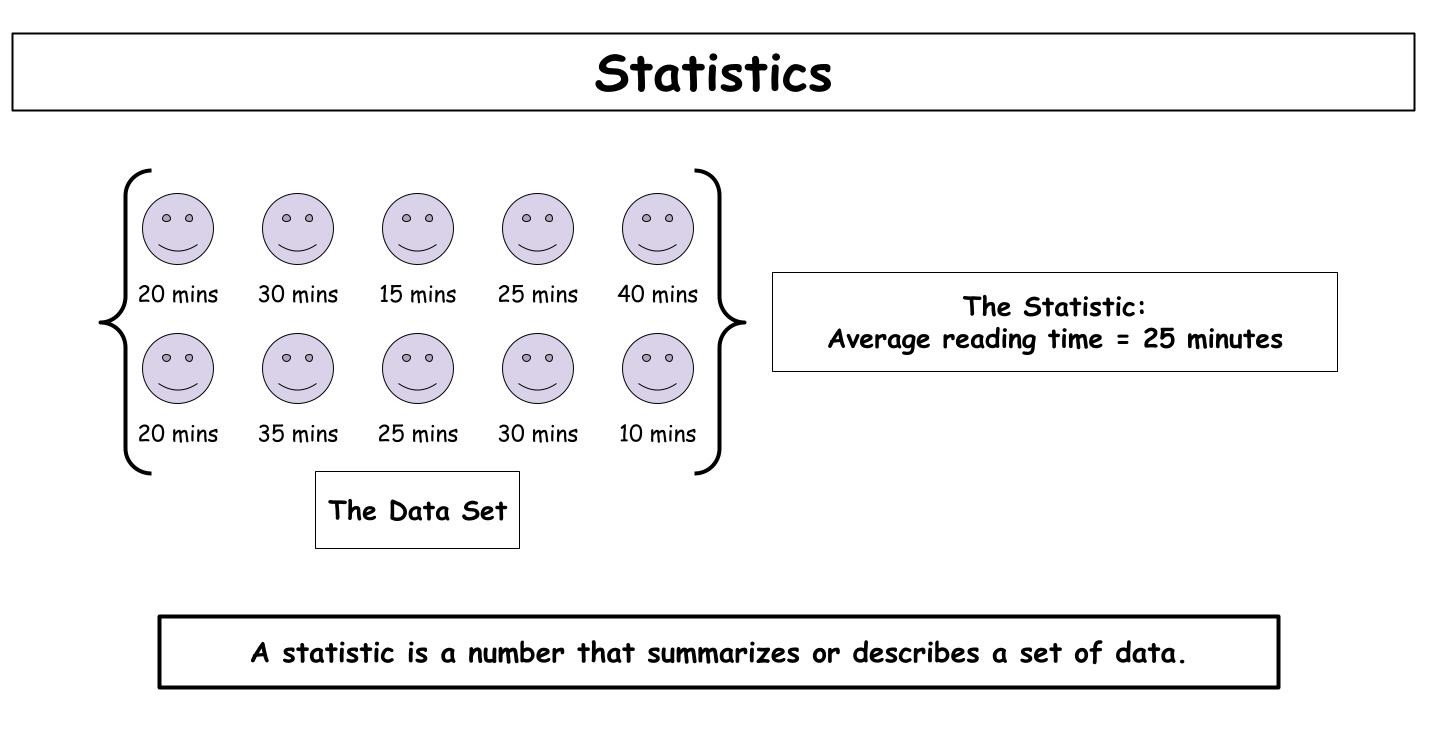
Now, we discussed above what a statistic is. A statistic is a known number that describes a sample. Statistics can change from sample to sample, since not every sample is the same.
A parameter is a fixed number that describes a population. These do not vary from parameter to parameter, since the population includes ALL samples and it will not change. We most likely do not know these numbers because we cannot examine the entire population. Now, since we primarily work with samples, we can say that a statistic is an estimate of a parameter