Interactive · 4 questions
+6 contributors




Adding and Subtracting Monomials of the Same Degree
Recall that the degree of a term is equal to the value of the exponent on its variable. As a refresher:

Image source: by Hannah Bonville
What is the degree of the term ?
If a term has multiple variables, the degree is the sum of the exponents.
For example, has a degree of because we add the on the and the on the .
What is the degree of the term ?
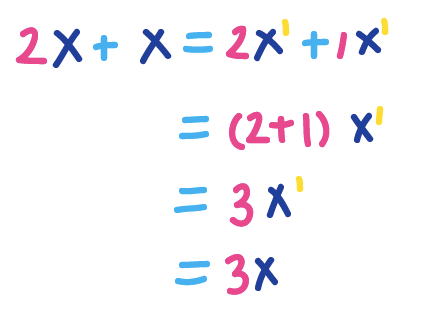
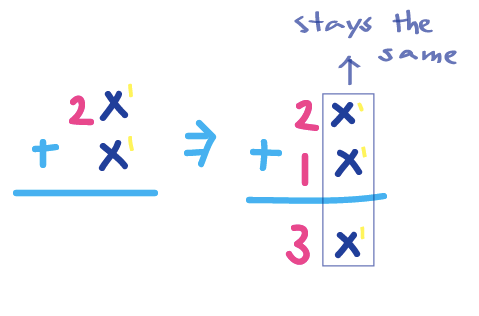
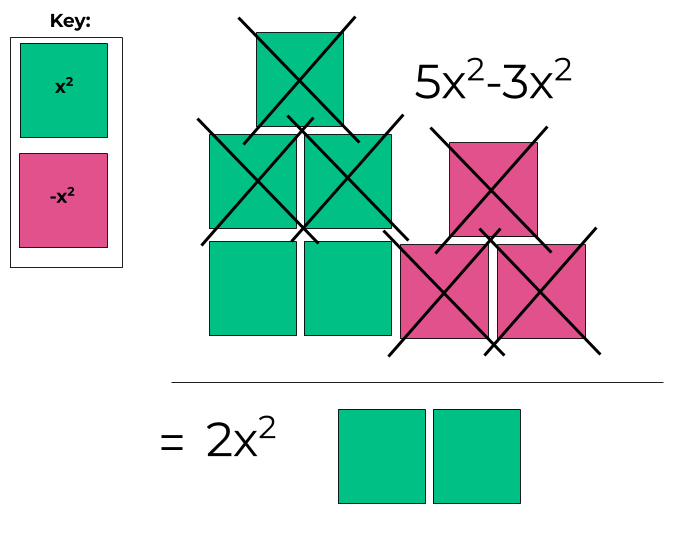
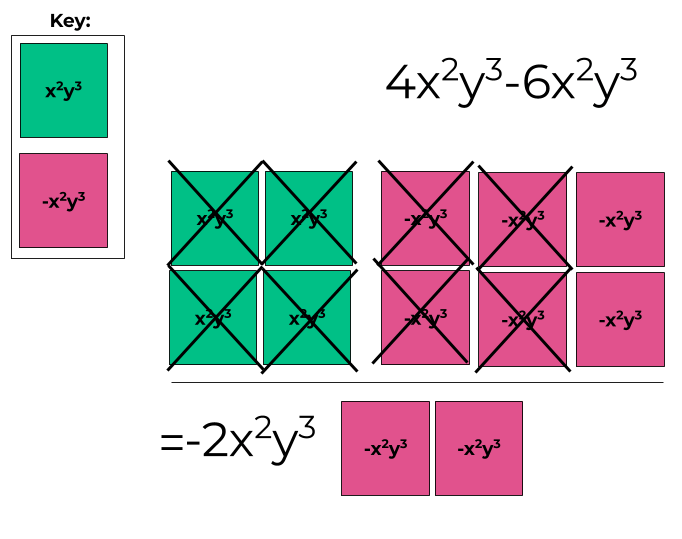
If two monomials (single terms) are of the same degree, we can simply add and subtract their coefficients, like this:
And this:
This is similar to combining like terms with algebraic equations.
What is the result of subtracting these two monomials?
What is the sum of these two monomials?
What if the Monomials Aren't of the Same Degree?
If that's the case, then all you can do is simplify the expression as much as possible and then leave it alone. You can't force terms that don't have the same exponents together. Don't do it :)

Image source: by Hannah Bonville
You might see an example like this one, below. In that case, just simplify the expression as much as you can.
Here, we've got a cubic function. We can also have quadratic functions like this!