Interactive · 3 questions
+6 contributors




DEFINITIONS
A polynomial is a mathematical expression of one or more algebraic terms (monomials).
The word "polynomial" comes from the root words poly- (many) and -nomial (terms).
A polynomial can have constants (numbers), variables (letters), and exponents (powers), but never negative exponents or division by a variable.
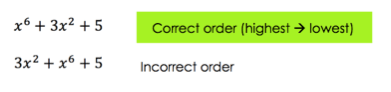
Polynomials like to be written in standard form. This means they contain no like terms and the exponents are in descending order (largest to smallest).
Which one of these polynomials is in standard form?
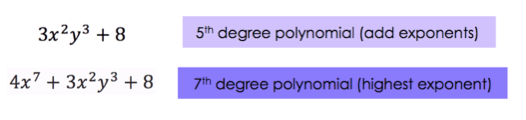
The degree of a polynomial with only one variable is the largest exponent of that variable.
Find the degree of the following polynomial:
Sometimes we have to put a polynomial in standard form before finding the degree, in particular if the distributive property has to come into play.
Example: Find the degree of
Solution: We need to get rid of any parentheses because standard form doesn't use parentheses. Let's distribute the
Now combine like terms and arrange the terms to be in standard form:
The terms are now in decreasing order by degree, so the degree is since the first term is an term.
CLASSIFYING POLYNOMIALS
Polynomials can be classified in two ways: by degree (highest exponent) and by their number of terms (terms are separated by addition or subtraction signs).
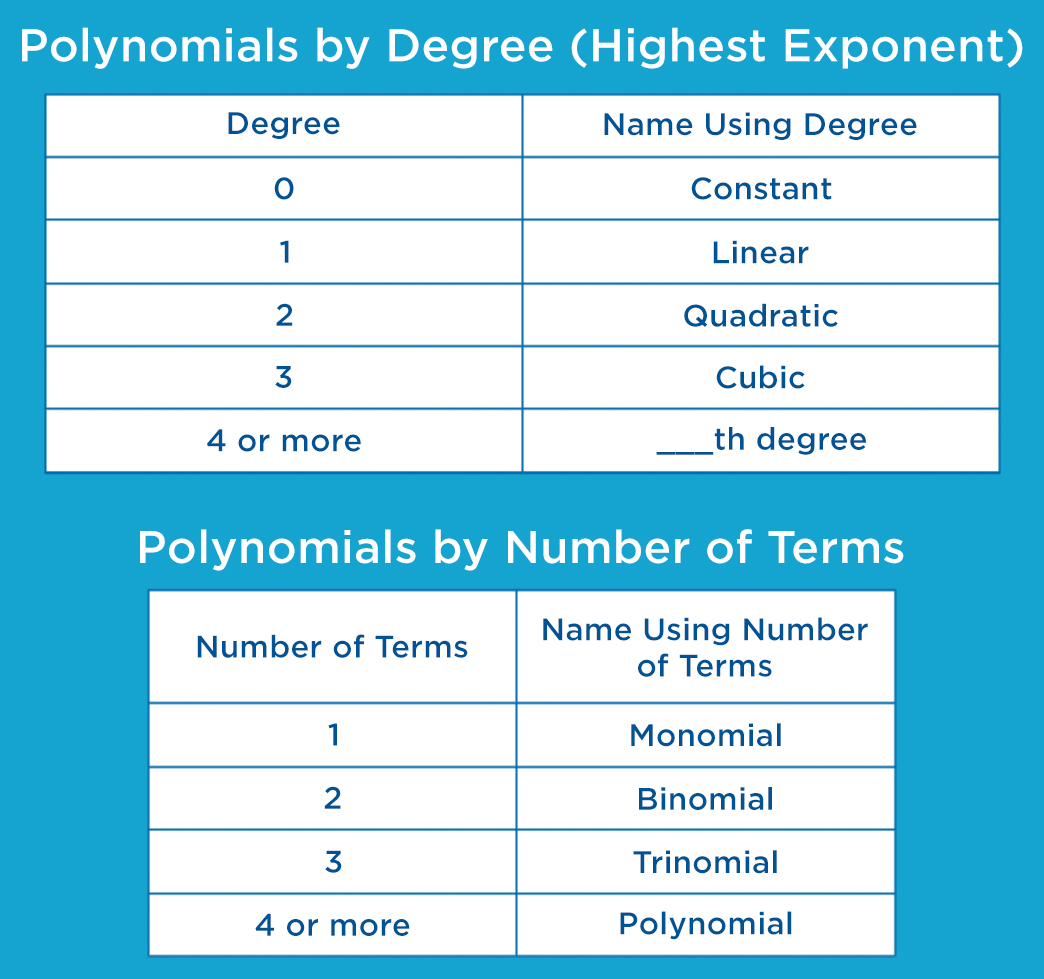
Note: Binomials and Trinomials are also polynomials, but we just have special names for them.
When classifying by number of terms, it can be helpful to think of different kinds of cycles: for instance, a monocycle has one wheel, a bicycle has two wheels, a tricycle has three wheels, et cetera.
Let's Practice: Classify the following polynomials by degree and number of terms:
When you've got multiple polynomials together in standard form, you can create a polynomial equation or polynomial function, where the higher degrees are at the start of the equation. You'll see this with quadratic equations, where the number of terms is up to ! You can also find polynomials in rational expressions.