Previously, we calculated areas through thin slices. Volume can be calculated in the same way! If we take thin slices whose volume we can calculate, we can integrate to find the volume as a whole. Let's start with some simple cylinder-shaped slices. Solids whose volume can be found in this manner are "solids of revolution", they are formed by rotating a curve about an axis. For example, rotating the function y=r2−x2 about the x-axis produces a sphere of radius r.
Now let's try to find the volume of the solid of revolution for the line y=ax, rotated about the x-axis, for the interval [0,h]. Think about what kind of solid this would create.
The solid in question is a cone, where the height is h, and the base radius is ah, or r. Now let's try to find the volume by slicing.
Say we take a small slice of the cone perpendicular to the x-axis, with width dx. What is the volume of this slice?
The width dx is so negligible that we can consider the cylindrical slice's radius to be essentially constant. Now let's collect these slices into an integral to sum them, making the total volume of the cone. Substituting y=hrx, we get
V=∫0hπh2r2x2dx=31πr2h.
The volumes of many solids can be found in this way!
If we want to find the volume of the function pictured above, y=−(x−4)2+1 from x=3 to x=5 when rotated around x=6, we run into some problems using methods like the slices method or the washer method. The first is that both of the radii (inner and outer) are defined by the same function, making it impossible to subtract the value of one from the other.
Here you can see that the radii are defined by the same function.
This means that in order to do a problem like this, we would need to change the function into another form, which will add to the work load and make things overall more difficult than they need to be. The solution to these issues is cylindrical shells. Cylindrical shells allow us to take a different kind of cross section.
Here you see a different kind of cross section than the washer or disk method.
Cylindrical shells solves the radii problem despite the fact that there are multiple radii in the shells (after all, the cylinder itself must have some width).
This is true because
πr22h−πr12h=πh(r22−r12)=πh(r2−r1)(r2+r1)=2hπ((r2+r1)/2)(r22−r12), so
2πh[ave. (r1,r2)]∆x and
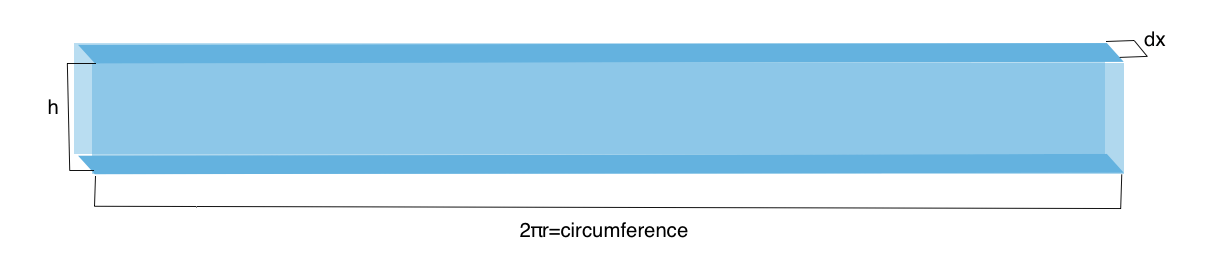
because r is somewhere between r1 and r2, the intermediate value theorem allows us to see that 2πrh∆x is the area of the cylinder, meaning that if this is integrated it can allow us to find the volume. The variable h is the height of the segment parallel to the axis of rotation and the variable r is the distance to the axis of rotation. A graphic depiction of the cylinder unrolled might help:
Because of this, cylindrical shells allow us to solve some problems we cannot solve with disks or with washers. Now, we will solve the initial problem, which is find the volume of the function pictured above, f(x)=-(x−4)2+1 from x=3 to x=5 when rotated around x=6.
∆x=dx
f(x)=h because the f(x) value is the height
r=6-x because the radius will be the distance from the axis of rotation
The equation will be ∫ab 2πrh∆x=V so V=-2π∫35((x−4)2+1)(6-x)dx
In this video by patrickJMT he shows you how you can use cylindrical shells in order to find the volume of a shape. This also requires integration. This method is an alternative way to find the volume if you don't want to use the disk and washer method.
Idea
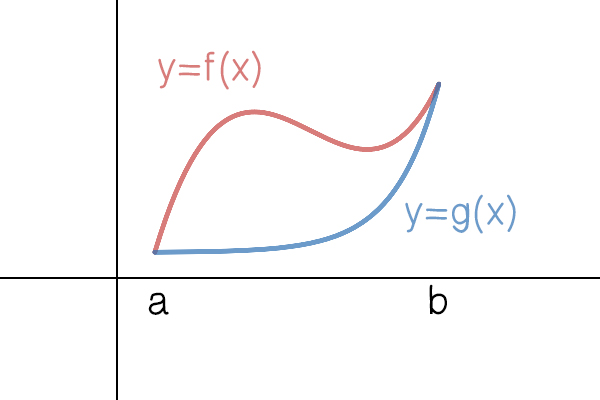
Suppose you had two functions y=f(x) and y=g(x) that span the x-axis from a to b.
Suppose we want to rotate it around the y-axis. What we do is take a small rectangle (called a shell) inside the region at some arbitrary point x and rotate it around the y-axis.
This shell, rotated around the y-axis, will have a radius of x and a height of f(x)−g(x). We do this for the infinite number of shells inside the region between a and b.
This formula becomes:
2π∫ab(x)[f(x)−g(x)]dx
Or we can denote this as:
2π∫ab(shell radius)(shell height)dx
Examples
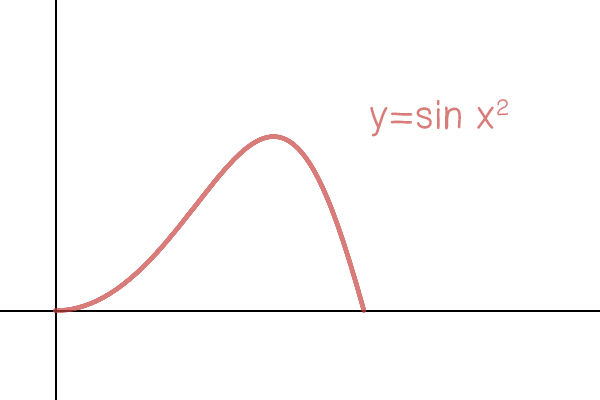
The first example he looks at is rotating the curve y=sin(x2) from 0 to π around the y-axis.
We begin by drawing our shell. It will have a radius of x and a height of sin(x2)−0.
So we can set up our integral as:
2π∫0π(x)[sin(x2)−0]dx
Simplifying this, we get:
2π∫0πxsin(x2)dx
Now we can integrate to find the volume of this shape. We will need to use u-substitution in order to solve this.
First, we let u equal something in the integral then find u's derivative.
udu=x2=2xdx⇒21du=xdx
Now we can substitute these into our integral.
2π∫0πxsin(x2)dx2π∫0πxsin(u)dx2π∫0π21sinuduπ∫0πsinudu
Now we integrate, plug x back in, and find the solution.
π∫0πsinuduπ[−cosu]0ππ[−cos(x2)]0π−π[cos(x2)]0π−π[cosπ−cos0]−π[−1−1]2π
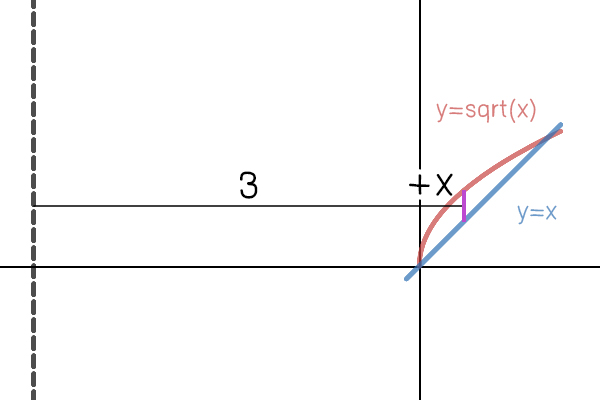
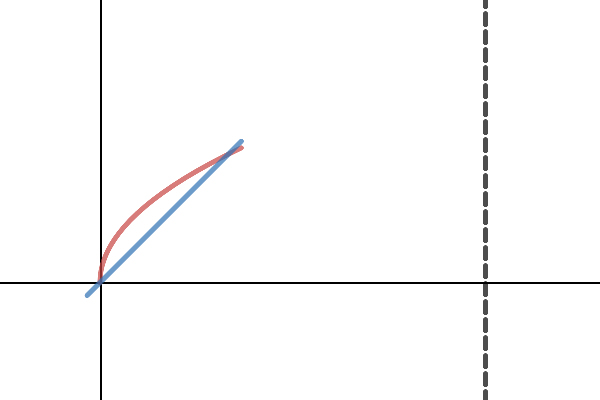
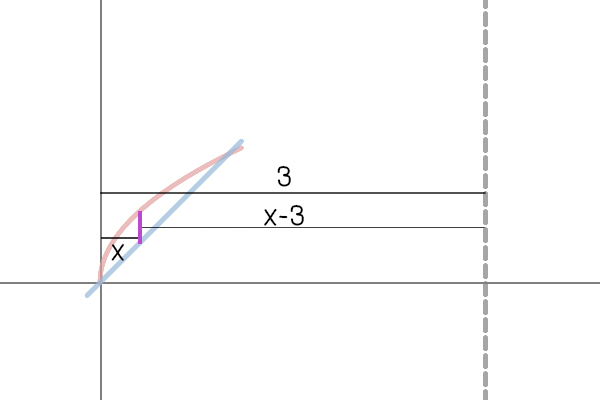
The next example is one looked at in the disk and washer explanation. It is the lines y=x and y=x rotated around the line x=−3.
You might recall when using the disk and washer method we had to rewrite the equations in terms of y before integrating. One perk of the shell method is we can leave the equations in terms of x when rotating around the y-axis.
We can find the limits of integration by setting the two equations equal to each other. Doing this gives us 0 and 1.
So to solve this we need to find the shell radius and shell height.
So the radius of the shell is 3+x. The height of the shell is x−x. Using this information we can set up the integral as:
2π∫01(3+x)[x−x]dx
We can FOIL and simplify this.
2π∫01(3+x)[x−x]dx2π∫01[3x−3x+xx−x2]dx2π∫01[3x−3x+x23−x2]dx2π[∫013xdx−∫013xdx+∫01x23dx−∫01x2dx]2π[3∫01xdx−3∫01xdx+∫01x23dx−∫01x2dx]
Now we can integrate.
2π[3∫01xdx−3∫01xdx+∫01x23dx−∫01x2dx]2π[3[32x23]01−3[21x2]01+[52x25]01−[31x3]01]2π[2[x23]01−23[x2]01+52[x25]01−31[x3]01]2π[2[x23]01−23[x2]01+52[x25]01−31[x3]01]2π[2−23+52−31]2π[3017]1517π
If we look at the disk and washer method, we see we got the same answer!
Now suppose we wanted to ingrate around the line x=3.
Our shell's radius now becomes x−3.
Setting up this integral we get:
2π∫01(x−3)[x−x]dx
We can again FOIL and simplify.
2π∫01(x−3)[x−x]dx2π∫01[xx−x2−3x+3x]dx2π∫01[x23−x2−3x+3x]dx2π[∫01x23dx−∫01x2dx−∫013xdx+∫013xdx]2π[∫01x23dx−∫01x2dx−3∫01xdx+3∫01xdx]
Finally we have solve.
2π[∫01x23dx−∫01x2dx−3∫01xdx+3∫01xdx]2π[[52x25]01−[31x3]01−3[32x23]01+3[21x2]01]2π[52[x25]01−31[x3]01−2[x23]01+23[x2]01]2π[52−31−2+23]2π[−3013]−1513π
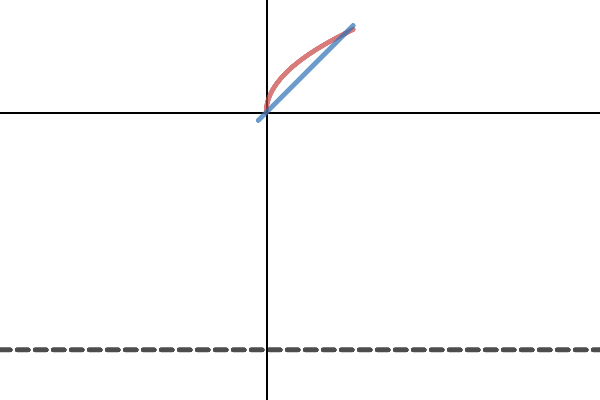
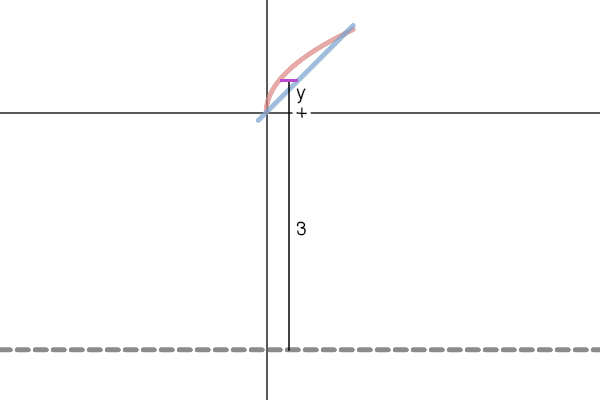
Now what happens if we want to rotate the region around an x-axis. Suppose we have the same region and we want to rotate it around y=−3.
The process is still the same. We need to make our shell parallel to the line of rotation. The shell radius will be the length from the shell to the line of rotation. So this will be y+3.
But, since we're changing the the axis of rotation, we need to rewrite the equations in terms of y. Luckily, y=x works both ways, but y=x becomes x=y2.
Setting the two equal to one another gives us the limits of integration. They're still from 0 to 1.
We can now take the shell height. This will be the right curve minus the left curve or y−y2.
Plugging all this into our formula we get:
2π∫01(y+3)[y−y2]dy
Again, we can FOIL and simplify.
2π∫01(y+3)[y−y2]dy2π∫01[y2−y3+3y−3y2]dy2π∫01[−y3−2y2+3y]dy2π[∫01−y3dy−∫012y2dy+∫013ydy]2π[−∫01y3dy−2∫01y2dy+3∫01ydy]
Finally, we can integrate and find the answer.
2π[−∫01y3dy−2∫01y2dy+3∫01ydy]2π[−[41y4]01−2[31y3]01+3[21y2]01]2π[−41[y4]01−32[y3]01+23[y2]01]2π[−41−32+23]2π[127]67π
To get a better understanding of this, please check out the video explanations by patrickJMT for disks/washers and shells.
It's important to note that you can use either method for any problem. You might just have to rearrange the equations in terms of x's or y's.
Below is a quick chart to show which method to use with regards to how the equations are written and what axis the line of rotation is parallel to. This will skip the step of rewriting the equations. This is not that important, since rewriting equations isn't an arduous task, but regardless here it is.
Equation Formy=f(x)y=f(x)x=f(y)x=f(y)Line of Rotation Parallel tox-axisy-axisx-axisy-axisMethodDisk/WasherShellShellDisk/Washer