Volume de um disco ou aro

Interactive · 4 questions

To find the area under a given curve, we've previously seen that one can consider a series of rectangles with constant width inscribed under a curve, and consider their total area as this common width becomes arbitrarily small. These sums were known as Riemann sums.

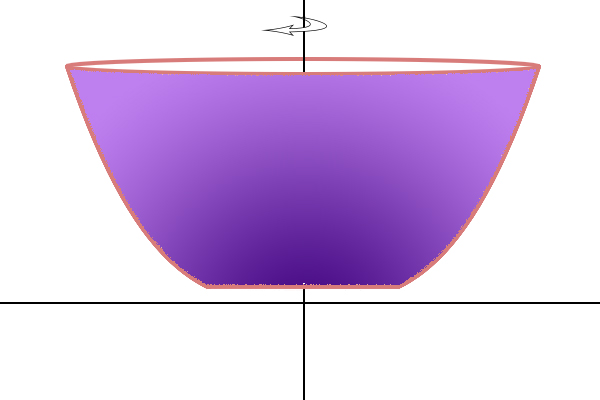
A similar trick works when we wish to find the volume of a region rotated around an axis of revolution. In particular, the Disk and Washer Methods are useful when the bounding lines are perpendicular to the axis of revolution (Shell Method works well when these are parallel). Let's first assume that the xx-axis is the axis of revolution. When each rectangle is rotated around this axis, a cylinder is formed.

What is the volume of each resulting cylinder, if we wish to revolve a function f(x)f(x) about the xx axis?

Choose one answer

Illustrated · 2 min

The volume of a solid is can be found using the definite integral ∫abA(x)dx\int_a^{b} A(x)dx). One method for using a definite integral to compute the volume bounded by a region is the Washer Method. To do this, we integrate the area (A(x)A(x)) between the two functions and within the limits of the integral. We take the area of infinitely many cross sections in the shapes of washers; we do this because there is a gap between the axis of integration and the function itself, which is similar to the shape of a washer that has an inner and outer radius.

The Washer Method is defined by the function ∫ab(π∗R2)−(π∗r2)dx\int_a^{b}(\pi*R^2)-(\pi*r^2) dx.

where RR equals the longer distance between the axis of rotation and the outer edge of the function

and rr equals the shorter distance between the axis of rotation and the inner edge of function; rr is the distance that defines the gap between the function and the axis of rotation.

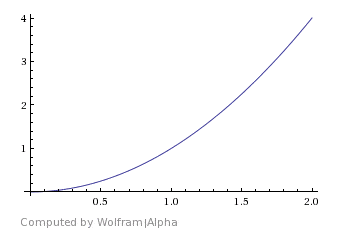
For example, we will set up (but not evaluate) a definite integral using the Washer Method to compute the volume of the solid obtained by rotating the region bounded by y=x2/4),y=0,x=1,y = x^2/4), y = 0, x = 1, and x=2x = 2 about the line y=2y=2.

It is important to draw the graph of the functions so that we can see the area that we are trying to integrate:

Graph of the region of integration for above equation

The green region is the region that we are trying to integrate about the line y=2y = 2.

Now we must find the values of RR and rr.

RR is the distance between the axis of rotation (in this case, the line y=2y = 2) and the outer edge of the function (y=0y = 0). Since both functions are in terms of yy, we can subtract the function of the outer edge from the function defining the axis of rotation. Doing this, we get: 2−0=22 - 0 = 2. R=2R = 2.

rr is the distance between the axis of rotation (y=2y = 2) and the inner edge of the function (x2/4x^2/4). We now subtract the function defining the inner edge from the function defining the axis of rotation.
Doing this, we get: 2−x2/42 - x^2/4. r=2−x2/4r = 2 - x^2/4.

Putting all of the information that we now have together to fit the formula for the Washer Method, we get the following definite integral:

∫12(π∗22)−(π∗(2−x2/4)2)dx\int_1^{2}(\pi*2^2)-(\pi*(2-x^2/4)^2) dx = ∫12(4π)−(π(2−x2/4)2)dx\int_1^{2}(4\pi)-(\pi(2-x^2/4)^2) dx

Interactive · 1 question

Volume calculated with disks where A(x)=π[f(x)]2A(x)=\pi[f(x)]^2 if ff is rotated around the xx-axis, or A(x)=π[a−f(x)]2A(x)=\pi[a−f(x)]^2 if ff is rotated around the line y=ay=a. Similarly, if the volume is calculated with washers where f(x)>g(x)f(x)>g(x), then Awasher=Aouterdisk−AinnerdiskA_{washer}=A_{outerdisk}−A_{innerdisk}, which can be wrote as A(x)=πR2−πr2A(x)=\pi R^2-\pi r^2. (RR is the radius of outer graph. rr is the radius of inner disk.)

Calculate the volume of the solid obtained by taking the area trapped between the curve f(x)=1xf(x)=1x, the xx-axis, and the vertical lines x=1x=1 and x=2x=2 about the xx-axis.

Choose one answer

Interactive · 2 questions

Lets go over the disk method. The disk method is a method using integration and a little geometry wit to find the volume of a rotated 2-D figure. This has application in many fields such as physics.

Ok, so we know how to calculate area under a curve by using integrals. If you aren't thinking about it, Area is a component for volume like with the volume of a cube. If the volume of a cube is V=s∗s∗sV= s*s*s we also know that s∗s=Areas*s =Area so V=A∗sV=A*s. We can apply something similar to the area's we find under curves using integrals. We can create 3D objects by utilizing the function f(x) within an integral by using it within an area equation like A=pi(r)2A=pi(r)^2. Inserting f(x) as (r) and then taking an integral of the whole equation between 2 points is essentially the disk method.

It is called the disk method because it uses the area of a circle or disk (A=pi(r2)(A=pi(r^2) with the integral of (f(x) to create a 3D version of the area under the curve that could have been spun 360 degrees about the y or x axis.

So lets try to comprehend this by rotating the area under the curve of y=x2y=x^2 about the x axis from 0 to 2. Picture on the graph that we will be spinning that curve 360 degrees and using integration of the area of a circle where the radius is the function of the curve (in this case x^2) to get the volume of what the curve would be if rotated about the x axis.

So to actually write this as an integral, lets go over what we want from the function. We know that our upper curve is f(x)=x2f(x)=x^2 and we are rotating from x=0 to x=2. We can also just say that our lower function is y=0y=0 because that is simply the x axis,.

So with this information, what does the integral look like? Keep in mind that we want to rotate the area under the curve 360 degrees.

Choose one answer

Video · + 3 min read

(Video) Using Disks or Washers to Find Volume

by PatrickJMT

In this video by patrickJMT he explains the disk or washer method of finding the volume of a region.

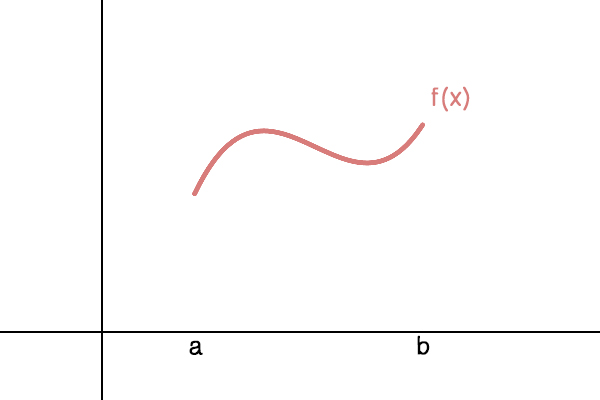
Suppose you have some function, f(x)f(x), that's defined on the interval aa to bb.

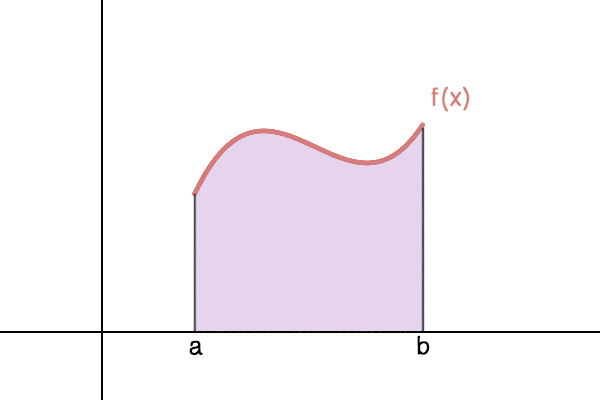
Now suppose we take the area under this curve,

And rotate it around the xx-axis.

What we're looking for is the volume inside this three dimensional object. The method of figuring this out uses disks or washers.

Our limits of integration come from the bounds of the xx-axis, i.e. aa and bb. Then you integrate π\pi times the curve squared. ∫abπ[f(x)]2dx\int_a^b\pi\left[f(x)\right]^2dx

The first problem he looks at is:

A region bounded by the xx-axis, yy-axis, x=4x=4, and y=xy=\sqrt x and rotated about the xx-axis.

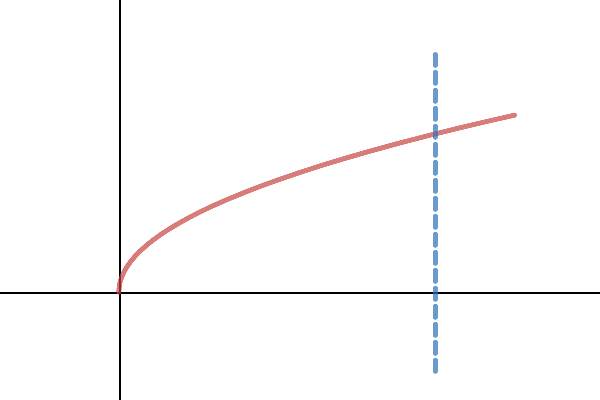
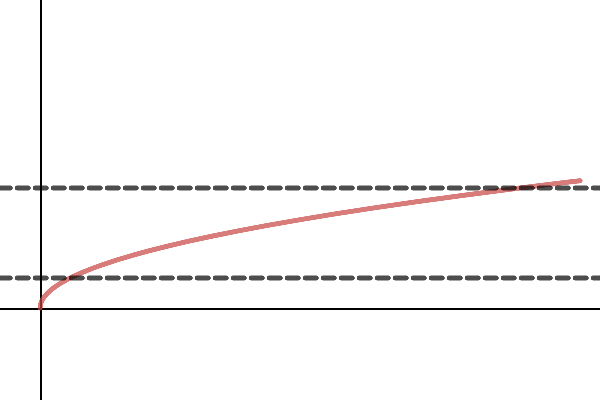
We first want to graph this.

The limits of integration span from 0 to 4 and our curve is y=xy=\sqrt x. If we rotate this curve around the xx-axis we can find the volume of the shape by setting up the integral: ∫04π[x]2dx\int_0^4\pi\left[\sqrt x\right]^2dx

Finally, we can solve for the volume of the rotated shape. ∫04π[x]2dx ∫04πx dx π∫04x dx π[12x2]04 π2[x2]04 π2[(4)2−(0)2] π2(16) 8π\begin{aligned} &\int_0^4\pi\left[\sqrt x\right]^2dx\\\ &\int_0^4\pi x\text{ }dx\\\ &\pi\int_0^4x\text{ }dx\\\ &\pi\left[\frac12x^2\right]_0^4\\\ &\frac\pi2\left[x^2\right]_0^4\\\ &\frac\pi2\left[(4)^2-(0)^2\right]\\\ &\frac\pi2(16)\\\ &\boxed{8\pi} \end{aligned}

The next question he looks at is:

A region bounded by y=xy=\sqrt x and y=xy=x.

There are three ways he looks at it rotated: about the xx-axis, about y=−3y=-3, and about y=8y=8. All of which are horizontal lines.

Let's start by graphing the equations.

This is a little different now. The shape rotating about the xx-axis is made up of two curves. We do a similar process as with finding the area between two curves: take the top most curve and subtract the bottom most curve. With volume we take the outer curve squared minus the inner curve squared.

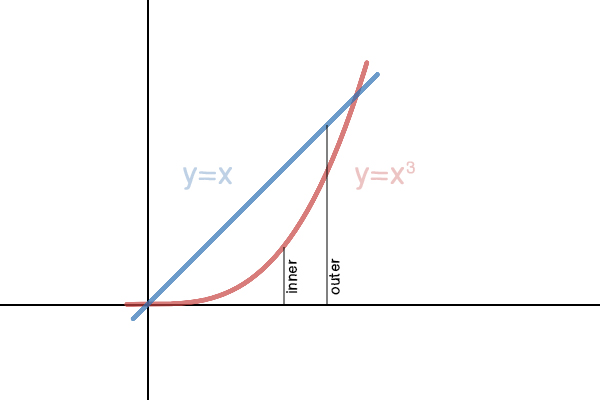
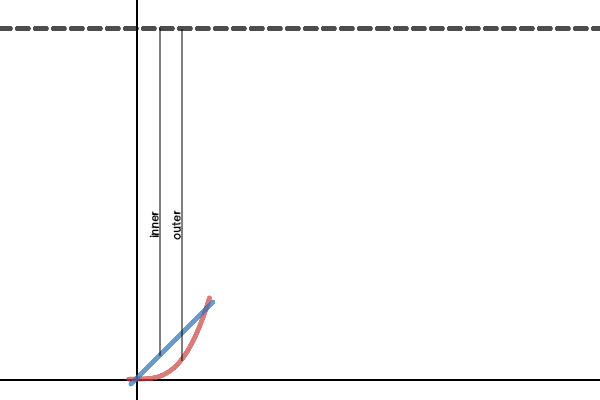
If you're ever unsure of which curve is the outer and which is the inner there's a simple trick. Draw a straight line from whatever line you're rotating about. The first of the curves that it touches will be the inner curve. The second curve that it touches will be the outer curve.

To find where the curves intersect, we set the equations equal to one another. x=xx2=xx2−x=0x(x−1)=0x=0 or 1\begin{aligned} x&=\sqrt x\\ x^2&=x\\ x^2-x&=0\\ x(x-1)&=0\\ x&=0\text{ or }1 \end{aligned}

So when we rotate this shape around the xx-axis we get: ∫01π[(outer)2−(inner)2]dx⇒∫01π[(x)2−(x)2]dx\int_0^1\pi\left[\left(\text{outer}\right)^2-\left(\text{inner}\right)^2\right]dx\Rightarrow \int_0^1\pi\left[\left(\sqrt x\right)^2-(x)^2\right]dx

Solving this we get: ∫01π[(x)2−(x)2]dx ∫01π[x−x2]dx π∫01x−x2 dx π[∫01x dx−∫01x2 dx] π[[12x2]01−[13x3]01] π[12[x2]01−13[x3]01] π[12[(1)2−(0)2]−13[(1)3−(0)3]] 16π\begin{aligned} &\int_0^1\pi\left[\left(\sqrt x\right)^2-(x)^2\right]dx\\\ &\int_0^1\pi\left[x-x^2\right]dx\\\ &\pi\int_0^1x-x^2\text{ }dx\\\ &\pi\left[\int_0^1x\text{ }dx-\int_0^1x^2\text{ }dx\right]\\\ &\pi\left[\left[\frac12x^2\right]_0^1-\left[\frac13x^3\right]^1_0\right]\\\ &\pi\left[\frac12\left[x^2\right]_0^1-\frac13\left[x^3\right]^1_0\right]\\\ &\pi\left[\frac12\left[(1)^2-(0)^2\right]-\frac13\left[(1)^3-(0)^3\right]\right]\\\ &\boxed{\frac16\pi} \end{aligned}

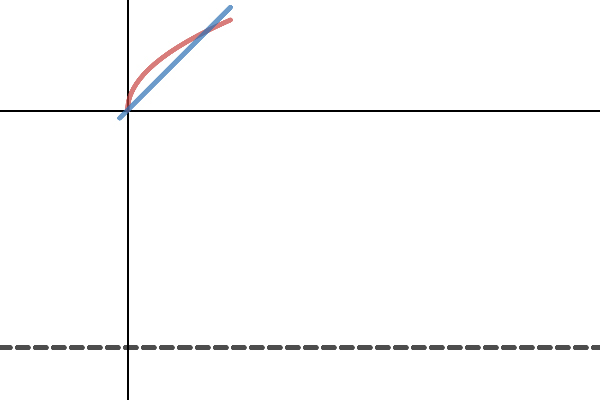
Now we want to look at solving this problem when we rotate it around the line y=−3y=-3.

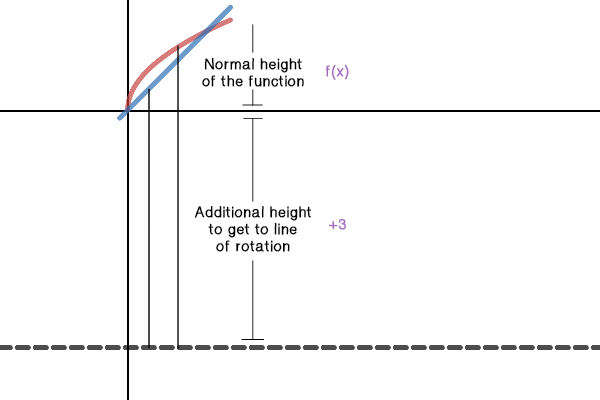
The limits of integration are still the same, i.e. 0 to 1, but now our line of rotation is farther down. If we extend a straight line up from the line we're rotating around, the first curve it hits is y=xy=x. Therefore, this will be our inner curve. The second curve it hits is y=xy=\sqrt x so this will be our outer curve.

Before, when we rotated about the xx axis, the height of the curve was just the function of the curve. Now the height of the curve is the function plus the distance from the xx-axis to the line y=−3y=-3.

So the outer curve will be x+3\sqrt x\color{red}{+3} and the inner curve will be y=x+3y=x\color{red}{+3}. The resulting integral is: π∫01[(x+3)2−(x+3)2]dx\pi\int_0^1\left[(\sqrt x+3)^2-(x+3)^2\right]dx

Now we can simplify. π∫01[(x+3)2−(x+3)2]dx π∫01[(x+6x+9)−(x2+6x+9)]dx π∫01[x+6x+9−x2−6x−9]dx π∫01[6x−x2−5x]dx π[∫016x dx−∫01x2 dx−∫015x dx] π[6∫01x dx−∫01x2 dx−5∫01x dx] \begin{aligned} &\pi\int_0^1\left[(\sqrt x+3)^2-(x+3)^2\right]dx\\\ &\pi\int_0^1\left[(x+6\sqrt x+9)-(x^2+6x+9)\right]dx\\\ &\pi\int_0^1\left[x+6\sqrt x+9-x^2-6x-9\right]dx\\\ &\pi\int_0^1\left[6\sqrt x-x^2-5x\right]dx\\\ &\pi\left[\int_0^16\sqrt x\text{ }dx-\int_0^1x^2\text{ }dx-\int_0^15x\text{ }dx\right]\\\ &\pi\left[6\int_0^1\sqrt x\text{ }dx-\int_0^1x^2\text{ }dx-5\int_0^1x\text{ }dx\right]\\\ \end{aligned}

Finally we can solve. π[6∫01x dx−∫01x2 dx−5∫01x dx] π[6[23x32]01−[13x3]01−5[12x2]01] π[4[x32]01−13[x3]01−52[x2]01] π[4−13−52] 76π\begin{aligned} &\pi\left[6\int_0^1\sqrt x\text{ }dx-\int_0^1x^2\text{ }dx-5\int_0^1x\text{ }dx\right]\\\ &\pi\left[6\left[\frac23x^{\frac32}\right]_0^1-\left[\frac13x^3\right]^1_0-5\left[\frac12x^2\right]_0^1\right]\\\ &\pi\left[4\left[x^{\frac32}\right]_0^1-\frac13\left[x^3\right]^1_0-\frac52\left[x^2\right]_0^1\right]\\\ &\pi\left[4-\frac13-\frac52\right]\\\ &\boxed{\frac76\pi} \end{aligned}

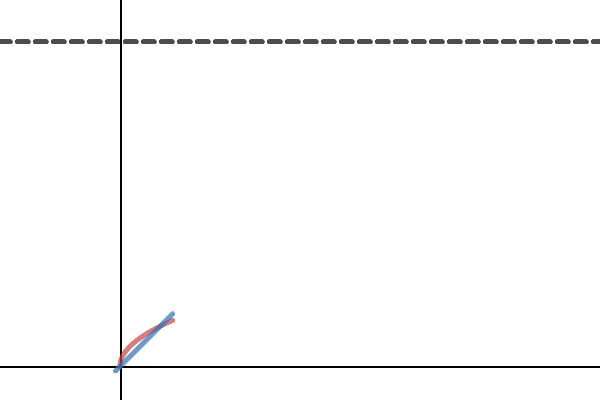
In the final example we change the line of rotation to be y=8y=8.

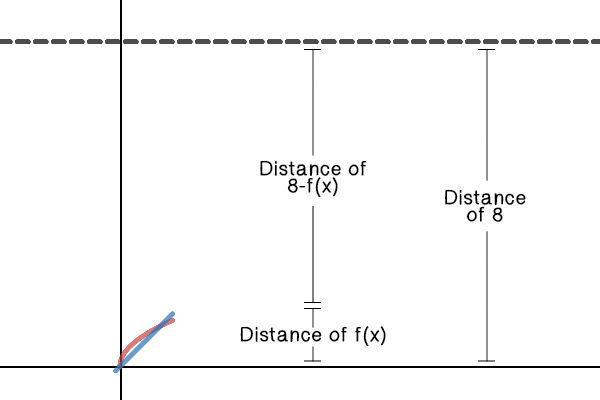
Notice how the outer curve and inner curve change when the line of rotation is above the curves. If we draw a line straight down from the line of rotation, the first curve it touches is y=xy=\sqrt x. Therefore, this curve becomes our inner curve. The second curve it touches is y=xy=x so that's now our outer curve.

What is the length of the line that we draw down from the line of rotation to the curve? Well, it's almost 8 because it almost touches the xx-axis. But we stop short. So that distance is 8−f(x)8-f(x).

So the outer curve will be 8−x\color{red}{8-}x and the inner curve will be 8−x\color{red}{8-}\sqrt x. Setting up the integral we get: π∫01[(8−x)2−(8−x)2]dx\pi\int_0^1\left[(8-x)^2-(8-\sqrt x)^2\right]dx

We can simplify this now. π∫01[(8−x)2−(8−x)2]dx π∫01[(64−16x+x2)−(64−16x+x)]dx π∫01[−17x+x2+16x]dx π[∫01−17x dx+∫01x2 dx+∫0116x dx] π[−17∫01x dx+∫01x2 dx+16∫01x dx] \begin{aligned} &\pi\int_0^1\left[(8-x)^2-(8-\sqrt x)^2\right]dx\\\ &\pi\int_0^1\left[(64-16x+x^2)-(64-16\sqrt x+x)\right]dx\\\ &\pi\int_0^1\left[-17x+x^2+16\sqrt x\right]dx\\\ &\pi\left[\int_0^1-17x\text{ }dx+\int_0^1x^2\text{ }dx+\int_0^116\sqrt x\text{ }dx\right]\\\ &\pi\left[-17\int_0^1x\text{ }dx+\int_0^1x^2\text{ }dx+16\int_0^1\sqrt x\text{ }dx\right]\\\ \end{aligned}

Finally we can solve. π[−17∫01x dx+∫01x2 dx+16∫01x dx] π[−17[12x2]01+[13x3]01+16[23x32]01] π[−172[x2]01+13[x3]01+323[x32]01] π[−172+13+323] 52π\begin{aligned} &\pi\left[-17\int_0^1x\text{ }dx+\int_0^1x^2\text{ }dx+16\int_0^1\sqrt x\text{ }dx\right]\\\ &\pi\left[-17\left[\frac12x^2\right]_0^1+\left[\frac13x^3\right]^1_0+16\left[\frac23x^{\frac32}\right]_0^1\right]\\\ &\pi\left[-\frac{17}2\left[x^2\right]_0^1+\frac13\left[x^3\right]^1_0+\frac{32}3\left[x^{\frac32}\right]_0^1\right]\\\ &\pi\left[-\frac{17}2+\frac13+\frac{32}3\right]\\\ &\boxed{\frac52\pi} \end{aligned}

Video · + 2 min read

(Videos) Volumes of Revolution Using Disks and Washers

by PatrickJMT

Here's a video by patrickJMT where he works through some more examples of finding the volume of a shape rotated around a line.

The first problem he looks at is:

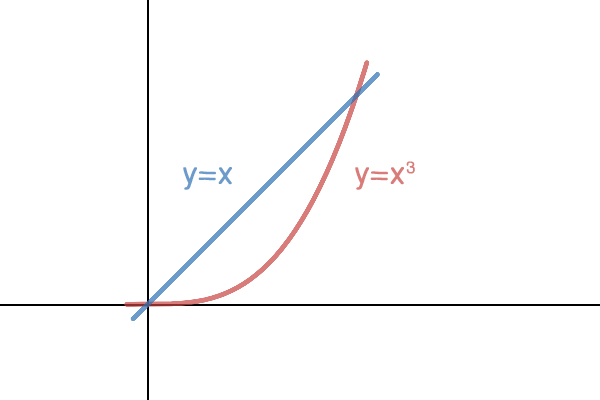
A region bounded by y=x3y=x^3, y=xy=x, and x≥0x\ge0 around the xx-axis.

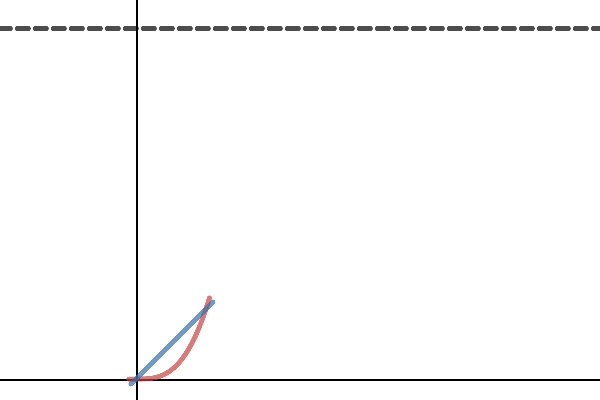
The first step is to graph your functions.

We find the limits of integration by setting the equations equal to one another. x3=xx3−x=0x(x2−1)=0x(x−1)(x+1)=0x=0 or ±1\begin{aligned} x^3&=x\\ x^3-x&=0\\ x(x^2-1)&=0\\ x(x-1)(x+1)&=0\\ x&=0\text{ or }\pm1 \end{aligned} Since x≥0x\ge0 we know the limits of integration are from 0 to 1.

The formula for finding the volume is π∫ab[(outer curve)2−(inner curve)2]dx\pi\int_a^b\left[(\text{outer curve})^2-(\text{inner curve})^2\right]dx We can see which is the inner curve by drawing a line from our line of rotation, to the curves. The first curve it touches is the inner curve. The second is the outer.

From here we can set up the integral. π∫01[(x)2−(x3)2]dx\pi\int_0^1\left[\left(x\right)^2-\left(x^3\right)^2\right]dx

Now we can simplify. π∫01[(x)2−(x3)2]dx π∫01[x2−x6]dx π[∫01x2 dx−∫01x6 dx]\begin{aligned} &\pi\int_0^1\left[\left(x\right)^2-\left(x^3\right)^2\right]dx\\\ &\pi\int_0^1\left[x^2-x^6\right]dx\\\ &\pi\left[\int_0^1x^2\text{ }dx-\int_0^1x^6\text{ }dx\right] \end{aligned}

Finally we can solve. π[∫01x2 dx−∫01x6 dx] π[[13x3]01−[17x7]01] π[13[x3]01−17[x7]01] π[13[(1)3−(0)3]−17[(1)7−(0)7]] π[13−17] 421π\begin{aligned} &\pi\left[\int_0^1x^2\text{ }dx-\int_0^1x^6\text{ }dx\right]\\\ &\pi\left[\left[\frac13x^3\right]_0^1-\left[\frac17x^7\right]_0^1\right]\\\ &\pi\left[\frac13\left[x^3\right]_0^1-\frac17\left[x^7\right]_0^1\right]\\\ &\pi\left[\frac13\left[(1)^3-(0)^3\right]-\frac17\left[(1)^7-(0)^7\right]\right]\\\ &\pi\left[\frac13-\frac17\right]\\\ &\boxed{\frac4{21}\pi} \end{aligned}

Here's another example by patrickJMT of finding the volume of a revolution.

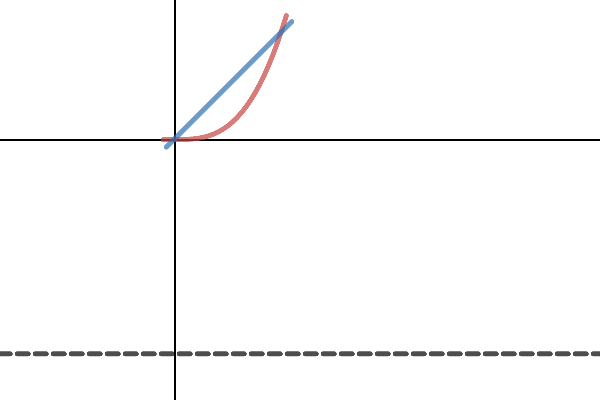
It uses the same functions as before but this time the line of rotation is y=−2y=-2.

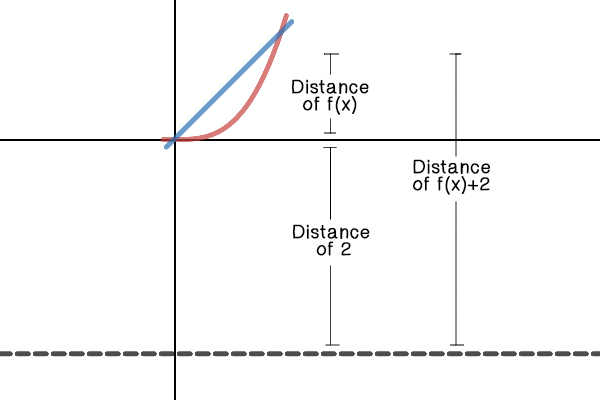
Before, when the xx-axis was our rotation line, the height of an arbitrary line from there to the function was just f(x)f(x). But now if we have a line from y=−2y=-2 to the function it's height will be f(x)+2f(x)\color{red}{+2}.

This means our outer curve will be x+2x\color{red}{+2} and our inner curve will be x3+2x^3\color{red}{+2}.

So our integral can be written as: π∫01[(x+2)2−(x3+2)2]dx\pi\int_0^1\left[(x+2)^2-(x^3+2)^2\right]dx

We can now simplify this. π∫01[(x+2)2−(x3+2)2]dx π∫01[(x2+4x+4)−(x6+4x3+4)]dx π∫01[x2+4x+4−x6−4x3−4]dx π∫01[x2+4x−x6−4x3]dx π[∫01x2 dx+∫014x dx−∫01x6 dx−∫014x3 dx] π[∫01x2 dx+4∫01x dx−∫01x6 dx−4∫01x3 dx] \begin{aligned} &\pi\int_0^1\left[(x+2)^2-(x^3+2)^2\right]dx\\\ &\pi\int_0^1\left[(x^2+4x+4)-(x^6+4x^3+4)\right]dx\\\ &\pi\int_0^1\left[x^2+4x+4-x^6-4x^3-4\right]dx\\\ &\pi\int_0^1\left[x^2+4x-x^6-4x^3\right]dx\\\ &\pi\left[\int_0^1x^2\text{ }dx+\int_0^14x\text{ }dx-\int_0^1x^6\text{ }dx-\int_0^14x^3\text{ }dx\right]\\\ &\pi\left[\int_0^1x^2\text{ }dx+4\int_0^1x\text{ }dx-\int_0^1x^6\text{ }dx-4\int_0^1x^3\text{ }dx\right]\\\ \end{aligned}

Finally, we can solve. π[∫01x2 dx+4∫01x dx−∫01x6 dx−4∫01x3 dx] π[[13x3]01+4[12x2]01−[17x7]01−4[14x4]01] π[13[x3]01+2[x2]01−17[x7]01−[x4]01] π[13+2−17−1] 2521π\begin{aligned} &\pi\left[\int_0^1x^2\text{ }dx+4\int_0^1x\text{ }dx-\int_0^1x^6\text{ }dx-4\int_0^1x^3\text{ }dx\right]\\\ &\pi\left[\left[\frac13x^3\right]_0^1+4\left[\frac12x^2\right]_0^1-\left[\frac17x^7\right]_0^1-4\left[\frac14x^4\right]_0^1\right]\\\ &\pi\left[\frac13\left[x^3\right]_0^1+2\left[x^2\right]_0^1-\frac17\left[x^7\right]_0^1-\left[x^4\right]_0^1\right]\\\ &\pi\left[\frac13+2-\frac17-1\right]\\\ &\boxed{\frac{25}{21}\pi} \end{aligned}

Here is the final video by patrickJMT where the line of rotation is changed yet again.

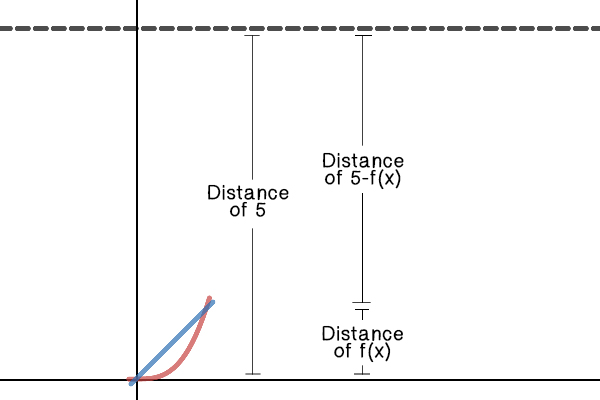
This time the line of rotation is above the curves at y=5y=5.

With the line above the curves we get y=xy=x being the inner curve and y=x3y=x^3 being the outer curve.

Since the line of rotation is at 5, that means the length of the line from the line of rotation to the curve will be 5−f(x)5-f(x).

So the curves will be expressed as 5−x3\color{red}{5-}x^3 and 5−x\color{red}{5-}x. We can now construct our integral as: π∫01[(5−x3)2−(5−x)2]dx\pi\int_0^1\left[(5-x^3)^2-(5-x)^2\right]dx

We can now simplify the integral. π∫01[(5−x3)2−(5−x)2]dx π∫01[(25−10x3+x6)−(25−10x+x2)]dx π∫01[25−10x3+x6−25+10x−x2]dx π∫01[−10x3+x6+10x−x2]dx π[∫01−10x3 dx+∫01x6 dx+∫0110x dx−∫01x2 dx] π[−10∫01x3 dx+∫01x6 dx+10∫01x dx−∫01x2 dx] \begin{aligned} &\pi\int_0^1\left[(5-x^3)^2-(5-x)^2\right]dx\\\ &\pi\int_0^1\left[(25-10x^3+x^6)-(25-10x+x^2)\right]dx\\\ &\pi\int_0^1\left[25-10x^3+x^6-25+10x-x^2\right]dx\\\ &\pi\int_0^1\left[-10x^3+x^6+10x-x^2\right]dx\\\ &\pi\left[\int_0^1-10x^3\text{ }dx+\int_0^1x^6\text{ }dx+\int_0^110x\text{ }dx-\int_0^1x^2\text{ }dx\right]\\\ &\pi\left[-10\int_0^1x^3\text{ }dx+\int_0^1x^6\text{ }dx+10\int_0^1x\text{ }dx-\int_0^1x^2\text{ }dx\right]\\\ \end{aligned}

Finally, we can solve the integral. π[−10∫01x3 dx+∫01x6 dx+10∫01x dx−∫01x2 dx] π[−10[14x4]01+[17x7]01+10[12x2]01−[13x3]01] π[−52[x4]01+17[x7]01+5[x2]01−13[x3]01] π[−52+17+5−13] 9742π\begin{aligned} &\pi\left[-10\int_0^1x^3\text{ }dx+\int_0^1x^6\text{ }dx+10\int_0^1x\text{ }dx-\int_0^1x^2\text{ }dx\right]\\\ &\pi\left[-10\left[\frac14x^4\right]_0^1+\left[\frac17x^7\right]_0^1+10\left[\frac12x^2\right]_0^1-\left[\frac13x^3\right]_0^1\right]\\\ &\pi\left[-\frac52\left[x^4\right]_0^1+\frac17\left[x^7\right]_0^1+5\left[x^2\right]_0^1-\frac13\left[x^3\right]_0^1\right]\\\ &\pi\left[-\frac52+\frac17+5-\frac13\right]\\\ &\boxed{\frac{97}{42}\pi} \end{aligned}

Video · + 2 min read

(Video) Volumes of Revolution about Vertical Lines Using Washers

by PatrickJMT

In this video by patrickJMT he shows you how to find the volume of a revolution about a vertical line. In the previous video he showed how to solve when it was around a horizontal line.

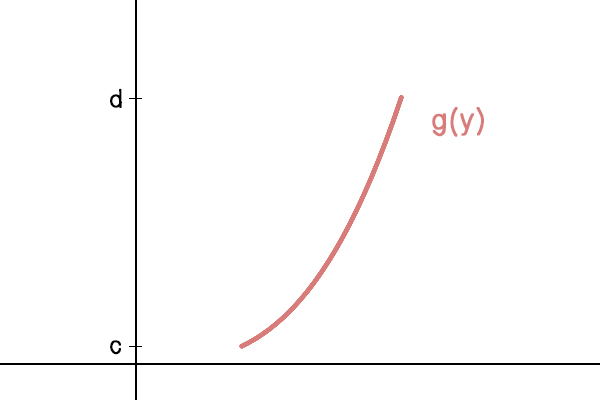
The process is pretty much the same except that we integrate with respect to yy. To explain, suppose we some function g(y)g(y) that's defined from cc to dd.

Now, suppose we rotated this curve around the yy-axis and wanted to find the volume of the resulting shape.

We can find the volume using the formula: π∫cd[g(y)]2dy\pi\int_c^d\left[g(y)\right]^2dy

The first problem he looks at is:

A region made up of y=xy=\sqrt x, y=1y=1 and y=4y=4 rotated about the yy-axis.

The first step is always to graph the region.

We want the region between the yy-axis and the function. The limits of integration is the range on the yy-axis, i.e. 1 to 4.

Before we create our intgeral we have to look at the function. Currently, it is with respect to xx. To put it into our integral, since our integral is with respect to yy, we need to solve for yy. y=x⟹y2=xy=\sqrt x\Longrightarrow y^2=x

Now we can construct the integral. π∫14[y2]2dy\pi\int_1^4\left[y^2\right]^2dy

We can now simplify the integral and solve. π∫14[y2]2dy π∫14y4 dy π[[15y5]14] π[15[y5]14] π[15[(4)5−(1)5]] π[15(1024−1)] 1023π5\begin{aligned} &\pi\int_1^4\left[y^2\right]^2dy\\\ &\pi\int_1^4y^4\space dy\\\ &\pi\left[\left[\frac15y^5\right]_1^4\right]\\\ &\pi\left[\frac15\left[y^5\right]_1^4\right]\\\ &\pi\left[\frac15\left[(4)^5-(1)^5\right]\right]\\\ &\pi\left[\frac15(1024-1)\right]\\\ &\boxed{\frac{1023\pi}{5}} \end{aligned}

Next, he looks at a slightly harder problem.

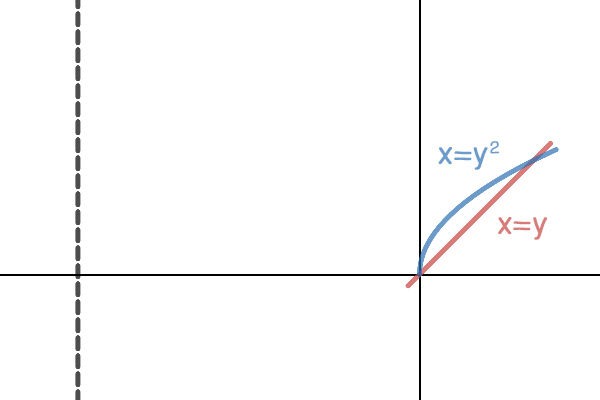
A region bounded by y=xy=x and y=xy=\sqrt x. Rotated about x=−3x=-3.

Begin by drawing the graph.

Notice each curve is written in terms of yy.

To find the limits of integration we need to find where the two curves intersect. We can do this by setting the equations equal to each other. y2=yy2−y=0y(y−1)=0y=0 or 1\begin{aligned} y^2&=y\\ y^2-y&=0\\ y(y-1)&=0\\ y&=0\text{ or }1 \end{aligned}

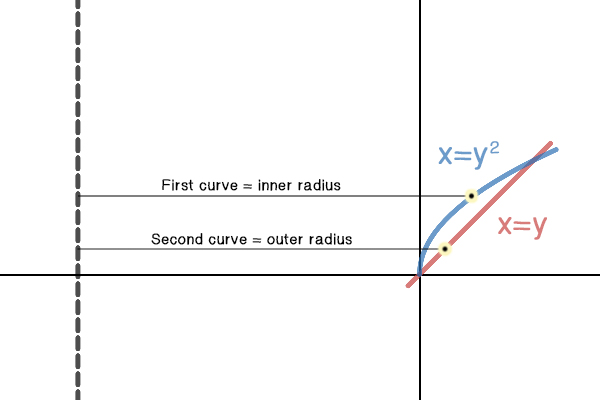
When setting up the integral when there's two curves you take the outer curve (or outer radius) squared minus the inner curve (or inner radius) squared.

To figure out which is which you draw a line from the line of rotation to the area being rotated. The first curve it touches will be the inner radius and the second curve it touches will be the outer radius.

Now we just need to figure out the lengths of these lines drawn. From the yy-axis to the curve the length is f(y)f(y). The length from the line of rotation to the yy-axis is 3. So the outer and inner radius become f(y)+3f(y)+3.

Now we can set up our integral. π∫01[(y+3)2−(y2+3)2]dy\pi\int_0^1\left[(y+3)^2-(y^2+3)^2\right]dy

Next, we simplify. π∫01[(y+3)2−(y2+3)2]dy π∫01[(y2+6y+9)−(y4+6y2+9)]dy π∫01[y2+6y+9−y4−6y2−9]dy π∫01[6y−y4−5y2]dy π[∫016y dy−∫01y4 dy−∫015y2 dy] π[6∫01y dy−∫01y4 dy−5∫01y2 dy] \begin{aligned} &\pi\int_0^1\left[(y+3)^2-(y^2+3)^2\right]dy\\\ &\pi\int_0^1\left[(y^2+6y+9)-(y^4+6y^2+9)\right]dy\\\ &\pi\int_0^1\left[y^2+6y+9-y^4-6y^2-9\right]dy\\\ &\pi\int_0^1\left[6y-y^4-5y^2\right]dy\\\ &\pi\left[\int_0^16y\space dy-\int_0^1y^4\space dy-\int_0^15y^2\space dy\right]\\\ &\pi\left[6\int_0^1y\space dy-\int_0^1y^4\space dy-5\int_0^1y^2\space dy\right]\\\ \end{aligned}

Finally, we solve. π[6∫01y dy−∫01y4 dy−5∫01y2 dy] π[6[12y2]01−[15y5]01−5[13y3]01] π[3[y2]01−15[y5]01−53[y3]01] π[3−15−53] 1715π\begin{aligned} &\pi\left[6\int_0^1y\space dy-\int_0^1y^4\space dy-5\int_0^1y^2\space dy\right]\\\ &\pi\left[6\left[\frac12y^2\right]_0^1-\left[\frac15y^5\right]_0^1-5\left[\frac13y^3\right]_0^1\right]\\\ &\pi\left[3\left[y^2\right]_0^1-\frac15\left[y^5\right]_0^1-\frac53\left[y^3\right]_0^1\right]\\\ &\pi\left[3-\frac15-\frac53\right]\\\ &\boxed{\frac{17}{15}\pi} \end{aligned}

Read · 1 min

To get a better understanding of this, please check out the video explanations by patrickJMT for disks/washers and shells.

It's important to note that you can use either method for any problem. You might just have to rearrange the equations in terms of xx's or yy's.

Below is a quick chart to show which method to use with regards to how the equations are written and what axis the line of rotation is parallel to. This will skip the step of rewriting the equations. This is not that important, since rewriting equations isn't an arduous task, but regardless here it is.

Equation FormLine of Rotation Parallel toMethody=f(x)x-axisDisk/Washery=f(x)y-axisShellx=f(y)x-axisShellx=f(y)y-axisDisk/Washer\begin{array}{|c|c|c|} \hline \text{Equation Form}&\text{Line of Rotation Parallel to}&\text{Method}\\ \hline y=f(x)&x\text{-axis}&\text{Disk/Washer}\\ y=f(x)&y\text{-axis}&\text{Shell}\\ x=f(y)&x\text{-axis}&\text{Shell}\\ x=f(y)&y\text{-axis}&\text{Disk/Washer}\\ \hline \end{array}

Type a concept, like “slope” or “photosynthesis”.

↑ ↓ to choose · Enter to openSearch explanations and problems