Regra da cadeia

Interactive · 3 questions

Suppose you were asked to differentiate the function f(x)=x2+1.f(x) = \sqrt{x^2 + 1}. The differentiation formulas such as the Product Rule and Quotient Rule are not sufficient to evaluate this derivative, as this function cannot easily be expressed as a product or quotient of two functions.

However, unlike regular numbers, functions have one additional property -- that of composition. We can express this function f(x)f(x) as a composition of two functions: g(u)=ug(u) = \sqrt{u} and h(x)=x2+1h(x) = x^2 + 1.

How would you express f(x)f(x) as a composition of gg and hh?

Choose one answer

Interactive · 4 questions

Let's try to figure out the derivative of (x+2)2(x+2)^2. This is actually the composition of two functions! Let: f(x)=x+2f(x) = x+2 and g(x)=x2.g(x) = x^2.

What is (x+2)2(x+2)^2 in terms of ff and gg?

Choose one answer

Interactive · 16 questions

Chain Rule from Bicycles

Let's start with something straightforward, which doesn't even involve Calculus!

(Don't worry, Calculus will materialize in due course.)

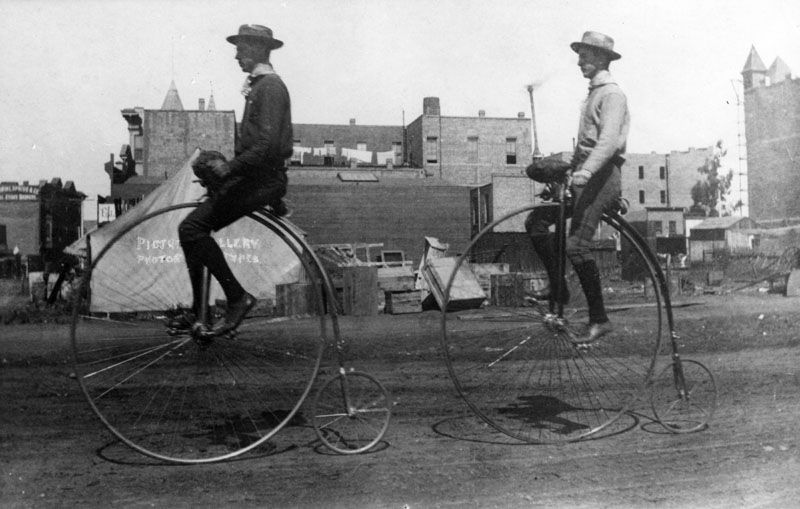
Penny Farthing Bicycles, circa 1886

Penny Farthing Bicycles, circa 1886

By Unknown - http://photos.lapl.org/carlweb/jsp/DoSearch?databaseID=968&index=w&terms=00054206, Public Domain, Wikimedia Commons

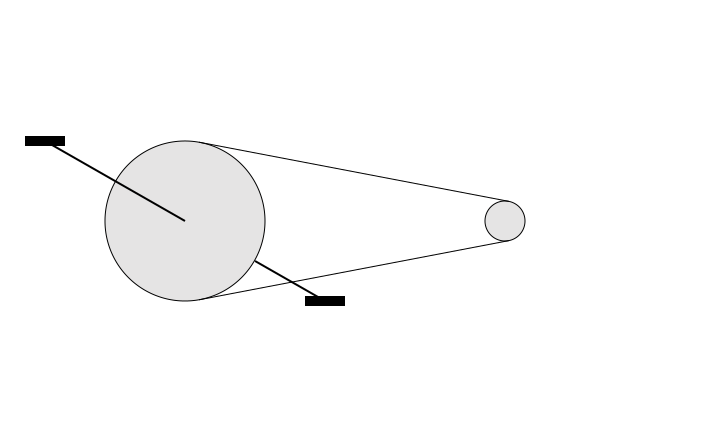
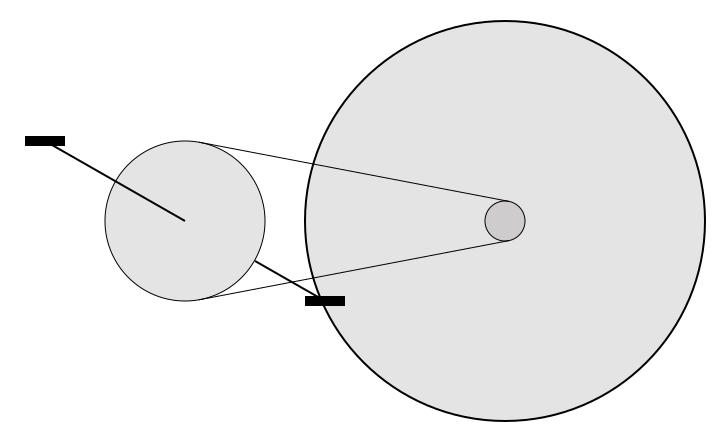
Why were early bicycles so tall?

Choose one answer

Interactive · 2 questions

General formula for functions f(x)f(x) and g(x)g(x):

ddx(f(g(x))=f′(g(x))g′(x)\frac{d}{dx}(f(g(x)) = f'(g(x))g' (x)

Find the derivative of sin⁡(2x)\sin(2x).

Choose one answer

Read · 1 min

See Pete Clark's physical intuition here, at point (2).

For a proof using linear approximation and (implicitly) little-o notation, see this proof on Wikipedia. (In fact, see if you can understand the slopes or "sensitivities" of the linear approximations in the proof through the aforementioned physical intuition of "multiplying rates".)

Interactive · 1 question

Use the chain rule to find the derivative of cos⁡2x\cos ^2x.

Choose one answer

Interactive · 2 questions

The formula for the Chain Rule for single-variable functions is f(g(x))=f′(g(x))g′(x)f(g(x))=f'(g(x))g'(x). If we have an equation f(g(x))=(x+2)3f(g(x))=(x+2)^3, we first determine the "outside" part of the function and the "inside" part of the function. The "outside" part of the function is x3x^3 and the "inside" part of the function is x+2x+2, therefore, by the formula, f(x)=g(x)3f(x)=g(x)^3 and g(x)=x+2g(x)=x+2.

Next, we take the derivative of the outside while keeping the inside the same, and then we take the derivative of the inside function and multiply them together, so it should look like this: f′(g(x))g′(x)=3(x+2)2(1)f'(g(x))g'(x)=3(x+2)^2 (1).

In this case, the derivative of the inside function is 1 so if we simplify it, we can just take it out (because anything multiplied by 1 doesn't change it). Simplified, it would just be f′(g(x))g′(x)=3(x+2)2f'(g(x))g'(x)=3(x+2)^2.

Using the chain rule, what is the derivative of f(g(x))=(5x2+7x)4f(g(x))=(5x^2+7x)^4?

Choose one answer

Read · 1 min

Suppose we need to take the derivative of 8x2+10\sqrt{8x^2+10}. We can do this by using the chain rule. In order to complete the chain rule it is always easier to rewrite the function in exponential form. For example, x\sqrt{x} would be rewritten as x1/2x^{1/2}.

First, rewrite 8x2+10\sqrt{8x^2+10} in exponential form.

(8x2+10)1/2(8x^2+10)^{1/2}

The next step is to execute the chain rule. I like to think of this rule as an "inside and out" method. What we will do now is** take the derivative of the "outside"** of the function then take the derivative of the "inside" of the function and multiply them together. For this it helps to think of the outside of the function as z1/2z^{1/2} where z=8x2+10z=8x^2+10.

First, take the derivative of the outside.

12 z−1/2\frac{1}{2}\,z^{-1/2}

Now take the derivative of the inside.

16x16x

Now multiple the outside and the inside together.

8x(z−1/2)8x(z^{-1/2})

And substitute in for zz.

8x(8x2+10)−1/28x(8x^2+10)^{-1/2} == 8x/8x2+108x/\sqrt{8x^2+10}

To recap

  1. Rewrite the function in exponential form
  2. Take the derivative of the "outside" of the function
  3. Take the derivative of the "inside" of the function
  4. Multiply the derivative of the outside of the function by the derivative of the inside of the function

Read · 1 min

Here is a worksheet containing chain rule problems. Answers are at the bottom. Good luck!

Interactive · 5 questions

Derivative of Inverse

What is the slope of f(x)=1000x2+1f(x) = \frac{1000}{x^2+1} at x=3x = 3?

Video

(Videos) Chain Rule Problems

by PatrickJMT

The Chain Rule is a very simple and important rule in derivatives that can get very complicated and messy very quickly. Below are a bunch of videos by patrickJMT showing you different examples of the chain rule.

Here's a combination of the product rule and the chain rule.

Here's a combination of the quotient rule and the chain rule.

Here are some more complex examples of the chain rule.

Video · + 1 min read

(Videos) Using Chain, Product, and Quotient Rules to Find Derivatives

by PatrickJMT

Here's a video by patrickJMT showing you how to use the chain, product, and quotient rules to find the derivatives of functions.

Recall the chain, product, and quotient rules: [f(g(x))]′=f′(g(x))⋅g′(x)[f(x)g(x)]′=f′(x)g(x)+g′(x)f(x)[f(x)g(x)]′=f′(x)g(x)−g′(x)f(x)[g(x)]2\begin{align} [f(g(x))]'&=f'(g(x))\cdot g'(x)\\ [f(x)g(x)]'&=f'(x)g(x)+g'(x)f(x)\\ \bigg[\frac{f(x)}{g(x)}\bigg]'&=\frac{f'(x)g(x)-g'(x)f(x)}{[g(x)]^2} \end{align}

The first problem he finds the derivative of is: f(x)=(2x13−6x53)3⋅(4x2−5x)13f(x)=(2x^{\frac13}-6x^{\frac53})^3\cdot(4x^2-5x)^{\frac13}

I like to calculate each pieces derivative separately and then plug them into the formula after. It helps me keep things organized.

So I'll start by finding the derivative of the first part. f1(x)=(2x13−6x53)3f_1(x)=(2x^{\frac13}-6x^{\frac53})^3 Here's where we use the chain rule. Take the derivative of the outside and then multiply it by the derivative of the inside. f1′(x)=3(2x13−6x53)3−1⋅(2x13−6x53)′=3(2x13−6x53)2⋅[2(13x13−1)−6(53x53−1)]=3(2x13−6x53)2⋅(23x−2310x23)\begin{align} f_1'(x)&=\color{red}{3}(2x^{\frac13}-6x^{\frac53})^{\color{red}{3-1}}\color{red}{\cdot(2x^{\frac13}-6x^{\frac53})'}\\ &=3(2x^{\frac13}-6x^{\frac53})^2\cdot[2(\color{red}{\frac13}x^{\color{red}{\frac13-1}})-6(\color{red}{\frac53}x^{\color{red}{\frac53-1}})]\\ &=\boxed{3(2x^{\frac13}-6x^{\frac53})^2\cdot\bigg(\frac23x^{-\frac23}10x^{\frac23}\bigg)} \end{align}

Now let's find the derivative of the second part. f2(x)=(4x2−5x)13f_2(x)=(4x^2-5x)^{\frac13} Again, we need to use the chain rule. f2′(x)=13(4x2−5x)13−1⋅(4x2−5x)′=13(4x2−5x)−23⋅[4(2x2−1)−5(1x1−1)]=13(4x2−5x)−23⋅(8x−5)\begin{align} f_2'(x)&=\color{red}{\frac13}(4x^2-5x)^{\color{red}{\frac13-1}}\color{red}{\cdot(4x^2-5x)'}\\ &=\frac13(4x^2-5x)^{-\frac23}\cdot[4(\color{red}{2}x^{\color{red}{2-1}})-5(\color{red}{1}x^{\color{red}{1-1}})]\\ &=\boxed{\frac13(4x^2-5x)^{-\frac23}\cdot(8x-5)} \end{align}

Now that we have all the pieces we can plug them into our product rule for derivatives formula. f′(x)=f1′(x)⋅f2(x)+f2′(x)⋅f1(x)=3(2x13−6x53)2⋅(23x−2310x23)⋅(4x2−5x)13+     +13(4x2−5x)−23⋅(8x−5)⋅(2x13−6x53)3=3(2x13−6x53)2⋅(23x−2310x23)⋅(4x2−5x)13+     +(8x−5)(2x13−6x53)33(4x2−5x)23\begin{align} f'(x)&=f_1'(x)\cdot f_2(x)+f_2'(x)\cdot f_1(x)\\ &=3(2x^{\frac13}-6x^{\frac53})^2\cdot\bigg(\frac23x^{-\frac23}10x^{\frac23}\bigg)\cdot(4x^2-5x)^{\frac13}+\\ &\ \ \ \ \ +\frac13(4x^2-5x)^{-\frac23}\cdot(8x-5)\cdot(2x^{\frac13}-6x^{\frac53})^3\\ &=3(2x^{\frac13}-6x^{\frac53})^2\cdot\bigg(\frac23x^{-\frac23}10x^{\frac23}\bigg)\cdot(4x^2-5x)^{\frac13}+\\ &\ \ \ \ \ +\frac{(8x-5)(2x^{\frac13}-6x^{\frac53})^3}{3(4x^2-5x)^{\frac23}} \end{align}

Here's another example of solving a derivative using the chain and quotient rules.

The problem he looks at is: g(x)=(2x3−5x)4(4x+1)5g(x)=\frac{(2x^3-5x)^4}{(4x+1)^5}

I like to calculate each pieces derivative separately and then plug them into the formula after. It helps me keep things organized.

Let's start with the top piece's derivative. g1(x)=(2x3−5x)4g_1(x)=(2x^3-5x)^4 Here we have to take the derivative outside the parentheses and then multiply on the derivative of inside the parentheses. g1′(x)=4(2x3−5x)4−1⋅(2x3−5x)′=4(2x3−5x)3⋅(2(3x3−1)−5(1x1−1))=4(2x3−5x)3⋅(6x2−5)\begin{align} g_1'(x)&=\color{red}{4}(2x^3-5x)^{\color{red}{4-1}}\color{red}{\cdot(2x^3-5x)'}\\ &=4(2x^3-5x)^3\cdot(2(\color{red}{3}x^{\color{red}{3-1}})-5(\color{red}{1}x^{\color{red}{1-1}}))\\ &=\boxed{4(2x^3-5x)^3\cdot(6x^2-5)} \end{align}

Now let's derive the bottom piece. g2(x)=(4x+1)5g_2(x)=(4x+1)^5 Again, we use the chain rule to find this derivative. g2′(x)=5(4x+1)5−1⋅(4x+1)=5(4x+1)4⋅(4(1x1−1)+0)=5(4x+1)4⋅(4)=20(4x+1)4\begin{align} g_2'(x)&=\color{red}{5}(4x+1)^{\color{red}{5-1}}\color{red}{\cdot(4x+1)}\\ &=5(4x+1)^4\cdot(4(\color{red}{1}x^{\color{red}{1-1}})+\color{red}{0})\\ &=5(4x+1)^4\cdot(4)\\ &=\boxed{20(4x+1)^4} \end{align}

So now we can plug these into our quotient rule derivative formula. g′(x)=g1′(x)⋅g2(x)−g2′(x)⋅g1(x)(g2(x))2=4(2x3−5x)3⋅(6x2−5)⋅(4x+1)5−20(4x+1)4⋅(2x3−5x)4[(4x+1)5]2=4(2x3−5x)3⋅(6x2−5)⋅(4x+1)5−20(4x+1)4⋅(2x3−5x)4(4x+1)10=4(4x+1)4(2x3−5x)3[(6x2−5)⋅(4x+1)−5(2x3−5x)](4x+1)10=4(2x3−5x)3[(6x2−5)⋅(4x+1)−5(2x3−5x)](4x+1)6=4(2x3−5x)3[24x3−20x+6x2−5−10x3+25x](4x+1)6=4(2x3−5x)3[14x3+6x2+5x−5](4x+1)6\begin{align} g'(x)&=\frac{g_1'(x)\cdot g_2(x)-g_2'(x)\cdot g_1(x)}{(g_2(x))^2}\\ &=\frac{4(2x^3-5x)^3\cdot(6x^2-5)\cdot(4x+1)^5-20(4x+1)^4\cdot(2x^3-5x)^4}{[(4x+1)^5]^2}\\ &=\frac{4(2x^3-5x)^3\cdot(6x^2-5)\cdot(4x+1)^5-20(4x+1)^4\cdot(2x^3-5x)^4}{(4x+1)^{10}}\\ &=\frac{4(4x+1)^4(2x^3-5x)^3[(6x^2-5)\cdot(4x+1)-5(2x^3-5x)]}{(4x+1)^{10}}\\ &=\frac{4(2x^3-5x)^3[(6x^2-5)\cdot(4x+1)-5(2x^3-5x)]}{(4x+1)^{6}}\\ &=\frac{4(2x^3-5x)^3[24x^3-20x+6x^2-5-10x^3+25x]}{(4x+1)^{6}}\\ &=\boxed{\frac{4(2x^3-5x)^3[14x^3+6x^2+5x-5]}{(4x+1)^{6}}} \end{align}

Here's a third video where he works through another derivative problem involving chain rule.

The problem he looks at this time is: h(x)=(x+1)2x−(2x3+1)2−5xh(x)=\frac{(x+1)^2}{x}-\bigg(\frac{2}{x^3+1}\bigg)^2-5x He first simplifies this problem before taking the derivative in order to make it easier. =x2+2x+1x−4(x3+1)2−5x=x+2+x−1−4(x3+1)−2−5x\begin{align} &=\frac{x^2+2x+1}{x}-\frac{4}{(x^3+1)^2}-5x\\ &=x+2+x^{-1}-4(x^3+1)^{-2}-5x \end{align} Now we can take the derivative. h′(x)=1+0+(−1x−2)−4[−2(x3+1)−3]⋅(3x2)−5=1−x−2+8(x3+1)−3(3x2)−5=−4−1x2+24x2(x3+1)3\begin{align} h'(x)&=1+0+(-1x^{-2})-4[-2(x^3+1)^{-3}]\cdot(3x^2)-5\\ &=1-x^{-2}+8(x^3+1)^{-3}(3x^2)-5\\ &=\boxed{-4-\frac{1}{x^2}+\frac{24x^2}{(x^3+1)^3}} \end{align}

Illustrated · 1 min

(Video) Chain Rule for Finding Derivatives

by PatrickJMT

Here's a video by patrickJMT explaining the chain rule and how to use it to find derivatives.

The chain rule can be though of as the outside-inside rule. You take the derivative of a function that's actually a composition of functions. It's the derivative of ff where the inside is left alone, multiplied by the derivative of the inside. h(x)=f[g(x)]h′(x)=f′[g(x)]⋅g′(x)h(x)=f[g(x)]\\h'(x)=f'[g(x)]\cdot g'(x)

The first problem that he looks at is: y=sin⁡x2y=\sin x^2 Here the outside function is the sine function. The inside function is x2x^2. So we take the derivative of the outside (leaving the inside alone) and then multiply on the derivative of the inside. y′=cos⁡x2⋅(x2)′=cos⁡x2⋅2x\begin{align} y'&=\cos x^2\cdot\color{red}{(x^2)'}\\ &=\boxed{\cos x^2\cdot2x} \end{align}

The second problem is: y=(x2+3x+4)30y=(x^2+3x+4)^{30} So here the outside function is the parentheses being raised to the 3030-th power. The inside function is x2+3x+4x^2+3x+4. y′=30(x2+3x+4)29⋅(x2+3x+4)′=30(x2+3x+4)29⋅(2x+3)\begin{align} y'&=30(x^2+3x+4)^{29}\cdot\color{red}{(x^2+3x+4)'}\\ &=\boxed{30(x^2+3x+4)^{29}\cdot(2x+3)} \end{align}

Video

(Videos) Chain Rule Examples

by PatrickJMT

Here's a video by patrickJMT where he works through some examples involving using the chain rule to find derivatives.

Recall: y=f[g(x)]y′=f′[g(x)]⋅g′(x)y=f[g(x)]\\ y'=f'[g(x)]\cdot g'(x)

The first example that he solves is: f(x)=6(x3+2x)100f(x)=6(x^3+2x)^{100} f′(x)=6∗100(x3+2x)99⋅(x3+2x)′=600(x3+2x)99⋅(3x2+2)=600(3x2+2)(x3+2x)99\begin{align} f'(x)&=6*100(x^3+2x)^{99}\cdot\color{red}{(x^3+2x)'}\\ &=600(x^3+2x)^{99}\cdot(3x^2+2)\\ &=\boxed{600(3x^2+2)(x^3+2x)^{99}} \end{align}

In this video he looks at another example. g(x)=(x2−1)42−6(x+7)4=12(x2−1)4−6(x+7)4g′(x)=12[4(x2−1)3(x2−1)′]−6[4(x+7)3(x+7)′]=2(x2−1)3(2x)−24(x+7)3(1)=4x(x2−1)3−24(x+7)3\begin{align} g(x)&=\frac{(x^2-1)^4}{2}-6(x+7)^4\\ &=\frac12(x^2-1)^4-6(x+7)^4\\ g'(x)&=\frac12[4(x^2-1)^3\color{red}{(x^2-1)'}]-6[4(x+7)^3\color{red}{(x+7)'}]\\ &=2(x^2-1)^3(2x)-24(x+7)^3(1)\\ &=\boxed{4x(x^2-1)^3-24(x+7)^3} \end{align}

The third problem he looks at has a nested chain rule; a chain rule within a chain rule. Don't fret. Just take it slow and be careful. h(x)=[5x−(1+x2)3]9h(x)=[5x-(1+x^2)^3]^9 Again, we work from the outside in. h′(x)=9[5x−(1+x2)3]8[5x−(1+x2)3]′=9[5x−(1+x2)3]8[(5x)′−((1+x2)3)′]\begin{align} h'(x)&=9[5x-(1+x^2)^3]^8\color{red}{[5x-(1+x^2)^3]'}\\ &=9[5x-(1+x^2)^3]^8\color{red}{[(5x)'-((1+x^2)^3)']} \end{align} Now we come to the second chain rule. h′(x)=9[5x−(1+x2)3]8[5−3(1+x2)2(1+x2)′]=9[5x−(1+x2)3]8[5−3(1+x2)2(2x)]=9[5x−(1+x2)3]8[5−6x(1+x2)2]\begin{align} h'(x)&=9[5x-(1+x^2)^3]^8[5-3(1+x^2)^2\color{red}{(1+x^2)'}]\\ &=9[5x-(1+x^2)^3]^8[5-3(1+x^2)^2(2x)]\\ &=\boxed{9[5x-(1+x^2)^3]^8[5-6x(1+x^2)^2]} \end{align}

Video · + 1 min read

(Videos) Harder Examples of the Chain Rule

by PatrickJMT

Hate yourself? Well here's a video by patrickJMT going over some harder chain rule examples. These can get long, messy, and tricky so be careful.

Recall: y=f[g(x)]y′=f′[g(x)]⋅g′(x)y=f[g(x)]\\ y'=f'[g(x)]\cdot g'(x)

The first example he tackles is: y=[tan⁡(sin⁡(x2+8x))]5y=[\tan(\sin(\sqrt{x^2+8x}))]^5 Here we have four chain rules nested within each other. y′=5[tan⁡(sin⁡( (x2+8x)12 )]4⋅[tan⁡(sin⁡( (x2+8x)12 )]′=5[tan⁡(sin⁡( (x2+8x)12 )]4⋅[sec⁡2(sin⁡( (x2+8x)12 )]⋅[sin⁡( (x2+8x)12 )]′=5[tan⁡(sin⁡( (x2+8x)12 )]4⋅[sec⁡2(sin⁡( (x2+8x)12 )]⋅                                               ⋅[cos⁡( (x2+8x)12 )]⋅[(x2+8x)12]′=5[tan⁡(sin⁡( (x2+8x)12 )]4⋅[sec⁡2(sin⁡( (x2+8x)12 )]⋅                        ⋅[cos⁡( (x2+8x)12 )]⋅[12(x2+8x)−12]⋅(x2+8x)′=5[tan⁡(sin⁡( (x2+8x)12 )]4⋅[sec⁡2(sin⁡( (x2+8x)12 )]⋅                        ⋅[cos⁡( (x2+8x)12 )]⋅[12(x2+8x)−12]⋅(2x+8)\begin{align} y'&=5[\tan(\sin(\ (x^2+8x)^{\frac12}\ )]^4\cdot\color{red}{[\tan(\sin(\ (x^2+8x)^{\frac12}\ )]'}\\ &=5[\tan(\sin(\ (x^2+8x)^{\frac12}\ )]^4\cdot[\sec^2(\sin(\ (x^2+8x)^{\frac12}\ )]\cdot\color{red}{[\sin(\ (x^2+8x)^{\frac12}\ )]'}\\ &=5[\tan(\sin(\ (x^2+8x)^{\frac12}\ )]^4\cdot[\sec^2(\sin(\ (x^2+8x)^{\frac12}\ )]\cdot\\ &\ \ \ \ \ \ \ \ \ \ \ \ \ \ \ \ \ \ \ \ \ \ \ \ \ \ \ \ \ \ \ \ \ \ \ \ \ \ \ \ \ \ \ \ \ \ \ \cdot[\cos(\ (x^2+8x)^{\frac12}\ )]\cdot\color{red}{[(x^2+8x)^{\frac12}]'}\\ &=5[\tan(\sin(\ (x^2+8x)^{\frac12}\ )]^4\cdot[\sec^2(\sin(\ (x^2+8x)^{\frac12}\ )]\cdot\\ &\ \ \ \ \ \ \ \ \ \ \ \ \ \ \ \ \ \ \ \ \ \ \ \ \cdot[\cos(\ (x^2+8x)^{\frac12}\ )]\cdot[\frac12(x^2+8x)^{-\frac12}]\cdot\color{red}{(x^2+8x)'}\\ &=5[\tan(\sin(\ (x^2+8x)^{\frac12}\ )]^4\cdot[\sec^2(\sin(\ (x^2+8x)^{\frac12}\ )]\cdot\\ &\ \ \ \ \ \ \ \ \ \ \ \ \ \ \ \ \ \ \ \ \ \ \ \ \cdot[\cos(\ (x^2+8x)^{\frac12}\ )]\cdot[\frac12(x^2+8x)^{-\frac12}]\cdot(2x+8)\\ \end{align}

And that's our answer. Isn't that just lovely to look at. Luckily you won't be asked to simplify this long string of expressions.

Here's another example of a harder chain rule problem. This time we have to use the quotient rule as well. f(x)=(x+4x2+1)3f(x)=\bigg(\frac{x+4}{\sqrt{x^2+1}}\bigg)^3 The first thing he does is rewrite the square root as a one half exponent. You don't need to do this but it does make it easier to work with. f(x)=(x+4(x2+1)12)3f(x)=\bigg(\frac{x+4}{(x^2+1)^{\frac12}}\bigg)^3 So let's take this derivative. Good luck to us all. f′(x)=3(x+4(x2+1)12)2⋅(x+4(x2+1)12)′=3(x+4(x2+1)12)2⋅((x+4)′[(x2+1)12]−(x+4)[(x2+1)12]′[(x2+1)12]2)=3(x+4(x2+1)12)2⋅((1)(x2+1)12−(x+4)[12(x2+1)−12(x2+1)′]x2+1)=3(x+4(x2+1)12)2⋅((1)(x2+1)12−(x+4)[12(x2+1)−12(2x)]x2+1)=3(x+4(x2+1)12)2⋅((x2+1)12−(x+4)[x(x2+1)−12]x2+1)=3(x+4)2x2+1⋅(x2+1)12−(x+4)[x(x2+1)−12]x2+1=3(x+4)2x2+1⋅(x2+1)−12[(x2+1)−x(x+4)]x2+1=3(x+4)2x2+1⋅(x2+1)−(x2+4x)(x2+1)(x2+1)12=3(x+4)2(1−4x)(x2+1)(x2+1)(x2+1)12=3(x+4)2(1−4x)(x2+1)52=3(x+4)2(1−4x)(x2+1)5\begin{align} f'(x)&=3\bigg(\frac{x+4}{(x^2+1)^{\frac12}}\bigg)^2\cdot\color{red}{\bigg(\frac{x+4}{(x^2+1)^{\frac12}}\bigg)'}\\ &=3\bigg(\frac{x+4}{(x^2+1)^{\frac12}}\bigg)^2\cdot\bigg(\frac{\color{red}{(x+4)'}[(x^2+1)^{\frac12}]-(x+4)\color{red}{[(x^2+1)^{\frac12}]'}}{[(x^2+1)^{\frac12}]^2}\bigg)\\ &=3\bigg(\frac{x+4}{(x^2+1)^{\frac12}}\bigg)^2\cdot\bigg(\frac{(1)(x^2+1)^{\frac12}-(x+4)[\frac12(x^2+1)^{-\frac12}\color{red}{(x^2+1)'}]}{x^2+1}\bigg)\\ &=3\bigg(\frac{x+4}{(x^2+1)^{\frac12}}\bigg)^2\cdot\bigg(\frac{(1)(x^2+1)^{\frac12}-(x+4)[\frac12(x^2+1)^{-\frac12}(2x)]}{x^2+1}\bigg)\\ &=3\bigg(\frac{x+4}{(x^2+1)^{\frac12}}\bigg)^2\cdot\bigg(\frac{(x^2+1)^{\frac12}-(x+4)[x(x^2+1)^{-\frac12}]}{x^2+1}\bigg)\\ &=\frac{3(x+4)^2}{x^2+1}\cdot\frac{(x^2+1)^{\frac12}-(x+4)[x(x^2+1)^{-\frac12}]}{x^2+1}\\ &=\frac{3(x+4)^2}{x^2+1}\cdot\frac{(x^2+1)^{-\frac12}[(x^2+1)-x(x+4)]}{x^2+1}\\ &=\frac{3(x+4)^2}{x^2+1}\cdot\frac{(x^2+1)-(x^2+4x)}{(x^2+1)(x^2+1)^{\frac12}}\\ &=\frac{3(x+4)^2(1-4x)}{(x^2+1)(x^2+1)(x^2+1)^{\frac12}}\\ &=\frac{3(x+4)^2(1-4x)}{(x^2+1)^{\frac52}}\\ &=\boxed{\frac{3(x+4)^2(1-4x)}{\sqrt{(x^2+1)^5}}} \end{align}

Here's the final example for harder derivatives involving the chain rule. y=xsin⁡1x+(1−3x)2+x54y=x\sin\frac1x+\sqrt[4]{(1-3x)^2+x^5} As always, let's rewrite our problem so there's no fractions or square roots. y=xsin⁡x−1+[(1−3x)2+x5]14y=x\sin x^{-1}+[(1-3x)^2+x^5]^{\frac14} So let's derive this now. Remember, the derivative of a sum is the derivative of each of its parts. So let's start by first taking the derivative of the expression in front of the plus sign. y1=xsin⁡x−1y1′=(x)′(sin⁡x−1)+(x)(sin⁡x−1)′=(1)(sin⁡x−1)+(x)(cos⁡x−1)(x−1)′=(sin⁡x−1)+(x)(cos⁡x−1)(−1x−2)=sin⁡1x−1xcos⁡1x\begin{align} y_1&=x\sin x^{-1}\\ y_1'&=\color{red}{(x)'}(\sin x^{-1})+(x)\color{red}{(\sin x^{-1})'}\\ &=(1)(\sin x^{-1})+(x)(\cos x^{-1})\color{red}{(x^{-1})'}\\ &=(\sin x^{-1})+(x)(\cos x^{-1})(-1x^{-2})\\ &=\sin\frac1x-\frac1x\cos\frac1x \end{align}

Now let's take the derivative of the second expression which is after the plus sign. y2=[(1−3x)2+x5]14y2′=14[(1−3x)2+x5]−34⋅[(1−3x)2+x5]′=14[(1−3x)2+x5]−34⋅[ [(1−3x)2]′+[x5]′ ]=14[(1−3x)2+x5]−34⋅[2(1−3x)⋅(1−3x)′+5x4]=14[(1−3x)2+x5]−34⋅[2(1−3x)(−3)+5x4]=14[(1−3x)2+x5]−34⋅[−6(1−3x)+5x4]=5x4+18x−64[(1−3x)2+x5]34\begin{align} y_2&=[(1-3x)^2+x^5]^{\frac14}\\ y_2'&=\frac14[(1-3x)^2+x^5]^{-\frac34}\cdot\color{red}{[(1-3x)^2+x^5]'}\\ &=\frac14[(1-3x)^2+x^5]^{-\frac34}\cdot[\ \color{red}{[(1-3x)^2]'+[x^5]'}\ ]\\ &=\frac14[(1-3x)^2+x^5]^{-\frac34}\cdot[2(1-3x)\cdot\color{red}{(1-3x)'}+5x^4]\\ &=\frac14[(1-3x)^2+x^5]^{-\frac34}\cdot[2(1-3x)(-3)+5x^4]\\ &=\frac14[(1-3x)^2+x^5]^{-\frac34}\cdot[-6(1-3x)+5x^4]\\ &=\frac{5x^4+18x-6}{4[(1-3x)^2+x^5]^{\frac34}} \end{align}

So now that we have both pieces we can just combine them witha plus sign and that's our derivative. y′=sin⁡1x−1xcos⁡1x+5x4+18x−64[(1−3x)2+x5]34\boxed{y'=\sin\frac1x-\frac1x\cos\frac1x+\frac{5x^4+18x-6}{4[(1-3x)^2+x^5]^{\frac34}}}

Video

(Videos) Using Chain, Product, and Quotient Rule to Find Derivatives

by PatrickJMT

Here's a video by patrickJMT showing you how to find the derivative of functions where you need to use multiple rules.

Recall the chain, product and quotient rules. [f( g(x) )]′=f′( g(x) )⋅g′(x)[f(x)g(x)]=f′(x)g(x)+f(x)g′(x)[f(x)g(x)]′=f′(x)g(x)−f(x)g′(x)[g(x)]2[f(\ g(x)\ )]'=f'(\ g(x)\ )\cdot g'(x)\\ [f(x)g(x)]=f'(x)g(x)+f(x)g'(x)\\ \bigg[\frac{f(x)}{g(x)}\bigg]'=\frac{f'(x)g(x)-f(x)g'(x)}{[g(x)]^2}

The first function he looks at is: f(x)=x4(5x−1)3f(x)=x^4(5x-1)^3 We have a chain rule inside a product rule for this one. f′(x)=(x4)′(5x−1)3+(x4)[(5x−1)3]′=4x3(5x−1)3+(x4)[3(5x−1)2⋅(5x−1)′]=4x3(5x−1)3+(x4)[3(5x−1)2(5)]=4x3(5x−1)3+15x4(5x−1)2=x3(5x−1)2[4(5x−1)+15x]=x3(5x−1)2[20x−4+15x]=x3(5x−1)2[35x−4]\begin{align} f'(x)&=\color{red}{(x^4)'}(5x-1)^3+(x^4)\color{red}{[(5x-1)^3]'}\\ &=4x^3(5x-1)^3+(x^4)[3(5x-1)^2\cdot\color{red}{(5x-1)'}]\\ &=4x^3(5x-1)^3+(x^4)[3(5x-1)^2(5)]\\ &=4x^3(5x-1)^3+15x^4(5x-1)^2\\ &=x^3(5x-1)^2[4(5x-1)+15x]\\ &=x^3(5x-1)^2[20x-4+15x]\\ &=\boxed{x^3(5x-1)^2[35x-4]} \end{align}

Here's another example of finding a derivative when you have to use both the product rule and the chain rule.

The problem he looks at is: h(x)=x2x3+1h(x)=x^2\sqrt{x^3+1} Let's rewrite this so there's no square root symbol. h(x)=x2(x3+1)12h(x)=x^2(x^3+1)^{\frac12} So as you might be able to see, we have a chain rule inside a product rule again. h′(x)=(x2)′(x3+1)12+(x2)[(x3+1)12]′=(2x)(x3+1)12+(x2)[12(x3+1)−12(x3+1)′]=2x(x3+1)12+x2[12(x3+1)−12(3x2)]=2x(x3+1)12+32x4(x3+1)−12=x(x3+1)−12[2(x3+1)+32x3]=x[2(x3+1)+32x3](x3+1)12=x[2x3+2+32x3](x3+1)12=x(72x3+2)x3+1\begin{align} h'(x)&=\color{red}{(x^2)'}(x^3+1)^{\frac12}+(x^2)\color{red}{[(x^3+1)^{\frac12}]'}\\ &=(2x)(x^3+1)^{\frac12}+(x^2)[\frac12(x^3+1)^{-\frac12}\color{red}{(x^3+1)'}]\\ &=2x(x^3+1)^{\frac12}+x^2[\frac12(x^3+1)^{-\frac12}(3x^2)]\\ &=2x(x^3+1)^{\frac12}+\frac32x^4(x^3+1)^{-\frac12}\\ &=x(x^3+1)^{-\frac12}[2(x^3+1)+\frac32x^3]\\ &=\frac{x[2(x^3+1)+\frac32x^3]}{(x^3+1)^{\frac12}}\\ &=\frac{x[2x^3+2+\frac32x^3]}{(x^3+1)^{\frac12}}\\ &=\boxed{\frac{x(\frac72x^3+2)}{\sqrt{x^3+1}}} \end{align}

Here's one final example where we need to use both the quotient and chain rule. The problem he looks at is: y=(x+3)4x2+5y=\frac{(x+3)^4}{\sqrt{x^2+5}} As always, rewrite the function to remove the square root symbol. y=(x+3)4(x2+5)12y=\frac{(x+3)^4}{(x^2+5)^{\frac12}} So here we have two chain rules inside a quotient rule. y′=[(x+3)4]′(x2+5)12−(x+3)4[(x2+5)12]′[(x2+5)12]2=[4(x+3)3(x+3)′](x2+5)12−(x+3)4[12(x2+5)−12(x2+5)′]x2+5=[4(x+3)3(1)](x2+5)12−(x+3)4[12(x2+5)−12(2x)]x2+5=4(x+3)3(x2+5)12−x(x+3)4(x2+5)−12x2+5=(x+3)3[4(x2+5)−x(x+3)]x2+5=(x+3)3(4x2+20−x2−3x)(x2+5)(x2+5)12=(x+3)3(3x2−3x+20)(x2+5)32\begin{align} y'&=\frac{\color{red}{[(x+3)^4]'}(x^2+5)^{\frac12}-(x+3)^4\color{red}{[(x^2+5)^{\frac12}]'}}{[(x^2+5)^{\frac12}]^2}\\ &=\frac{[4(x+3)^3\color{red}{(x+3)'}](x^2+5)^{\frac12}-(x+3)^4[\frac12(x^2+5)^{-\frac12}\color{red}{(x^2+5)'}]}{x^2+5}\\ &=\frac{[4(x+3)^3(1)](x^2+5)^{\frac12}-(x+3)^4[\frac12(x^2+5)^{-\frac12}(2x)]}{x^2+5}\\ &=\frac{4(x+3)^3(x^2+5)^{\frac12}-x(x+3)^4(x^2+5)^{-\frac12}}{x^2+5}\\ &=\frac{(x+3)^3[4(x^2+5)-x(x+3)]}{x^2+5}\\ &=\frac{(x+3)^3(4x^2+20-x^2-3x)}{(x^2+5)(x^2+5)^{\frac12}}\\ &=\boxed{\frac{(x+3)^3(3x^2-3x+20)}{(x^2+5)^{\frac32}}}\\ \end{align}

Video

(Video) Complicated Derivative Examples

by PatrickJMT

Here's a video by patrickJMT going over some derivative problems that have a mix of different rules.

The first problem he looks at has a power rule, a chain rule, and a trig rule. y=1+tan⁡x43y=\sqrt[3]{1+\tan x^4} Rewrite this in order to remove the radical symbol. y=(1+tan⁡x4)13y=(1+\tan x^4)^{\frac13} Now we can start to derive. y′=13(1+tan⁡x4)−23⋅[1+tan⁡x4]′=13(1+tan⁡x4)−23⋅[sec⁡2x4⋅(x4)′]=13(1+tan⁡x4)−23⋅[sec⁡2x4⋅(3x4)]=3x4sec⁡2x43(1+tan⁡x4)23=x4sec⁡2x4(1+tan⁡x4)23\begin{align} y'&=\frac13(1+\tan x^4)^{-\frac23}\cdot\color{red}{[1+\tan x^4]'}\\ &=\frac13(1+\tan x^4)^{-\frac23}\cdot[\sec^2x^4\cdot\color{red}{(x^4)'}]\\ &=\frac13(1+\tan x^4)^{-\frac23}\cdot[\sec^2x^4\cdot(3x^4)]\\ &=\frac{3x^4\sec^2x^4}{3(1+\tan x^4)^{\frac23}}\\ &=\boxed{\frac{x^4\sec^2x^4}{(1+\tan x^4)^{\frac23}}} \end{align}

The next problem includes the chain rule and the product rule. y=(t4−1)3(t3+1)4y′=[(t4−1)3]′(t3+1)4+(t4−1)3[(t3+1)4]′=[3(t4−1)2(t4−1)′](t3+1)4+(t4−1)3[4(t3+1)3(t3+1)′]=[3(t4−1)2(4t3)](t3+1)4+(t4−1)3[4(t3+1)3(3t2)]=12t3(t4−1)2(t3+1)4+12t2(t4−1)3(t3+1)3=12t2(t4−1)2(t3+1)3[t(t3+1)+(t4−1)]=12t2(t4−1)2(t3+1)3[t4+t+t4−1]=12t2(t4−1)2(t3+1)3(2t4+t−1)\begin{align} y&=(t^4-1)^3(t^3+1)^4\\ y'&=\color{red}{[(t^4-1)^3]'}(t^3+1)^4+(t^4-1)^3\color{red}{[(t^3+1)^4]'}\\ &=[3(t^4-1)^2\color{red}{(t^4-1)'}](t^3+1)^4+(t^4-1)^3[4(t^3+1)^3\color{red}{(t^3+1)'}]\\ &=[3(t^4-1)^2(4t^3)](t^3+1)^4+(t^4-1)^3[4(t^3+1)^3(3t^2)]\\ &=12t^3(t^4-1)^2(t^3+1)^4+12t^2(t^4-1)^3(t^3+1)^3\\ &=12t^2(t^4-1)^2(t^3+1)^3[t(t^3+1)+(t^4-1)]\\ &=12t^2(t^4-1)^2(t^3+1)^3[t^4+t+t^4-1]\\ &=\boxed{12t^2(t^4-1)^2(t^3+1)^3(2t^4+t-1)} \end{align}

The final problem consists of the product rule, chain rule, and a trig rule. y=xsin⁡1xy=x\sin\frac1x First let's rewrite fractions. y=xsin⁡x−1y′=(x)′(sin⁡x−1)+(x)[sin⁡x−1]′=(1)(sin⁡x−1)+(x)[(cos⁡x−1)(x−1)′]=(1)(sin⁡x−1)+(x)[(cos⁡x−1)(−1x−2)]=sin⁡1x−cos⁡1xx\begin{align} y&=x\sin x^{-1}\\ y'&=\color{red}{(x)'}(\sin x^{-1})+(x)\color{red}{[\sin x^{-1}]'}\\ &=(1)(\sin x^{-1})+(x)[(\cos x^{-1})\color{red}{(x^{-1})'}]\\ &=(1)(\sin x^{-1})+(x)[(\cos x^{-1})(-1x^{-2})]\\ &=\boxed{\sin\frac1x-\frac{\cos\frac1x}{x}} \end{align}

Illustrated · 2 min

(Video) Solving Every Derivative Ever

by PatrickJMT

Okay, maybe it's not EVERY derivative ever but here's a video by patrickJMT going over different derivatives for a whopping 35 minutes.

Let's have a season recap of some formulas before we go in. ddxxn=nxn−1ddxcot⁡x=−csc⁡2xddxk=0ddxsec⁡x=sec⁡xtan⁡xddxsin⁡x=cos⁡xddxex=exddxcos⁡x=−sin⁡xddxax=axln⁡addxtan⁡x=sec⁡2xddxln⁡x=1xddxcsc⁡x=−csc⁡xcot⁡xddxlog⁡ax=1xln⁡a\begin{alignat}{2} & \frac{d}{dx}x^n=nx^{n-1} \quad && \frac{d}{dx}\cot x=-\csc^2 x\\ & \frac{d}{dx}k=0 \quad && \frac{d}{dx}\sec x=\sec x \tan x\\ & \frac{d}{dx}\sin x=\cos x \quad && \frac{d}{dx}e^x=e^x\\ & \frac{d}{dx}\cos x=-\sin x \quad && \frac{d}{dx}a^x=a^x\ln a\\ &\frac{d}{dx}\tan x=\sec^2x \quad && \frac{d}{dx}\ln x=\frac1x\\ &\frac{d}{dx}\csc x=-\csc x\cot x \quad &&\frac{d}{dx}\log_ax=\frac1{x\ln a} \end{alignat}

Also let's recap the product, quotient, and chain rule. [f(x)g(x)]′=f′(x)g(x)+f(x)g′(x)[f(x)g(x)]′=f′(x)g(x)−f(x)g′(x)[g(x)]2[f( g(x) )]′=f′( g(x) )⋅g′(x)\begin{align} [f(x)g(x)]'&=f'(x)g(x)+f(x)g'(x)\\ \bigg[\frac{f(x)}{g(x)}\bigg]'&=\frac{f'(x)g(x)-f(x)g'(x)}{[g(x)]^2}\\ [f(\ g(x)\ )]'&=f'(\ g(x)\ )\cdot g'(x) \end{align}

Problem 1

y=x2+3x+4y′=2x2−1+3(1x1−1)+0=2x+3\begin{align} y&=x^2+3x+4\\ y'&=2x^{2-1}+3(1x^{1-1})+0\\ &=\boxed{2x+3} \end{align}

Problem 2

y=5t−23y′=5(−23t−23−1)=−103t−53=−103t53\begin{align} y&=5t^{-\frac23}\\ y'&=5(-\frac23t^{-\frac23-1})\\ &=-\frac{10}3t^{-\frac53}\\ &=\boxed{-\frac{10}{3t^{\frac53}}} \end{align}

Problem 3

y=3x−1x=3x−1x12=3xx12−1x12=3x12−x−12y′=3(12x−12)−(−12x−32)=32x12+12x32=3x+12x32\begin{align} y&=\frac{3x-1}{\sqrt x}\\ &=\frac{3x-1}{x^{\frac12}}\\ &=\frac{3x}{x^{\frac12}}-\frac{1}{x^{\frac12}}\\ &=3x^{\frac12}-x^{-\frac12}\\ y'&=3(\frac12x^{-\frac12})-(-\frac12x^{-\frac32})\\ &=\frac{3}{2x^{\frac12}}+\frac{1}{2x^{\frac32}}\\ &=\boxed{\frac{3x+1}{2x^{\frac32}}} \end{align}

Problem 4

y=(x+4)(x−4)=x2−4x+4x−16=x2−16y′=2x2−1−0=2x\begin{align} y&=(x+4)(x-4)\\ &=x^2-4x+4x-16\\ &=x^2-16\\ y'&=2x^{2-1}-0\\ &=\boxed{2x} \end{align}

Problem 5

y=x−1x+1=x12−1x12+1y′=(x12−1)′(x12+1)−(x12−1)(x12+1)′(x12+1)2=12x−12(x12+1)−(x12−1)(12x−12)(x12+1)2=12x−12[(x12+1)−(x12−1)](x12+1)2=(x12+1)−(x12−1)2x(x12+1)2=22x(x12+1)2=1x(x12+1)2\begin{align} y&=\frac{\sqrt x-1}{\sqrt x+1}\\ &=\frac{x^{\frac12}-1}{x^{\frac12}+1}\\ y'&=\frac{\color{red}{(x^{\frac12}-1)'}(x^{\frac12}+1)-(x^{\frac12}-1)\color{red}{(x^{\frac12}+1)'}}{(x^{\frac12}+1)^2}\\ &=\frac{\frac12x^{-\frac12}(x^{\frac12}+1)-(x^{\frac12}-1)(\frac12x^{-\frac12})}{(x^{\frac12}+1)^2}\\ &=\frac{\frac12x^{-\frac12}[(x^{\frac12}+1)-(x^{\frac12}-1)]}{(x^{\frac12}+1)^2}\\ &=\frac{(x^{\frac12}+1)-(x^{\frac12}-1)}{2\sqrt x(x^{\frac12}+1)^2}\\ &=\frac{2}{2\sqrt x(x^{\frac12}+1)^2}\\ &=\boxed{\frac{1}{\sqrt x(x^{\frac12}+1)^2}} \end{align}

Problem 6

y=2x−x⋅xx2=2x−x32x2=2xx2−x32x2=2x−1x12=2x−1−x−12y′=2(−1x−2)−(−12x32)=12x32−2x2\begin{align} y&=\frac{2x-\sqrt{x}\cdot x}{x^2}\\ &=\frac{2x-x^{\frac32}}{x^2}\\ &=\frac{2x}{x^2}-\frac{x^{\frac32}}{x^2}\\ &=\frac{2}{x}-\frac{1}{x^{\frac12}}\\ &=2x^{-1}-x^{-\frac12}\\ y'&=2(-1x^{-2})-(-\frac12x^{\frac32})\\ &=\boxed{\frac{1}{2x^{\frac32}}-\frac{2}{x^2}} \end{align}

Problem 7

y=(sin⁡x)(x12)y′=(sin⁡x)′(x12)+(sin⁡x)(x12)′=(cos⁡x)(x12)+(sin⁡x)(12x−12)=xcos⁡x+sin⁡x2x\begin{align} y&=(\sin x)(x^{\frac12})\\ y'&=\color{red}{(\sin x)'}(x^{\frac12})+(\sin x)\color{red}{(x^{\frac12})'}\\ &=(\cos x)(x^{\frac12})+(\sin x)(\frac12x^{-\frac12})\\ &=\boxed{\sqrt{x}\cos x+\frac{\sin x}{2\sqrt x}} \end{align}

Problem 8

y=(sin⁡x)(cos⁡x)y′=(sin⁡x)′(cos⁡x)+(sin⁡x)(cos⁡x)=(cos⁡x)(cos⁡x)+(sin⁡x)(−sin⁡x)=cos⁡2x−sin⁡2x=cos⁡(2x)\begin{align} y&=(\sin x)(\cos x)\\ y'&=\color{red}{(\sin x)'}(\cos x)+(\sin x)\color{red}{(\cos x)}\\ &=(\cos x)(\cos x)+(\sin x)(-\sin x)\\ &=\cos^2x-\sin^2x\\ &=\boxed{\cos(2x)} \end{align}

Problem 9

y=sin⁡(cos⁡x)y′=cos⁡(cos⁡x)⋅[cos⁡x]′=cos⁡(cos⁡x)⋅(−sin⁡x)=−sin⁡xcos⁡(cos⁡x)\begin{align} y&=\sin(\cos x)\\ y'&=\cos(\cos x)\cdot\color{red}{[\cos x]'}\\ &=\cos(\cos x)\cdot(-\sin x)\\ &=\boxed{-\sin x\cos(\cos x)} \end{align}

Problem 10

y=sec⁡[(1+x2)12]y′=sec⁡[(1+x2)12]⋅tan⁡[(1+x2)12]⋅[(1+x2)12]′=sec⁡[(1+x2)12]⋅tan⁡[(1+x2)12]⋅12(1+x2)−12⋅(1+x2)′=sec⁡[(1+x2)12]⋅tan⁡[(1+x2)12]⋅12(1+x2)−12⋅(2x)=xsec⁡[(1+x2)12]tan⁡[(1+x2)12]1+x2\begin{align} y&=\sec[(1+x^2)^{\frac12}]\\ y'&=\sec[(1+x^2)^{\frac12}]\cdot\tan[(1+x^2)^{\frac12}]\cdot\color{red}{[(1+x^2)^{\frac12}]'}\\ &=\sec[(1+x^2)^{\frac12}]\cdot\tan[(1+x^2)^{\frac12}]\cdot\frac12(1+x^2)^{-\frac12}\cdot\color{red}{(1+x^2)'}\\ &=\sec[(1+x^2)^{\frac12}]\cdot\tan[(1+x^2)^{\frac12}]\cdot\frac12(1+x^2)^{-\frac12}\cdot(2x)\\ &=\boxed{\frac{x\sec[(1+x^2)^{\frac12}]\tan[(1+x^2)^{\frac12}]}{\sqrt{1+x^2}}} \end{align}

Problem 11

y=tan⁡2[sin⁡(θ3)]y′=2tan⁡[sin⁡(θ3)]⋅[ tan⁡[sin⁡(θ3)] ]′=2tan⁡[sin⁡(θ3)]⋅sec⁡2[sin⁡(θ3)]⋅[sin⁡(θ3)]′=2tan⁡[sin⁡(θ3)]⋅sec⁡2[sin⁡(θ3)]⋅cos⁡(θ3)⋅(θ3)′=2tan⁡[sin⁡(θ3)]⋅sec⁡2[sin⁡(θ3)]⋅cos⁡(θ3)⋅3θ2=6θ2tan⁡[sin⁡(θ3)]sec⁡2[sin⁡(θ3)]cos⁡(θ3)\begin{align} y&=\tan^2[\sin(\theta^3)]\\ y'&=2\tan[\sin(\theta^3)]\cdot\color{red}{[\ \tan[\sin(\theta^3)]\ ]'}\\ &=2\tan[\sin(\theta^3)]\cdot\sec^2[\sin(\theta^3)]\cdot\color{red}{[\sin(\theta^3)]'}\\ &=2\tan[\sin(\theta^3)]\cdot\sec^2[\sin(\theta^3)]\cdot\cos(\theta^3)\cdot\color{red}{(\theta^3)'}\\ &=2\tan[\sin(\theta^3)]\cdot\sec^2[\sin(\theta^3)]\cdot\cos(\theta^3)\cdot3\theta^2\\ &=\boxed{6\theta^2\tan[\sin(\theta^3)]\sec^2[\sin(\theta^3)]\cos(\theta^3)} \end{align}

Problem 12

y=xsin⁡(3x−1)y′=(x)′[sin⁡(3x−1)]+(x)[sin⁡(3x−1)]′=(1)sin⁡(3x−1)+(x)cos⁡(3x−1)⋅(3x−1)′=sin⁡(3x−1)+(x)cos⁡(3x−1)⋅3(−1x−2)=sin⁡(3x−1)−3xcos⁡(3x−1)x2=sin⁡(3x)−3cos⁡(3x)x=xsin⁡(3x)−3cos⁡(3x)x\begin{align} y&=x\sin(3x^{-1})\\ y'&=\color{red}{(x)'}[\sin(3x^{-1})]+(x)\color{red}{[\sin(3x^{-1})]'}\\ &=(1)\sin(3x^{-1})+(x)\cos(3x^{-1})\cdot\color{red}{(3x^{-1})'}\\ &=\sin(3x^{-1})+(x)\cos(3x^{-1})\cdot3(-1x^{-2})\\\\ &=\sin(3x^{-1})-\frac{3x\cos(3x^{-1})}{x^{2}}\\ &=\sin(\frac3x)-\frac{3\cos(\frac3x)}{x}\\ &=\boxed{\frac{x\sin(\frac3x)-3\cos(\frac3x)}{x}} \end{align}

Problem 13

y=(x3+4)2(x2+1)4y′=[(x3+4)2]′(x2+1)4−(x3+4)2[(x2+1)4]′[(x2+1)4]2=2(x3+4)(x3+4)′(x2+1)4−4(x3+4)2(x2+1)3(x2+1)′(x2+1)8=6x2(x3+4)(x2+1)4−8x(x3+4)2(x2+1)3(x2+1)8=6x2(x3+4)(x2+1)4−8x(x3+4)2(x2+1)3(x2+1)8=2x(x3+4)(x2+1)3[3x(x2+1)−4(x3+4)](x2+1)8=2x(x3+4)[3x(x2+1)−4(x3+4)](x2+1)5=2x(x3+4)[(3x3+3x)−(4x3+16)](x2+1)5=2x(x3+4)(−x3+3x−16)(x2+1)5\begin{align} y&=\frac{(x^3+4)^2}{(x^2+1)^4}\\ y'&=\frac{\color{red}{[(x^3+4)^2]'}(x^2+1)^4-(x^3+4)^2\color{red}{[(x^2+1)^4]'}}{[(x^2+1)^4]^2}\\ &=\frac{2(x^3+4)\color{red}{(x^3+4)'}(x^2+1)^4-4(x^3+4)^2(x^2+1)^3\color{red}{(x^2+1)'}}{(x^2+1)^8}\\ &=\frac{6x^2(x^3+4)(x^2+1)^4-8x(x^3+4)^2(x^2+1)^3}{(x^2+1)^8}\\ &=\frac{6x^2(x^3+4)(x^2+1)^4-8x(x^3+4)^2(x^2+1)^3}{(x^2+1)^8}\\ &=\frac{2x(x^3+4)(x^2+1)^3[3x(x^2+1)-4(x^3+4)]}{(x^2+1)^8}\\ &=\frac{2x(x^3+4)[3x(x^2+1)-4(x^3+4)]}{(x^2+1)^5}\\ &=\frac{2x(x^3+4)[(3x^3+3x)-(4x^3+16)]}{(x^2+1)^5}\\ &=\boxed{\frac{2x(x^3+4)(-x^3+3x-16)}{(x^2+1)^5}} \end{align}

Problem 14

y=ln⁡(x)+x3y′=1x+3x2=3x3+1x\begin{align} y&=\ln(x)+x^3\\ y'&=\frac1x+3x^2\\ &=\boxed{\frac{3x^3+1}{x}} \end{align}

Problem 15

y=x2exy′=(x2)′ex+x2(ex)′=2xex+x2ex=xex(x+2)\begin{align} y&=x^2e^x\\ y'&=\color{red}{(x^2)'}e^x+x^2\color{red}{(e^x)'}\\ &=2xe^x+x^2e^x\\ &=\boxed{xe^x(x+2)} \end{align}

Problem 16

y=et⋅cos⁡(2t)y′=et⋅cos⁡(2t)⋅[t⋅cos⁡(2t)]′=et⋅cos⁡(2t)⋅[(t)′cos⁡(2t)+t[cos⁡(2t)]′]=et⋅cos⁡(2t)⋅[cos⁡(2t)−tsin⁡(2t)⋅(2t)′]=et⋅cos⁡(2t)⋅[cos⁡(2t)−2tsin⁡(2t)]\begin{align} y&=e^{t\cdot\cos(2t)}\\ y'&=e^{t\cdot\cos(2t)}\cdot\color{red}{[t\cdot\cos(2t)]'}\\ &=e^{t\cdot\cos(2t)}\cdot[\color{red}{(t)'}\cos(2t)+t\color{red}{[\cos(2t)]'}]\\ &=e^{t\cdot\cos(2t)}\cdot[\cos(2t)-t\sin(2t)\cdot\color{red}{(2t)'}]\\ &=\boxed{e^{t\cdot\cos(2t)}\cdot[\cos(2t)-2t\sin(2t)]} \end{align}

Problem 17

y=cos⁡(eπx)y′=−sin⁡(eπx)⋅(eπx)′=−sin⁡(eπx)⋅eπx(πx)′=−πeπxsin⁡(eπx)\begin{align} y&=\cos(e^{\pi x})\\ y'&=-\sin(e^{\pi x})\cdot\color{red}{(e^{\pi x})'}\\ &=-\sin(e^{\pi x})\cdot e^{\pi x}\color{red}{(\pi x)'}\\ &=\boxed{-\pi e^{\pi x}\sin(e^{\pi x})} \end{align}

Problem 18

y=(1+2e3x)12y′=12(1+2e3x)−12⋅(1+2e3x)′=12(1+2e3x)−12⋅2e3x⋅(3x)′=3e3x1+2e3x\begin{align} y&=(1+2e^{3x})^{\frac12}\\ y'&=\frac12(1+2e^{3x})^{-\frac12}\cdot\color{red}{(1+2e^{3x})'}\\ &=\frac12(1+2e^{3x})^{-\frac12}\cdot2e^{3x}\cdot\color{red}{(3x)'}\\ &=\boxed{\frac{3e^{3x}}{\sqrt{1+2e^{3x}}}} \end{align}

Problem 19

y=5−1x=5−x−1y′=5−x−1⋅ln⁡5⋅(−x−1)′=5−x−1⋅ln⁡5⋅(x−2)=ln⁡551xx2\begin{align} y&=5^{-\frac1x}\\ &=5^{-x^{-1}}\\ y'&=5^{-x^{-1}}\cdot\ln5\cdot\color{red}{(-x^{-1})'}\\ &=5^{-x^{-1}}\cdot\ln5\cdot(x^{-2})\\ &=\boxed{\frac{\ln5}{5^{\frac1x}x^2}} \end{align}

Problem 20

y=ln⁡(x4sin⁡2x)y′=1x4sin⁡2x⋅[x4sin⁡2x]′=1x4sin⁡2x⋅[(x4)′sin⁡2x+x4(sin⁡2x)′]=4x3sin⁡2x+2x4sin⁡x⋅(sin⁡x)′x4sin⁡2x=4x3sin⁡2x+2x4sin⁡xcos⁡xx4sin⁡2x=2x3sin⁡x(2sin⁡x+xcos⁡x)x4sin⁡2x=2(2+xcos⁡x)xsin⁡x=4x+2cot⁡x\begin{align} y&=\ln(x^4\sin^2x)\\ y'&=\frac{1}{x^4\sin^2x}\cdot\color{red}{[x^4\sin^2x]'}\\ &=\frac{1}{x^4\sin^2x}\cdot[\color{red}{(x^4)'}\sin^2x+x^4\color{red}{(\sin^2x)'}]\\ &=\frac{4x^3\sin^2x+2x^4\sin x\cdot\color{red}{(\sin x)'}}{x^4\sin^2x}\\ &=\frac{4x^3\sin^2x+2x^4\sin x\cos x}{x^4\sin^2x}\\ &=\frac{2x^3\sin x(2\sin x+x\cos x)}{x^4\sin^2x}\\ &=\frac{2(2+x\cos x)}{x\sin x}\\ &=\boxed{\frac4x+2\cot x} \end{align}

Problem 21

y=ln⁡5x−12x+3=ln⁡(5x−12x+3)12=12[ln⁡(5x−12x+3)]=12[ln⁡(5x−1)−ln⁡(2x+3)]y′=12[15x−1⋅(5x−1)′−12x+3⋅(2x+3)′]=12[55x−1−22x+3]=12[5(2x+3)−2(5x−1)(5x−1)(2x+3)]=12[10x+15−−10x+210x2+13x−3]=12[1710x2+13x−3]=1720x2+26x−6\begin{align} y&=\ln\sqrt{\frac{5x-1}{2x+3}}\\ &=\ln\bigg(\frac{5x-1}{2x+3}\bigg)^{\frac12}\\ &=\frac12\bigg[\ln\bigg(\frac{5x-1}{2x+3}\bigg)\bigg]\\ &=\frac12[\ln(5x-1)-\ln(2x+3)]\\ y'&=\frac12[\frac{1}{5x-1}\cdot\color{red}{(5x-1)'}-\frac{1}{2x+3}\cdot\color{red}{(2x+3)'}]\\ &=\frac12\bigg[\frac{5}{5x-1}-\frac{2}{2x+3}\bigg]\\ &=\frac12\bigg[\frac{5(2x+3)-2(5x-1)}{(5x-1)(2x+3)}\bigg]\\ &=\frac12\bigg[\frac{10x+15--10x+2}{10x^2+13x-3}\bigg]\\ &=\frac12\bigg[\frac{17}{10x^2+13x-3}\bigg]\\ &=\boxed{\frac{17}{20x^2+26x-6}} \end{align}

Problem 22

y=t3−3ty′=3t2−3t⋅ln⁡3=3t2−3tln⁡3\begin{align} y&=t^3-3^t\\ y'&=3t^2-3^t\cdot\ln3\\ &=\boxed{3t^2-3^t\ln3} \end{align}

Problem 23

y=ln⁡(sec⁡x+tan⁡x)y′=1sec⁡x+tan⁡x⋅[sec⁡x+tan⁡x]′=1sec⁡x+tan⁡x⋅[sec⁡x⋅tan⁡x+sec⁡2x]=sec⁡xtan⁡x+sec⁡2xsec⁡x+tan⁡x\begin{align} y&=\ln(\sec x+\tan x)\\ y'&=\frac{1}{\sec x+\tan x}\cdot\color{red}{[\sec x+\tan x]'}\\ &=\frac{1}{\sec x+\tan x}\cdot[\sec x\cdot\tan x+\sec^2x]\\ &=\boxed{\frac{\sec x\tan x+\sec^2x}{\sec x+\tan x}} \end{align}

Problem 24

y=log⁡10(2xx−1)=log⁡10(2x)−log⁡10(x−1)y′=12xln⁡10⋅(2x)′−1(x−1)ln⁡10⋅(x−1)′=22xln⁡10−1(x−1)ln⁡10=1xln⁡10−1(x−1)ln⁡10\begin{align} y&=\log_{10}\bigg(\frac{2x}{x-1}\bigg)\\ &=\log_{10}(2x)-\log_{10}(x-1)\\ y'&=\frac{1}{2x\ln10}\cdot\color{red}{(2x)'}-\frac{1}{(x-1)\ln10}\cdot\color{red}{(x-1)'}\\ &=\frac{2}{2x\ln10}-\frac{1}{(x-1)\ln10}\\ &=\boxed{\frac{1}{x\ln10}-\frac{1}{(x-1)\ln10}} \end{align}

Problem 25

y=ln⁡xx2y′=(ln⁡x)′(x2)−(ln⁡x)(x2)′[x2]2=1x(x2)−2x(ln⁡x)x4=x−2x(ln⁡x)x4=1−2ln⁡xx3\begin{align} y&=\frac{\ln x}{x^2}\\ y'&=\frac{\color{red}{(\ln x)'}(x^2)-(\ln x)\color{red}{(x^2)'}}{[x^2]^2}\\ &=\frac{\frac1x(x^2)-2x(\ln x)}{x^4}\\ &=\frac{x-2x(\ln x)}{x^4}\\\\ &=\boxed{\frac{1-2\ln x}{x^3}} \end{align}

Type a concept, like “slope” or “photosynthesis”.

↑ ↓ to choose · Enter to openSearch explanations and problems