Interactive · 10 questions
Now that we know common techniques and limits in trigonometry, the limit definition of a derivative, and how to take the derivative of products and quotients, we can do all sorts of cool things. Specifically, we can find the derivatives of trigonometric functions, which will be very useful to us later.
How could we use our limit definition of a derivative to find the derivatives of trig functions? How would we find the derivative of ?
Just to review, the derivative of a function at , or , is
With that in mind, we set out to find the derivative of . Let's go back to our definition of a derivative. Now, our function is . So, our derivative, is
How can we make this limit look easier to evaluate?
We can use our trusty angle sum formula! Now our limit becomes
We have lots of products in our limit. How can we factor those products into limits that should look familiar to us?
Try to split up the limit into two common trig limits.
Our limit is equivalent to
We remember (or derive quickly, or go back and learn how to) that
and
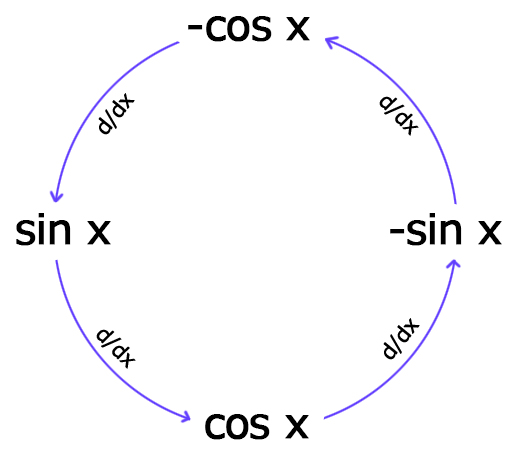
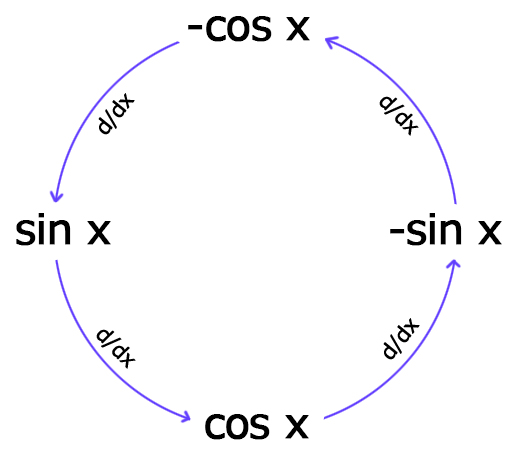
Substituting these values into our limit, we find that ! Nice. You'll probably want to remember that one.
Turns out that we can find the derivative of in a very similar way.
Try to find the derivative of by slightly modifying our method for finding the derivative of .
What is ?
Whew, we have accomplished a lot. We can now reap the benefits of our efforts. Remember that all of the basic trig functions can be written as combinations of sine and cosine? We can use the Quotient Rule to find all of their derivatives quickly! Let's walk through one example, and then you will be ready to conquer the rest.
How can we write in terms of and ?
Try to compute the derivative of with the Quotient Rule.
We can compute that
Awesome! Try , , and for yourself before checking your answers below.
The derivative of is
The derivative of is
The derivative of is
And that's all there is to it! (Well, until you run into those weirdos that like to multiply random trig functions together... but even then, you'll be able to handle it.)