
Interactive · 4 questions
+6 contributors




Combining like terms is sort of like cleaning up a messy sock drawer. I don't even like to open my sock drawer because every time I do, I'm met with polka dot socks, white socks, tall socks, short socks, and socks that I'm not even sure are mine.

Complex equations can look like a messy sock drawer, with variables and like terms scattered all over the place. The approach to manage these complex equations is the same one you'd take to clean up that messy drawer: match up terms that go together (we call these "like terms" - think of them like matching socks).
It feels darn near impossible to solve an equation that's not simplified—just like your chances of finding a particular sock in that messy drawer would be pretty much zero. So, let's take a look at a few examples on how we can "clean up" these equations.
This neat trick will be immensely helpful when tackling large, complex equations with a bunch of different variables and constants. Practicing this skill is essential to helping you solve for !
Take a look at this equation. Pretty messy, right?
To start, let's define like terms. Like terms are different terms that share the same variable and power. In our equation here, and are like terms since they both have an . Notice how we include the variable and its coefficient (the number in front of it). Similarly, any terms containing are like terms with each other. And finally, all the terms without or in them are also considered like terms (constants).
Let's check-in. Which of these choices includes like terms?
Now that we have that established, let's get to combining like terms! The first thing we need to do is get rid of those pesky parentheses. Recall that things with parentheses need to be handled first according to the Order of Operations (PEMDAS). Use the distributive property to get rid of the parentheses.
Now that we've got our equation down to a form with only numbers, variables, and simple operations like addition and subtraction, we can start combining like terms.
For this example, it doesn't matter which side of the equation you put them on or whether they're together. Recall that it is most common to format your equation, though, in a way that gives you as many positive values as possible.
Which of these is the most simplified form of our equation?
Again, this is just one way of writing the simplified equation. We chose this approach because it kept all of our values positive. Here we can see that combining like terms helped us to see the equation more clearly.
Let's look at another equation, this time with three variables (, , and ).
That's a pretty messy equation with fractions, but it's totally manageable. Let's follow the same approach we took before: handle parentheses and operations like multiplication and division, and then combine like terms.
We're going to opt to change our term into . Think of as the same as . Since it's completely fine for us to rewrite our as . This instantly gets rid of the pesky division operation in the equation. Now, we've got an equation with a decimal.
Now, handle the parentheses via the distributive property.
What does the right side of the equation look like once you get rid of the parentheses?
Now we're ready to combine our like terms.
Which of these shows a simplified equation with all like terms combined?
Just like before, it's up to you how you arrange these terms. We chose this arrangement because it kept most of our terms positive.
Also, you are free to change the decimal back to a fraction in your simplified equation, or you can leave it as it is. It's the same information either way!
Let's do one more example. Solve for by grouping the like terms in the equation:
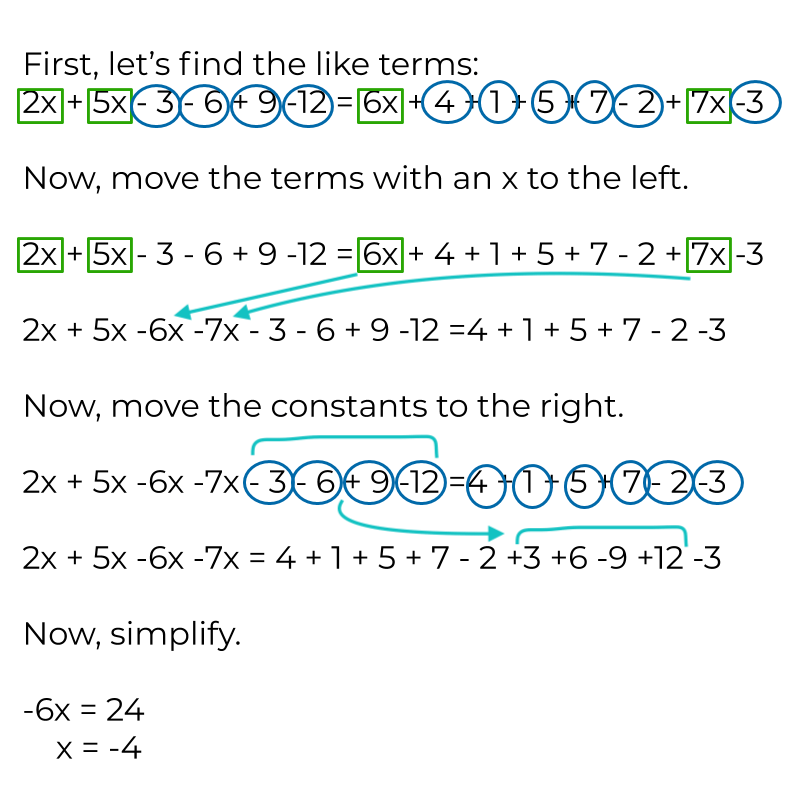
Image source: by Hannah Bonville
It's a good idea to double check your answer for the value when you're solving these types of equations.


