Frações

Interactive · 1 question

Solving Equations with Fractions

Variable in the Numerator

Sometimes, you are given an equation with a fraction that has a variable in the numerator. How do you solve for this variable?
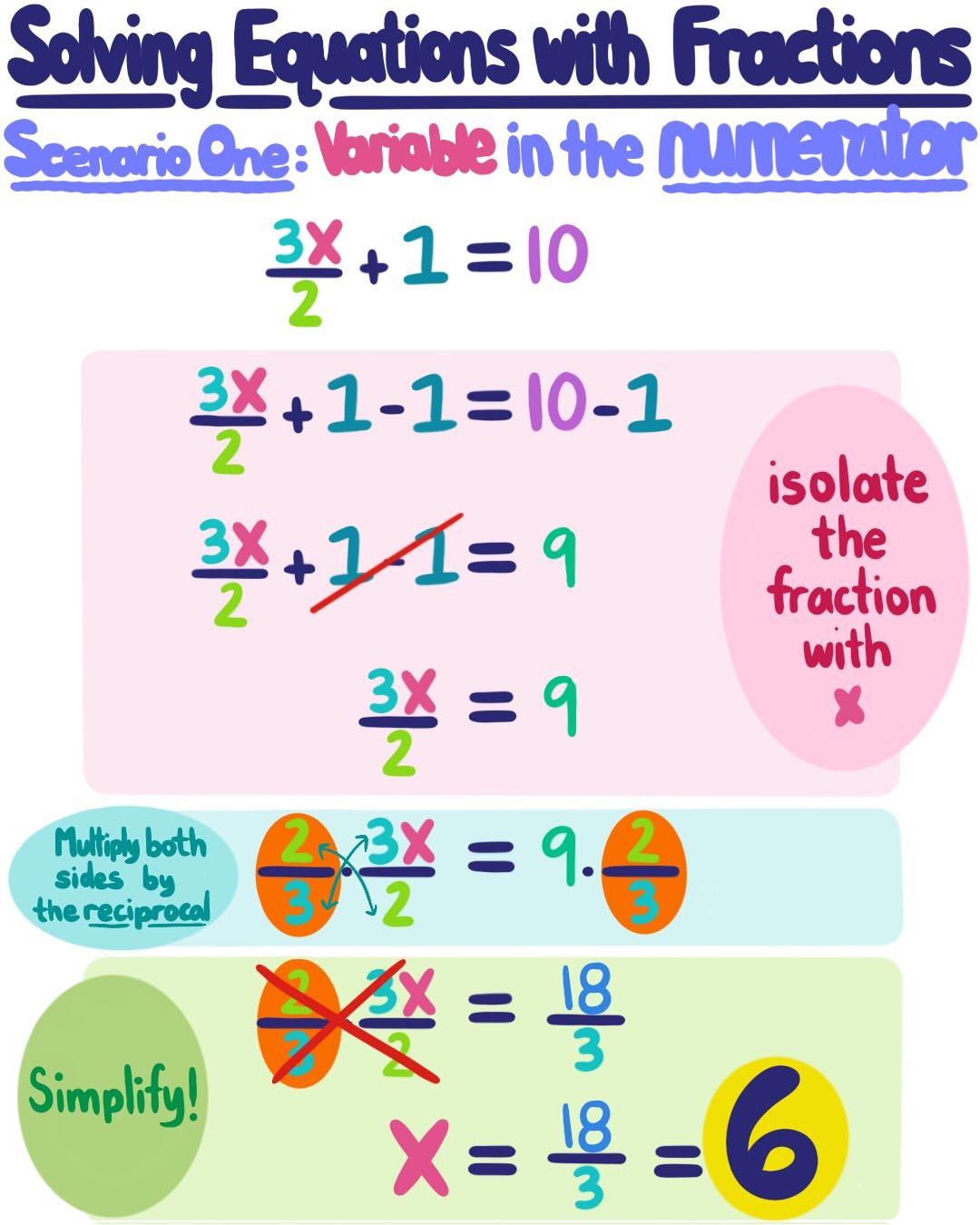
Solving Equations with Fractions. Scenario One: Variable in the numerator. Image shows the steps to solve the equation (3x/2)+1=10. First you isolate the fraction with x, then you multiply both sides of the equation by the reciprocal of the fraction with x, then you simplify. The answer is x=6

Image source: by Caroline Kulczycky

Variable in the Denominator

Other times, you are given an equation with a fraction that has a variable in the denominator. Here's an example of how to solve:
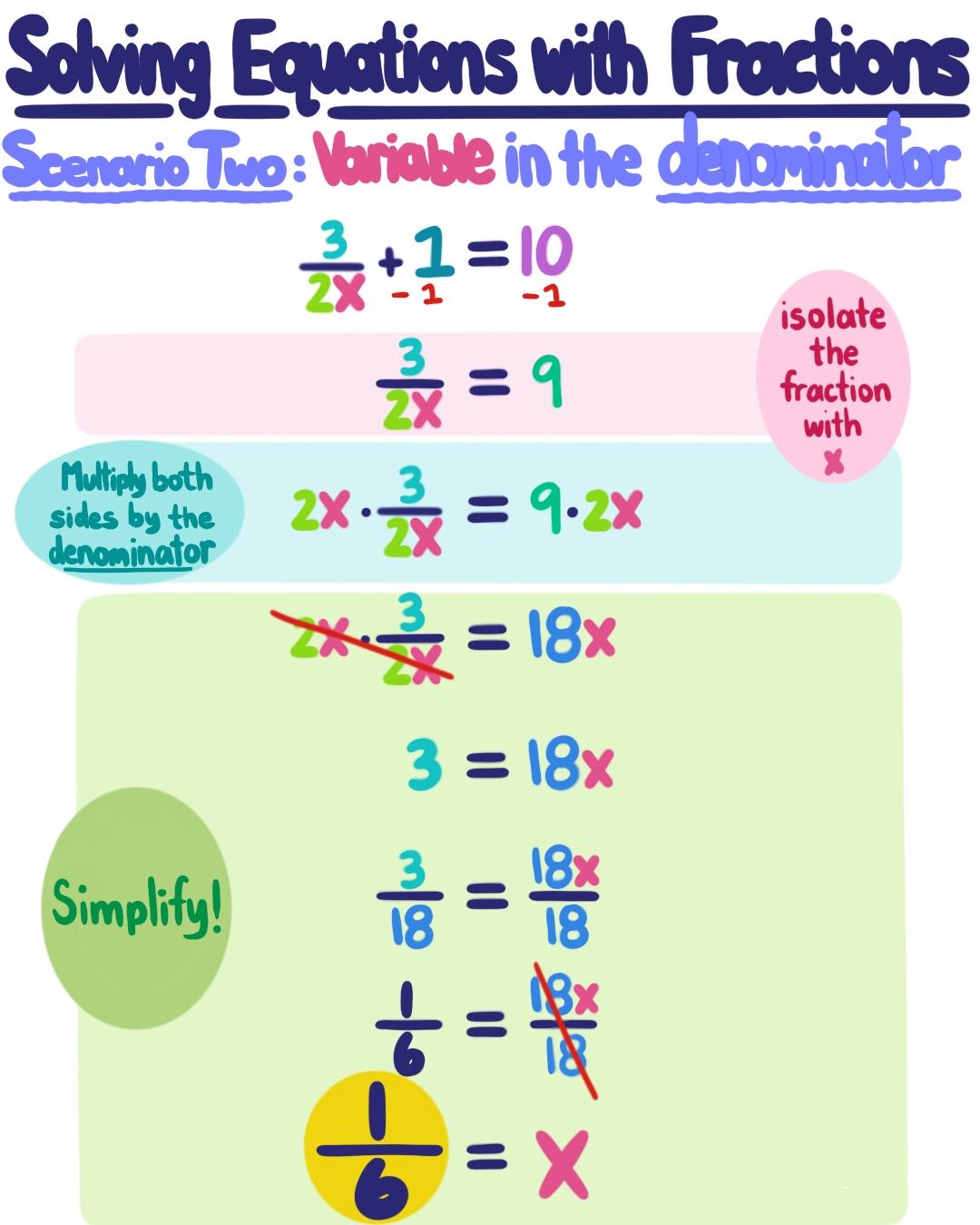
Solving Equations with Fractions. Scenario Two: Variable in the denominator. Image shows the steps to solve the equation (3/(2x))+1=10. First you isolate the fraction with x, then you multiply both sides of the equation by the denominator of the fraction with x, then you simplify. The answer is x=1/6

Image source: By Caroline Kulczycky

Let's do an problem that encompasses both scenarios!

32y+5+23=1\dfrac{3}{2y+5}+\dfrac{2}{3} = 1

Solve for y.y.

Choose one answer

Video

(Videos) Solving Linear Equations by Clearing Fractions

by mathman1024

Here's a video by mathman1024 showing you how to solve equations that have a lot of fractions. The simplest way to do so is by clearing fractions.

Summary\large{\text{Summary}}

The steps he gives are:

  1. Identify the LCD of all terms in the equation.
  2. Multiply each terms by the LCD and simplify.
  3. Solve the resulting equation.

The problem he looks at is: 34x−23=56\frac34x-\frac23=\frac56. So we have denominators with 44, 33, and 66. The least common denominator would be 1212 since all those numbers can go into that. So we multiply each term by 1212.

34x−23=5612 × 34x−12 × 23=12 × 569x−8=109x−8 + 8=10 + 89x=189x9=189x=2\begin{align} \frac34x-\frac23&=\frac56\\ {\color{#8925AE}{12\,\times}}\,\frac34x-{\color{#8925AE}{12\,\times}}\,\frac23&={\color{#8925AE}{12\,\times}}\,\frac56\\ 9x-8&=10\\ 9x-8\,{\color{#8925AE}{+\,8}}&=10\,\color{#8925AE}{+\,8}\\ 9x&=18\\ \frac{9x}{\color{#8925AE}{9}}&=\frac{18}{\color{#8925AE}{9}}\\ x&=2 \end{align}

(Video) Solving Linear Equations

by mathman1024

Try this next problem by yourself first.

  1. 25x+115=34x−1720\frac25x+\frac1{15}=\frac34x-\frac{17}{20}

(Video) Solving Linear Equations

by mathman1024

Finally, there's one more video with one more problem. Try this one on your own too!

  1. 78+32x−2=54x−1116\frac78+\frac32x-2=\frac54x-\frac{11}{16}

Interactive · 5 questions

There are three key approaches when working with equations with fractions:

  1. Isolate xx on one side of the equation (whether xx is part of the fraction or not).
  2. If the only terms in your equation are fractions, you can cross-multiply them.
  3. If you need to combine more than one fraction, find a common denominator.

The goal here (other than solving for xx) is to keep your heart beating at its normal pace!

Equations with Fractions on One Side (Isolating)

Let's start by looking at an example: −7=x3+2-7 = \frac{x}{3} + 2

Let's recall—what's the numerator of the fraction in this equation?

Choose one answer

Video

(Video) Solving a Linear Equation

by PatrickJMT

How do you handle fractions in two step equations? Get rid of them! In this video, Patrick JMT uses a couple strategies to solve a linear equation with fractions.

Summary\large{\text{Summary}}

In this video, he looks at the problem: 5−x3=4(x+1)65-\frac x3=\frac{4(x+1)}{6}

First, he makes sure that all his fractions are in the simplest form, so that all the denominators are as small as they can be. On the right hand side, the 44 and 66 can be simplified. 5−x3=4(x+1)65−x3=2(x+1)3\begin{align} 5-\frac x3&=\frac{4(x+1)}{6}\\ 5-\frac x3&=\frac{2(x+1)}{3} \end{align}

Then, he finds the lowest common denominator, in this example it's 33, and multiplies the whole equation by it to get rid of all of the fractions. 5−x3=2(x+1)33 × (5−x3)=3 × 2(x+1)315−x=2(x+1)\begin{align} 5-\frac x3&=\frac{2(x+1)}{3}\\ {\color{#8925AE}{3\,\times}}\,\left(5-\frac x3\right)&={\color{#8925AE}{3\,\times}}\,\frac{2(x+1)}{3}\\ 15-x&=2(x+1) \end{align}

Then, all you have to do is solve the two-step equation how you would normally! 15−x=2(x+1)15−x=2x+215−x + x=2x+2 + x15=3x+215 − 2=3x+2 − 213=3x133=3x3133=x\begin{align} 15-x&=2(x+1)\\ 15-x&=2x+2\\ 15-x\,{\color{#8925AE}{+\,x}}&=2x+2\,{\color{#8925AE}{+\,x}}\\ 15&=3x+2\\ 15\,{\color{#8925AE}{-\,2}}&=3x+2\,{\color{#8925AE}{-\,2}}\\ 13&=3x\\ \frac{13}{{\color{#8925AE}{3}}}&=\frac{3x}{{\color{#8925AE}{3}}}\\ \boxed{\frac{13}{3}} &= x \end{align}

Interactive · 1 question

Fractions and Equations

Solving an equation with a fraction isn't much different than solving an equation full of whole numbers. You group the variable terms on one side, the constants on the other, and then simplify.

Example 11:

Find xx in 32x+15=34\frac{3}{2}x + \frac{1}{5} = \frac{3}{4}.

First, group the variable terms on one side and the constants on the other: 32x+15=3432x+15 − 15=34 − 15\begin{align} \frac{3}{2}x +\frac{1}{5} &=\frac{3}{4}\\ \frac{3}{2}x+\frac{1}{5}\,\color{#8925AE}{ - \,\frac{1}{5}} &=\frac{3}{4}\,\color{#8925AE}{ -\, \frac{1}{5}}\\ \end{align}

Next, simplify: 32x=1520−42032x=112023 × 32x=1120 × 23x=1130\begin{align} \frac{3}{2}x &= \frac{15}{20} - \frac{4}{20}\\ \frac{3}{2}x &= \frac{11}{20}\\ {\color{#8925AE}{\frac{2}{3}\, \times}}\, \frac{3}{2}x &= \frac{11}{20} \,\color{#8925AE}{\times\,\frac{2}{3}}\\ x &= \frac{11}{30} \end{align}

Example 22:

Find xx in 5−x3=4(x+1)65-\frac{x}{3}= \frac{4(x+1)}{6}.

First, reduce the 46\frac{4}{6} on the right side of the equation and put 55 into fraction form on the left side of the equation. 5−x3=4(x+1)651−x3=2(x+1)3\begin{align} 5-\frac{x}{3}&= \frac{4(x+1)}{6}\\ \frac{5}{1}-\frac{x}{3}&= \frac{2(x+1)}{3} \end{align}

Now, find the LCD for 51\frac{5}{1} and x3\frac{x}{3}. 51−x3=2(x+1)333×(51)−x3=2(x+1)3153−x3=2(x+1)315−x3=2(x+1)315−x3=2(x+1)3\begin{align} \frac{5}{1}-\frac{x}{3}&= \frac{2(x+1)}{3}\\ {\color{#8925AE}{\frac{3}{3}} \times} \left(\frac{5}{1}\right)-\frac{x}{3}&= \frac{2(x+1)}{3}\\ \frac{15}{3}-\frac{x}{3}&= \frac{2(x+1)}{3}\\ \frac{15-x}{3}&= \frac{2(x+1)}{3}\\ \frac{15-x}{3}&= \frac{2(x+1)}{3} \end{align}

Now, we can multiply both sides by 33. 15−x3=2(x+1)33 × 15−x3=3 × 2(x+1)315−x=2(x+1)\begin{align} \frac{15-x}{3}&= \frac{2(x+1)}{3}\\ {\color{#8925AE}{3}\,\times}\,\frac{15-x}{3}&= {\color{#8925AE}{3}\,\times}\,\frac{2(x+1)}{3}\\ 15-x&= 2(x+1) \end{align}

Distribute the 22 into (x+1)(x+1). 15−x=2(x+1)15−x=2x+2\begin{align} 15-x&= 2(x+1)\\ 15-x&= {\color{#8925AE}2}x+{\color{#8925AE}2} \end{align}

Add xx to both sides. 15−x=2x+215−x + x=2x+2 + x15=3x+2\begin{align} 15-x&= 2x+2\\ 15-x\,{\color{#8925AE}{+\,x}}&=2x+2\,{\color{#8925AE}{+\,x}}\\ 15&=3x+2 \end{align}

Subtract 22 and divide by 33. 15 − 2=3x+2 − 213=3x133=3x3133=x\begin{align} 15\,{\color{#8925AE}{-\,2}}&=3x+2\,{\color{#8925AE}{-\,2}}\\ 13&=3x\\ \frac{13}{\color{#8925AE}{3}}&=\frac{3x}{\color{#8925AE}{3}}\\ \frac{13}{3}&=x \end{align}

Now, try one on your own!

Test Yourself: Solve for xx. 3x5−x=4\frac{3x}{5-x}=4

Choose one answer

Type a concept, like “slope” or “photosynthesis”.

↑ ↓ to choose · Enter to openSearch explanations and problems

