
Interactive · 2 questions
+3 contributors


Converse of the Pythagorean Theorem
Don't let the name of this concept stress you out. It's not as complicated as it might seem.

The Pythagorean theorem applies to right triangles.
Recall that the Pythagorean Theorem states, for a right triangle with legs of length and and hypotenuse of length , that . The hypotenuse is the side that is across from the right angle, and it is the longest side of the triangle. and are the lengths of the other two sides, called legs.
The Converse of the Pythagorean Theorem tells us that if the square of one side of a triangle is equal to the sum of the squares of the other two sides, then the triangle is a right triangle.
So, what the Converse of the Pythagorean Theorem allows us to do is to determine if a triangle is a right triangle.
If you plug in the lengths of each side of the triangle into the Pythagorean equation and get a TRUE statement, then the triangle is a right triangle.
Note: In order for to be true, the side length must be the largest side length. So in order to test whether a triangle is right, you only need to plug in values where is the largest among .

Plug in the lengths of each side into the Pythagorean equation:
Is this a right triangle?
This produces a true statement (), which tells us that our triangle is in fact a right triangle.
The order of and (as and ) doesn't really matter. However, it is important that we checked the Pythagorean rule by plugging in , the largest among . If we had plugged in or , we would've gotten something like or instead. The test is only useful when is the largest side.
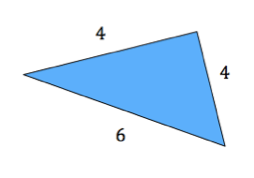
Let's try another one. Plug the lengths of the sides of the blue triangle into the Pythagorean equation. Is this a right triangle?
We can tell that this triangle is not a right triangle because the result of using the Pythagorean equation produces a FALSE statement, even though we plugged in the largest side length, , for .

