Teorema de Pitágoras

Before this, knowIdentidades dos triângulos retângulos

Video · + 3 min read

(Video) Math Life Hack - How to Use the Pythagorean Theorem to Cut Corners

This video, created by the Expii team, talks about the pythagorean theorem in a real life situation!

Summary\large{\text{Summary}}

What is the Pythagorean Theorem?

The Pythagorean Theorem was discovered by Pythagoras around 500500 BCE when Pythagoras was running late and saw his bus pulling away. Struck by the sudden understanding of geometry and the universe, he realized he could cut through an alley (doing sick parkour along the way) and arrive before the bus.

He later realized this worked because of a simple geometric shape: right triangles.

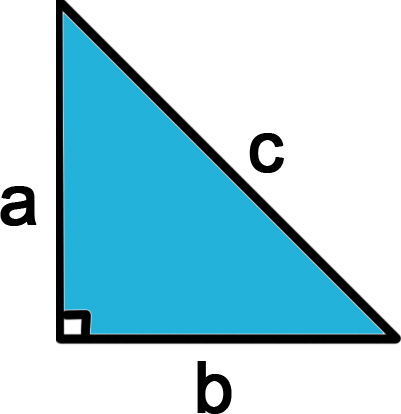
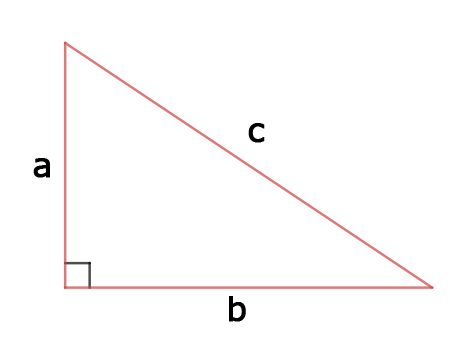
This is an image of a right triangle. The right angle is on the lower right side of the image. The vertical leg is labeled "a", and the horizontal leg is labeled "b". The hypotenuse is labeled "c".

The little square in the corner tells us that it is a right triangle.

After much calculation he discovered that when you square the length of each side of the triangle, they are related by the following formula: a2+b2=c2a^2+b^2=c^2

Okay, and?

This simple relation was a game changer. As you saw in the video, it's pretty effective at catching buses. Let's take a closer look at why that is.

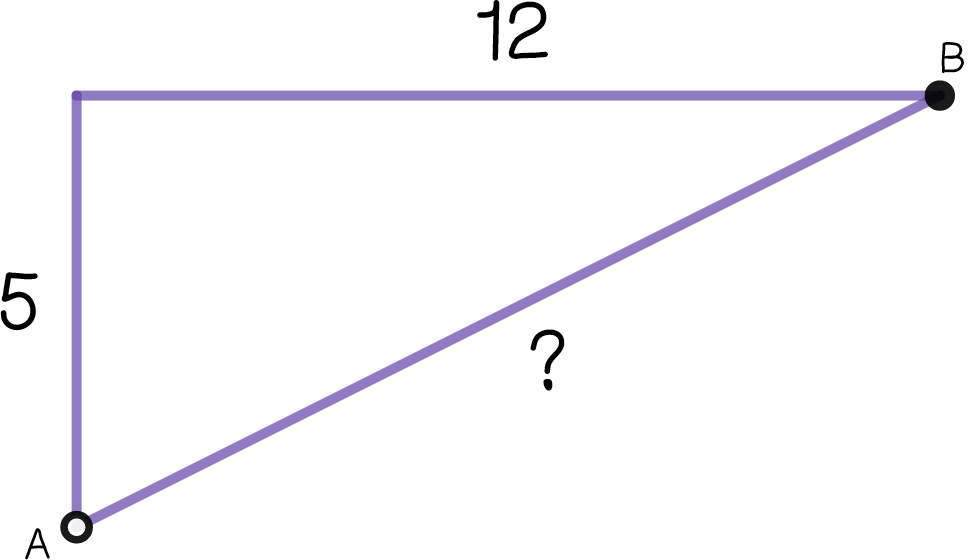
In the video, we are given the diagram:

This is an image of a right triangle with the right angle on the lower right side of the image. The vertical leg is labeled 3 and includes an image of a bus. There is a down arrow indicating the direction of the bus toward the right angle. The horizontal leg is labeled 4. There is a left facing arrow indicating the direction of the bus between the right angle and the hypotenuse. The hypotenuse is labeled "?". The vertex of the vertical leg and hypotenuse is labeled "start". The vertex of the horizontal leg and the hypotensue is lebeled "finish".

Don't worry about units of length.

There are two options to catch the bus at the next stop (finish):

  1. Run along the outside of the triangle: going down then toward the finish (the same way the bus is going).
  2. Run along the diagonal of the triangle.

We know the lengths of the outside of the triangle. If we were to run this path, we would run down a distance of 33 and then would run toward the finish for a distance of 44. To get the total distance we would travel, just add them up.

What is the total distance traveled if we went along the outside of the triangle?

Choose one answer

Preparing for a math contest?

Working through past problems on one idea at a time is one of the most effective ways to prepare. These are real problems from the AMC 8, AMC 10, AMC 12 and AIME, the national math competitions for middle and high school students, each with a worked solution on LIVE by Po-Shen Loh.

Video

(Video) The Pythagorean Theorem

by PatrickJMT

In this video by PatrickJMT, he explains the Pythagorean Theorem and goes over some problems that you might encounter with it.

Summary\large{\text{Summary}}

The Pythagorean Theorem is by far one of the most well known theorems in all of math. Its states that for any right triangle: a2+b2=c2a^2+b^2=c^2

A right triangle with legs a and b and hypotenuse c.
a2+b2=c2a^2+b^2=c^2
A right triangle with legs 5 and 7 and hypotenuse x.

Test Yourself

Test Yourself: Find the length of xx in the triangle above.

Choose one answer

Interactive · 3 questions

Using the Pythagorean Theorem

One way to identify a right triangle is by using the Pythagorean Theorem. The Pythagorean Theorem shows the relationship among the lengths of the sides of a right triangle.

A right triangle with legs a and b and hypotenuse c.

cc is the longest side, called the hypotenuse, and its the side that is across from the right angle. aa and bb are the lengths of the other two sides, called legs.

If you plug in the lengths of each side of the triangle into the Pythagorean equation and get a TRUE statement, then the triangle is a right triangle.

Note: In order for a2+b2=c2a^2+b^2=c^2 to be true, the side length cc must be the largest side length. So in order to test whether a triangle is right, you only need to plug in values where cc is the largest among a,b,ca,b,c.

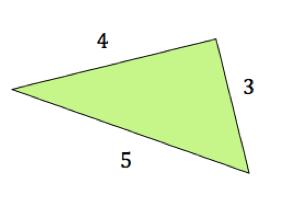
A triangle with side lengths 3, 4, and 5.

Plug in the lengths of each side of the green triangle into the Pythagorean equation:

a2+b2=c2a^2+b^2=c^2

Is this a right triangle?

Choose one answer

Illustrated · 2 min

The Pythagorean Theorem

Let's start with what a theorem is. A theorem is a statement that's been proven to be true from other things that are either known or accepted to be true.

Pythagoras was this guy a long time ago who was insanely smart and was able to prove this theorem.

The important thing to know is that the Pythagorean Theorem describes an important geometric relationship between all three sides of a right triangle.

The Pythagorean Theorem

For a right triangle with legs aa and bb and hypotenuse cc a2+b2=c2a^2+b^2=c^2

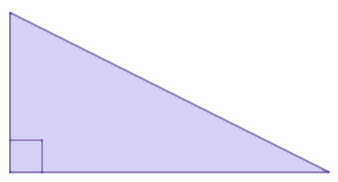
It's important to note that the Pythagorean Theorem only applies to right triangles. A right triangle is any triangle that has a right angle, an angle that equals 90∘90^{\circ}. Right triangles are usually denoted with a square around their right angle.

A right triangle.

The right angle also helps you identify an important side of a right triangle, the hypotenuse. The hypotenuse is always the longest side of a right triangle and it is always located opposite the right angle. It is denoted by the letter cc.

A right triangle.  The longest side is labelled "hypotenuse."

The sides that touch, or form, the right angle are called the legs of the triangle. It doesn't matter which we call aa and which we call bb as log as we keep track of it and stay consistent.

A right triangle.  The legs are labelled a and b.  The hypotenuse is labelled c.

3,4,5 Triangle

Let's look at a special right triangle in order to make sense of this theorem. This special right triangle is called a 33,44,55 Triangle because its sides have the relative lengths of 33, 44, and 55.

A right triangle with legs 3 and 4 and hypotenuse 5.

Let's see how the Pythagorean Theorem works for this. a2+b2=c2a^2+b^2=c^2

Our first side, aa, has a length of 33. The Pythagorean Theorem tells us to square this. 32=3∗3=93^2=3*3=9

Our second side, bb has a length of 44. The Pythagorean Theorem tells us to square this. 42=4∗4=164^2=4*4=16

It says to add these two values together now. 9+16=259+16=25

According to the Pythagorean Theorem this will be the same number as when we square the hypotenuse, cc, which is 55. 52=5∗5=255^2=5*5=25

As you get see we got 2525 both times! So a2+b2=c2a^2+b^2=c^2!

That's cool, but why should I care?

The reason the Pythagorean Theorem is so important is that it's a useful tool to help us use information we do know to find out information we don't know.

If you have a right triangle and only know how long two of its sides are, the Pythagorean Theorem tells you how to find the length of the third, unknown, side.

For example, suppose we had this triangle:

A right triangle with legs 3 and 2.  The hypotenuse is unknown.

We could easily find the length of this unknown side using the Pythagorean Theorem. a2+b2=c222+32=c24+9=c213=c213=c213=c\begin{align} a^2+b^2&=c^2\\ \color{red}{2}^2+\color{red}{3}^2&=c^2\\ 4+9&=c^2\\ 13&=c^2\\ \sqrt{13}&=\sqrt{c^2}\\ \sqrt{13}&=c \end{align}

Let's look at another example where we know only one of the legs and the hypotenuse.

A right triangle with one leg 4 and hypotenuse 6.  The other leg is unknown.

Use the Pythagorean Theorem to find the length. a2+b2=c242+b2=6216+b2=36b2=36−16b2=20b2=20b=25\begin{align} a^2+b^2&=c^2\\ \color{red}{4}^2+b^2&=\color{red}{6}^2\\ 16+b^2&=36\\ b^2&=36-16\\ b^2&=20\\ \sqrt{b^2}&=\sqrt{20}\\ b&=2\sqrt5 \end{align}

Test a Triangle

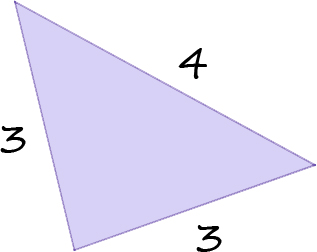
We can also use the Pythagorean Theorem to test if a triangle is a right triangle. For example, lets look at this triangle:

A triangle with sides 3, 3, and 4.

The Pythagorean Theorem can tell us if it's a right triangle as long as we know all three sides. Since 44 is the longest side, we can plug that into cc and the others into aa and bb to test it. a2+b2≟c232+32≟429+9≟1618≠16\begin{align} a^2+b^2≟c^2\\ \color{red}{3}^2+\color{red}{3}^2≟\color{red}{4}^2\\ 9+9≟16\\ 18\ne16 \end{align} Since these two sides are not equal, we can conclude that the triangle is NOT a right triangle.

Video

(Video) The Pythagorean Theorem

by Mahalo Math

Mahalo Math has a good video explaining what the Pythagorean theorem is and why it is useful.

The Pythagorean theorem only applies to right triangles and is written like a2+b2=c2a^2+b^2=c^2

You can call either side aa and bb but cc must be the hypotenuse which is the longest side across from the right angle.

You can use the pythagorean theorem to find the length of an unknown side of a right triangle.

Video · + 1 min read

(Video) Word Problem Using the Pythagorean Theorem

by PatrickJMT

Patrick JMT has some great Pythagorean theorem word problems. The Pythagorean theorem is one of your most useful tools in mathematics so being able to identify when to use it will help you immensely.

Summary\large{\text{Summary}}

The Pythagorean theorem states a2+b2=c2a^2+b^2=c^2 when aa and bb are the legs and cc is the hypotenuse.

Example 11:

If you have an equilateral triangle with height 88, find the length of each side.

We draw the right triangle such that the one leg is 88 and the other is 12x\frac{1}{2}x and cc is xx. We set up the equation: 82+(12x)2=x28^2+(\frac{1}{2}x)^2=x^2

Now, we simplify. 82+(12x)2=x264+(14x)=x264=x2−14x264=x2−14x264=34x243×64=x22563=x22563=x21633=x\begin{align} 8^2+(\frac{1}{2}x)^2&=x^2\\ 64+(\frac{1}{4}x)&=x^2\\ 64&=x^2-\frac{1}{4}x^2\\ 64&=x^2-\frac{1}{4}x^2\\ 64&=\frac{3}{4}x^2\\ \frac{4}{3}\times 64&=x^2\\ \frac{256}{3}=x^2\\ \sqrt{\frac{256}{3}}&=\sqrt{x^2}\\ \frac{16\sqrt{3}}{3}&=x \end{align}

Example 22:

You have two cyclists that start from the same direction. They are going the same speed and one is going east and one is going north. Find the speed of each in minutes per hour if after two hours they are 17217\sqrt{2} miles apart.

We draw the triangle such that they hypotenuse is 17217\sqrt{2} and each side is xx. So, x2+x2=(172)2x^2+x^2=(17\sqrt{2})^2. We simplify this to get 1717 which we then divide by two to find the speed of each of the cyclists. 172\frac{17}{2} minutes per hour is how fast each of the cyclists are going.

Video

(Videos) Pythagorean Theorem

by tecmath

This video by tecmath works through a Pythagorean theorem example problem.

Summary\large{\text{Summary}}

a2+b2=c2a^2+b^2=c^2

We are given a quadrilateral. We can make a triangle and a square out of the quadrilateral. We then know the sides are 1010 and 33. We can plug in those numbers to find xx. 102+32=x210^2+3^2=x^2

This is the same as 109=x\sqrt{109}=x This is equal to 10.4410.44

Feel free to watch the other example in the video for more practice!

Video · + 1 min read

(Videos) Quadratic Equations and the Pythagorean Theorem

by PatrickJMT

Patrick JMT has a bunch of more complicated problems that use both the Pythagorean theorem and the Quadratic Formula together. Here is an example below.

Summary\large{\text{Summary}}

In his example, he tries to solve for xx for a triangle with sides 5(x−1)5(x-1) and xx, and a hypotenuse of 66 We need to use the pythagorean theorem to set up the equation [5(x−1)]2+(x)2=62[5(x-1)]^2 + (x)^2 = 6^2 Then, distributing the squares, we get an equation of: 25[(x−1)(x−1)]+x2=3625[(x-1)(x-1)] + x^2 = 36 25[x2–2x+1]+x2=3625[x^2 – 2x + 1] + x^2 = 36 25x2–50x+25+x2=3625x^2 – 50x + 25 + x^2 = 36 Adding like terms will give us: 26x2−50x+25=3626x^2 -50x + 25 = 36 Now we want the equation on the left to equal 00, so we subtract 3636 from both sides to get 26x2–50x–11=026x^2 – 50x – 11 = 0 Using the quadratic formula with values of a=26,b=−50,a = 26, b = -50, and c=−11c = -11, we can find the values for xx x=−b±b2−4ac2ax=\frac{-b\pm\sqrt{b^2-4ac}}{2a} x=−(−50)±(−50)2−4(26)(−11)2(26)x = \frac{-(-50)\pm\sqrt{(-50)^2-4(26)(-11)}}{2(26)} x=50±2500+114452x=\frac{50 \pm \sqrt{2500 +1144}}{52} x=50±364452x = \frac{50 \pm \sqrt{3644}}{52} Note that in the video, he reduced 3644\sqrt{3644} to 60.3760.37. You can either leave it as a radical, or you can also reduce it to a decimal.

So, what you get in the end is a lower limit and an upper limit. For our problem, the lower limit is negative. However, given the nature of the problem, which is finding the length of a triangle side, we do not want negative numbers. For sides of shapes, or any measurements at all, you cannot have negative numbers. So, our xx value will be x=50+364452x = \frac {50 + \sqrt{3644}}{52}.

Video

(Video) Pythagorean Theorem

by yaymath

Here's a video by yaymath explaining the Pythagorean theorem and showing you how you can use it to see if a triangle is right triangle or not.

Summary\large{\text{Summary}}

A right triangle is a triangle with a right angle in it.

A right triangle with legs a and b and hypotenuse c.

The Pythagorean Theorem states that given any right triangle: a2+b2=c2a^2+b^2=c^2 You can also prove that any triangle is right triangle by plugging in the lengths of its sides and seeing if the Pythagorean Theorem holds true.

When solving problems involving right triangles the steps are usually:

  1. Figure out the aa, bb, and cc of the triangle and what's missing.
  2. Use the formula a2+b2=c2a^2+b^2=c^2.
  3. Plug in the sides that you know.
  4. Solve for the side that you don't know.
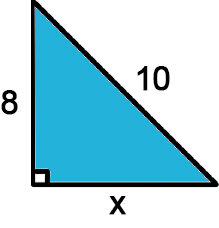
A right triangle with legs 8 and x and hypotenuse 10.

Test Yourself

Test Yourself: Using the triangle above, find xx.

Choose one answer

Video · + 1 min read

(Video) The Pythagorean Theorem

by mathman1024

Here's a video by mathman1024 explaining the Pythagorean Theorem.

Summary\large{\text{Summary}}

The Pythagorean Theorem is very simple. It states: a2+b2=c2a^2+b^2=c^2 Cool! But what do those letters mean? Well, they're all the sides of right triangle.

A right triangle with legs a and b and hypotenuse c.

Here cc is the hypotenuse of the triangle. The hypotenuse is always the longest side of the triangle. It will also always be on the opposite side of the right angle. The aa and bb denote the legs of the triangle.

The first problem he looks at is:

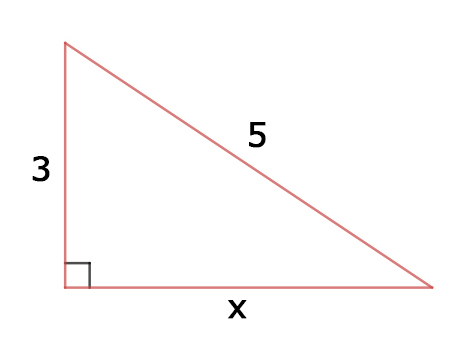
A right triangle with legs 3 and x and hypotenuse 5.

Where we want to use the Pythagorean Theorem to find xx. a2+b2=c2(3)2+(x)2=(5)29+x2=259−9+x2=25−9x2=16x=±4\begin{align} &a^2+b^2=c^2\\ &(3)^2+(x)^2=(5)^2\\ &9+x^2=25\\ &9\color{red}{-9}+x^2=25\color{red}{-9}\\ &x^2=16\\ &x=\pm4 \end{align} Since we can't have a negative length we can toss x=−4x=-4 out the window. That means x=4x=4.

This problem was actually an example of a Pythagorean Triples. Pythagorean Triples are integer solutions to the Pythagorean Theorem. In the last problem, 32+42=523^2+4^2=5^2 so the triple is 3,4,53,4,5. Remember that the larger number is always the hypotenuses length. These are useful to remember because they can let you solve a problem quickly. Some other common ones are: 5,12,137,24,258,15,179,40,415,12,13\\ 7,24,25\\ 8,15,17\\ 9,40,41 Here's a list of a bunch of Pythagorean Triples.

Test Yourself: A right triangle has a leg that's 99 inches and a hypotenuse that's 1515 inches. What's the length of the other leg?

Choose one answer

Type a concept, like “slope” or “photosynthesis”.

↑ ↓ to choose · Enter to openSearch explanations and problems