$ax^2+bx+c$ onde $ac<0$

Before this, know$x^2+bx+c$ onde $c<0$

Interactive · 2 questions

Factoring Quadratics - ax2+bx+c,ac<0ax^2+bx+c, ac<0

Here is another way to evaluate a common quadratic form with factor by grouping.

The first step to factor a polynomial with the form ax2+bx+cax^2+bx+c when ac<0ac<0 is to find two numbers, dd and ee, where d⋅e=acd\cdot e=ac and d+e=bd+e=b. dd and ee are the middle terms. Assume that we have found the two numbers. Since acac is negative, we need to set −d⋅e=ac-d \cdot e=ac and −d+e=b-d+e=b.

Let's plug in dd and ee. Remember that we picked −d-d, so the polynomial becomes ax2−dx+ex+cax^2-dx+ex+c. This can be grouped with parentheses to (ax2−dx)+(ex+c)(ax^2-dx)+(ex+c). These groups share a greatest common factor. The GCF gets factored out, and we are left with an expression of two multiplied binomials. This is the factored form of the quadratic.

Example 1:

−2x2+5x+3-2x^2 + 5x + 3

Since −1⋅6=−6=−2⋅3-1 ⋅ 6 = -6 = -2 ⋅ 3, and since −1+6=5-1 + 6 = 5, we can rewrite our polynomial as follows:

−2x2−1x+6x+3-2x^2 - 1x + 6x + 3

Now, we factor out greatest common factors from our polynomial's first two terms and from our polynomial's last two terms:

−x(2x+1)+3(2x+1)-x(2x + 1) + 3(2x + 1)

Finally, we factor the binomial 2x+12x + 1 out of our expression (note that we are only able to do this because our expression consists of two terms that are both being multiplied by the binomial 2x+12x + 1):

(−x+3)(2x+1)(-x + 3)(2x + 1) =−(x−3)(2x+1)= -(x - 3)(2x + 1)

Here's a graphic with another example!
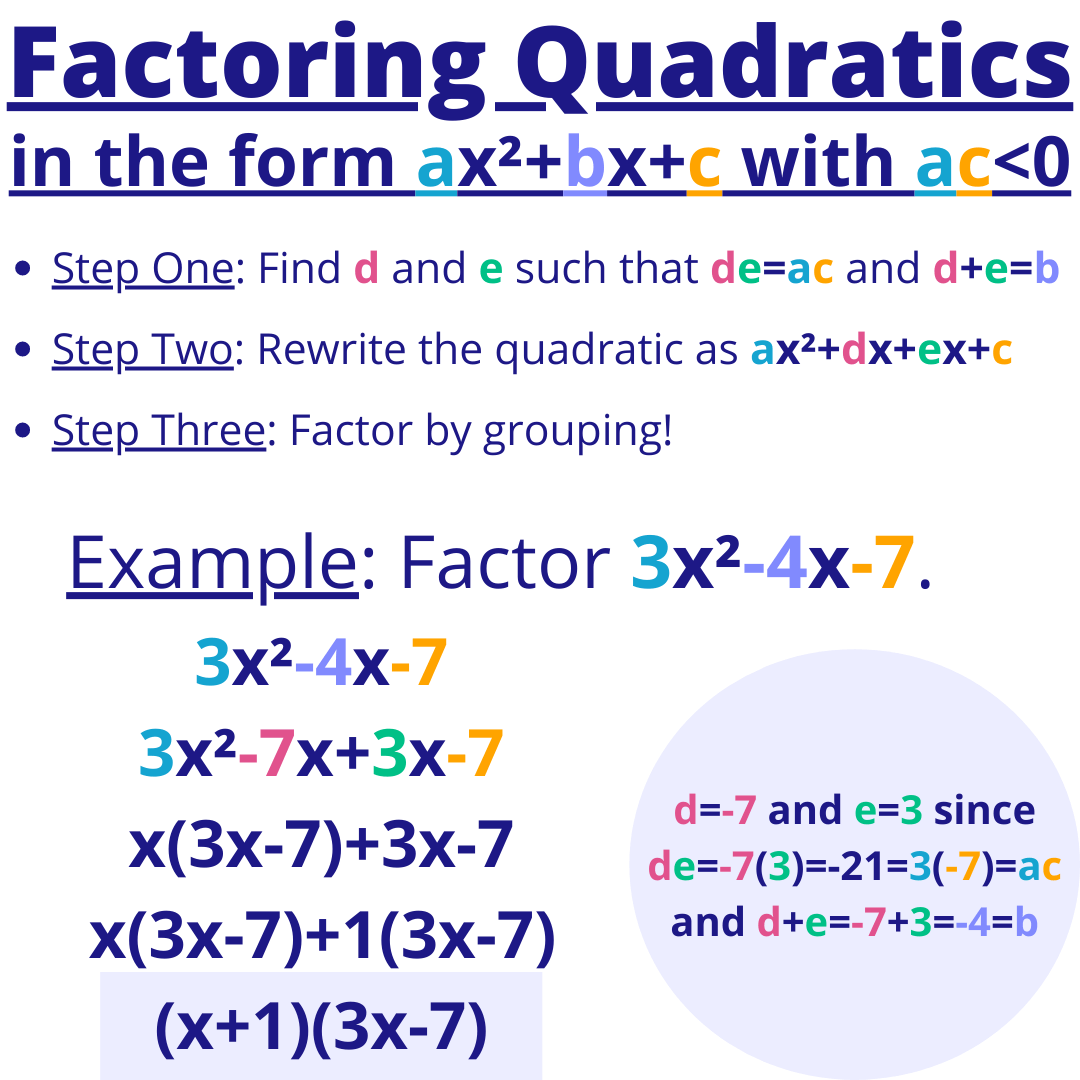
Factoring Quadratics in the form ax^2+bx+c with ac>0. Step One: Find d and e such that de=ac and d+e=b. Step Two: Rewrite the quadratic as ax^2+dx+ex+c. Step Three. factor by grouping! Example: Factor 3x^2-4x-7. 3x^2-4x-7 ---> 3x^2-7x+3x-7 ---> x(3x-7)+3x-7---> x(3x-7)+1(3x-7) ---> (x+1)(3x-7). In this example, d=-7 and e=3 since de=-7(3)=-21=3(-7)=ac and d+e=-7+3=-4=b. All the a's, b's, c's, d's, and e's have their own colors throughout the graphic.

Image source: By Caroline Kulczycky

Test Yourself!

Let's do some more problems.

Factor 4x2−10x−64x^2 - 10x - 6

Choose one answer

Interactive · 1 question

Let's start with a factorization where a=1a=1 to get into the factoring mindset.

Pre-explanation

Which of the following is a factor of x2+11x+28x^2+11x+28?

Choose one answer

Video

(Video) Example: Factoring a Quadratic with a Negative Leading Coefficient

by Global Freshman Academy

This video by Global Freshman Academy discusses how to factor a quadratic with a negative leading coefficient.

Summary\large{\text{Summary}}

Let's start with a problem. You start to factor by pulling a negative out front. −2x2−3x+14=−(2x2+3x−14)-2x^2-3x+14=-(2x^2+3x-14) Now, we find the factors that multiply to get −28-28 and add to 33. We can use −4-4 and 33. We see, −(2x2+3x−14)=−(−2x2−4x+7x−14)-(2x^2+3x-14)=-(-2x^2-4x+7x-14) We now look for common factors in 2x2−4x2x^2-4x and 7x−147x-14. We see we can pull out a 2x2x and a 77. Therefore, our factors are −(x−2)-(x-2) and (2x+7)(2x+7).

You can check your work by using the FOIL method. Our final answer is −2x2−3x+14=−(x−2)(2x+7)-2x^2-3x+14=-(x-2)(2x+7)

Example 22: Start with the quadratic and pull out a common factor. −4x2+28x−48=−4(x2−7x+12)-4x^2+28x-48 = -4(x^2-7x+12) Try this problem from here and see if you get the correct answer!

The answer is −4x2+28x−48=−4(x−3)(x−4)-4x^2+28x-48 = -4(x-3)(x-4)

Type a concept, like “slope” or “photosynthesis”.

↑ ↓ to choose · Enter to openSearch explanations and problems