
Interactive · 6 questions
+1 contributors

Previously, you have learnt about what is Riemann sum and the four main types of Riemann sum as well as how to apply it. Now we are going one step further and draw the link between limits and definite integrals.
Before that, let us revise what you have learnt in Riemann sums.
Evaluate the Left Riemann Sum for from to with rectangles.
What about Right Riemann Sum?
What about Middle Riemann Sum?
I promise you, this is the last one: What about Trapezoidal Sum?
Well, as some of you may have figured it out, I am basically asking you to approximate the value of for 4 times (ain't nobody got time for that!), and two of them are off by about 7-8% from the actual value of ! However, this error can be minimized by increasing the number of rectangles, . As we increase the value of , the width of the rectangle will get narrower and narrower, as shown in the animation below.
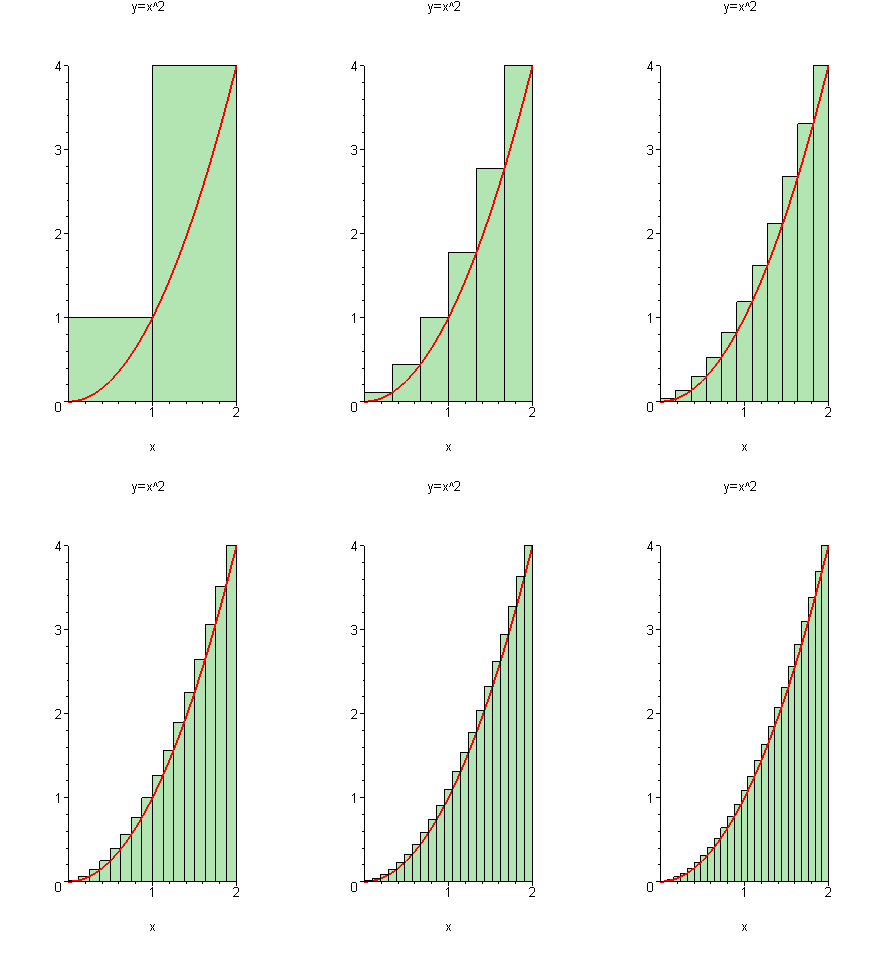

Because of this narrowing of the rectangles, can you see why the magnitude of the error is getting smaller and smaller?
To properly start on this section, we shall introduce a new term, Riemann Integrability.
Riemann Integrability
is Riemann integrable on if exists, where is the width of the rectangle and is a value chosen in the range . In particular, this limit is defined to be equal to , if it exists.
Note: if is continuous on , then is Riemann integrable there. If is Riemann integrable on , then is bounded there.
One should note that the Riemann Integral does not depend on the choice of the partitions (how you partition the interval) or the choice of the points in the interval But for easiness sake, we partition the interval into equal subintervals, which leads to the following useful identity.
Observe the identity above. Can you identify which expression corresponds to ?
Now, identify the expression that corresponds to .
With that in mind, we are ready to get our hands dirty. As an exercise for you, represent the following limits as a definite integral and evaluate the limits. You may assume that the limits exist.
In conclusion, we make the rectangles as thin as possible to get a more accurate approximation or evaluation of the integrals.