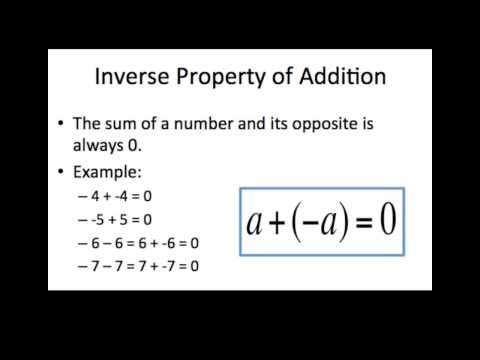
Propriedade inversa da adição

Before this, knowPropriedade do elemento neutro

Interactive · 2 questions

Combining Opposite Numbers to Make 00

When you add a negative number to its positive counterpart, the answer will always be 00.

Let’s take a look at an example. 2+(−2)2+(-2).

First, let’s draw a number line and start at 22.

2 on the number line

Made using Desmos

Next, add −2-2 to 22. This is essentially the same as subtracting 22 from 22.

2 + (-2) = 0

Made using Desmos

The answer is 00 because −2-2 is a counterpart of 22. As a result, we say −2-2 is the additive inverse of 22. Also, 22 is called the additive inverse of −2-2.

Let's look at another example: −19+19-19+19.

We can solve this problem without drawing a number line. Looking at the equation, we can observe that 1919 is the counterpart of −19-19. Adding these two numbers will result in 00, so −19+19=0-19+19=0. This can be thought of solving the equation

x−19=0x - 19 = 0

where xx is a variable. Adding 1919 to both sides is the same as finding the additive inverse.

Now, let's try a couple of examples without drawing a number line. You can still draw it yourself if you need to. After a while you probably won't need to. The picture will pop up in your head like magic!

5+(−5)=?5+(-5)={?}

Choose one answer

Illustrated · 1 min

Adding a negative and a positive of the same number will equal 00

The Inverse Property of Addition states the following:

Adding a number and it's negative version of itself yields 00.

In other words, if you add −3+3-3 + 3 or 152+(−152)152 + (-152), the answer will always be 00.

Also, we can add either the positive or the negative number first. This is because addition is commutative.

A number line with one arrow going from 0 to -8 and another arrow going from -8 to 0.

Think of adding numbers as connecting arrows of different sizes together. Opposite values will always be the same size but point in different directions.

Illustrated · 1 min

Opposite quantities cancel each other out

When you add positive and negative versions of the same number together, they will always equal zero. This is because when we add numbers, we essentially connect their positions relative to zero. For example, if we add 4+(−4)4 + (-4), we would do the following:

A number line with a dot on the number 4.

Find 4 (the first number)

A number line with a dot on -4 and 4.

Find -4

The dot on -4 is 4 spaces backwards from 0.

Find -4's position relative to 0

If we move 4 spaces backward from 4, we end on 0.

Find the same position relative to the first number (4).

This will also work the other way around if we add a positive number to a negative number (so in the case of this example, (−4)+4(-4) + 4).

If we move up 4 spaces from -4 we also get to 0.

Move to the right 4 spaces from -4 to get 0.

Video

(Video) Opposites and the Addition Property of 0

by mathman1024

This video by mathman1024 shows how adding a number to its opposite always equals zero. He then goes over the Addition Property of Zero.

Summary\large{\text{Summary}}

The first example he looks at is: 8+(−8)=08+(-8)=0. If you increase something by 88 and then decrease it by 88, you're back where you started.

It doesn't matter if you start with a negative first either. For example, −12+12=0-12+12=0. As long as the signs are different the addition of them will always be 00. Why can we do either order? Addition obeys the commutative property.

This leads us to the Addition Property of Zero. a+0=aa+0=a Any number plus 00 doesn't change the number at all.

  • 19+0=1919+0=19
  • −27+0=−27-27+0=-27
  • 0+(−83)=−830+(-83)=-83

Interactive · 4 questions

Inverse Property of Addition

The inverse property of addition states:

If you add the positive and negative versions of a number, the sum will be 00. x+(−x)=0x+(-x) =0

Unless x=0x = 0, we are adding a positive number and a negative number together. The two numbers look almost the same. However, the second number has a negative sign in front.

Inverse Property of Addition: a + (-a) = 0

Image by Caroline Kulczycky

Let's look at some problems you might encounter about the inverse property of addition.

Example 1\\ −3−?=0-3-{?}=0

Choose one answer

Video

(Video) Inverse Property of Addition and Multiplication

by William Chermak

Here's a video by William Chermak that shows the inverse property of addition. It also discusses the inverse property of multiplication. However, in this explanation we'll focus on addition.

Summary\large{\text{Summary}}

The inverse property of addition states that any number added to its opposite will always equal 00. a+(−a)=0\boxed{a+(-a)=0}

Example

5+(−5)=05+(-5)=0

We might be asked to find the additive inverse of a number. This additive inverse acts as a variable you'll need to find. In other words, it's an equation that can be solved with addition or subtraction.

Test Yourself: If x+−6=0x+-6=0 then what is xx?

Choose one answer

Type a concept, like “slope” or “photosynthesis”.

↑ ↓ to choose · Enter to openSearch explanations and problems