Reciprocidade na divisão

Before this, knowPropriedade inversa da multiplicação

Interactive · 2 questions

Turn that Frown Upside Down

A reciprocal of a number is 11 divided by the number. Before we start complaining about having to do division, there's a really easy way to find the reciprocal.
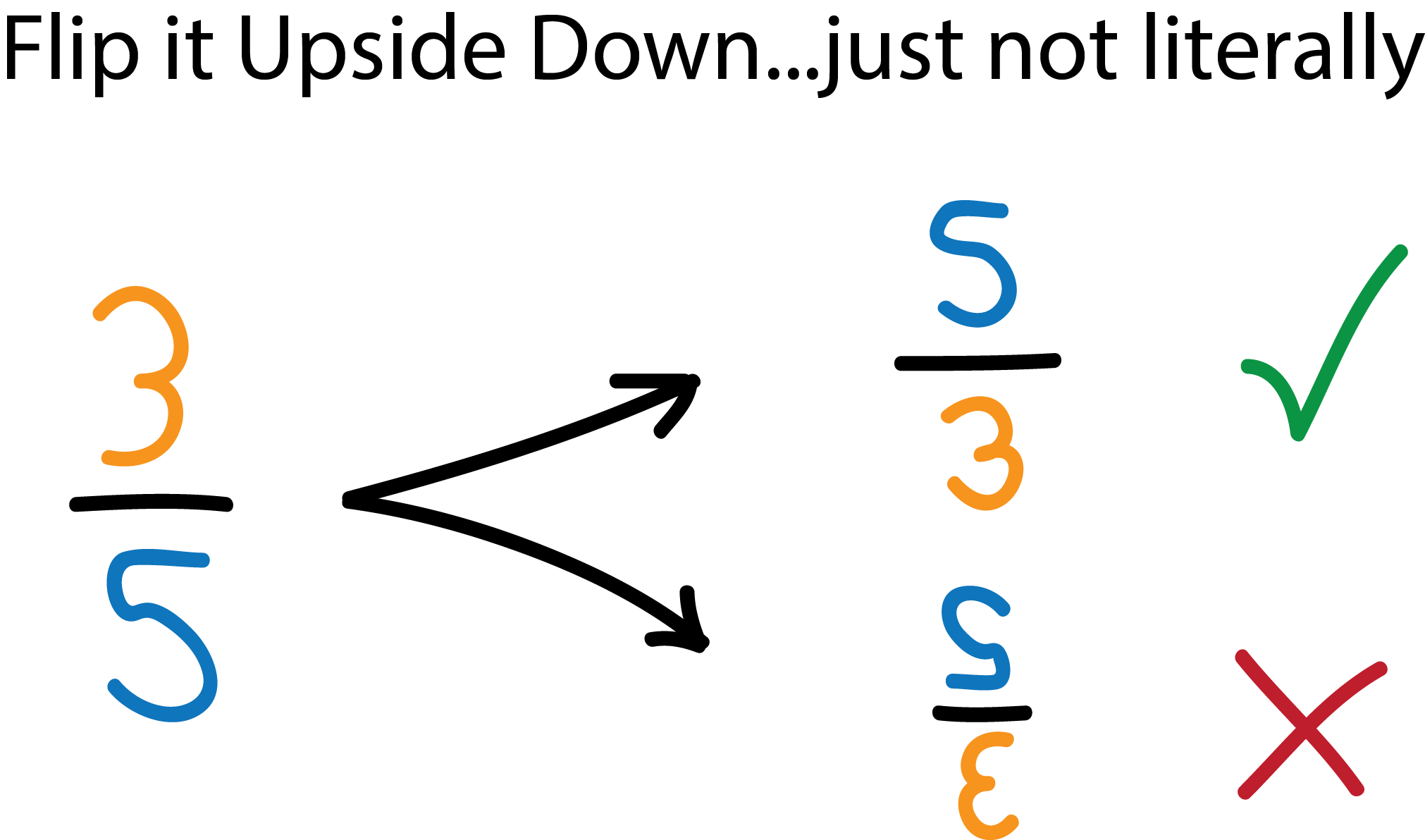
Flip it Upside Down...just not literally.
3/5 becomes 5/3
Frown turned into a smile

Image source: By Clker-Free-Vector-Images CC0, via pixabay.com

Edited by Expii

The reciprocal of a number is just the numerator and denominator switched! That means for a fraction ab\frac{a}{b}, the reciprocal is

ba\frac{b}{a}

Okay, but what about numbers that don't have a denominator, like 77. Oh please, math has thought of this. Just put the number over 11. If we divide a number by 11, we get the same number. That is, putting a 11 in the denominator doesn't change the value.

7→717\rightarrow\frac71

Now, we flip the numerators and denominators. 71→17\frac71\rightarrow\frac17

It's worth noting that this process works for proper and improper fractions. The type of fraction doesn't make a difference here.

We can also find reciprocals of mixed numbers. To get those, we have to convert to an improper fraction first.

As for decimal numbers, we can convert these to fractions first as well. In finding the reciprocal of a decimal, the final answer may be improper or proper. However, if we find the reciprocal of a mixed number, the fraction at the end will be proper.

What's the reciprocal of 83\frac8{3}?

Choose one answer

Interactive · 9 questions

Division and Reciprocals

A number's reciprocal is the upside down version of that number when it's written as a fraction. Another name for reciprocal is multiplicative inverse.

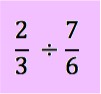
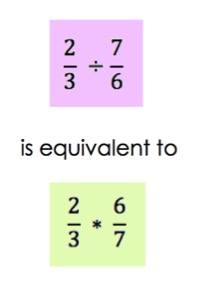
Reciprocals are really helpful when it comes to dividing fractions. We can use reciprocals to turn fraction division into fraction multiplication.

So, before we try out some of these division problems, let's review how to find a number's reciprocal.

Finding the Reciprocal of a Fraction

This is easy business. All you need to do to find the reciprocal of a fraction is to flip the fraction over.

Take a look at the table below for some examples:

Fraction // Reciprocal
1/2 // 2/1
5/6 // 6/5
-17/3 // -3/17

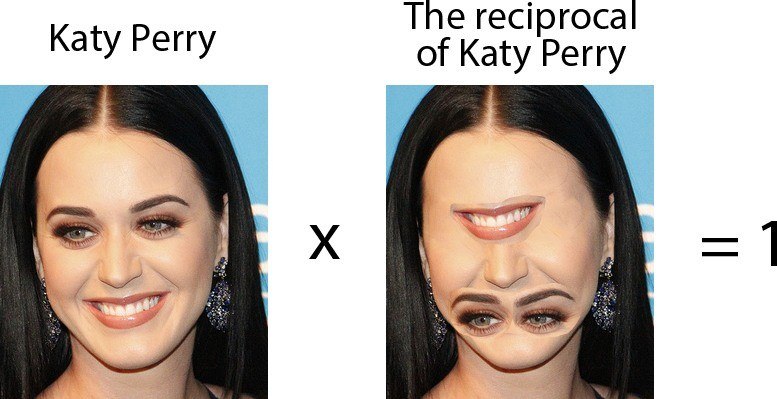
Notice how we just flip the fraction over to find its reciprocal. Multiply any number by its reciprocal, and you'll get 11.

Let's practice.

What is the reciprocal of −29-\frac{2}{9}?

Choose one answer

Video · + 1 min read

(Video) Art of Problem Solving: What's a Reciprocal?

by Art of Problem Solving

This video by Richard Rusczyk explains why we have reciprocals of numbers.

Summary\large{\text{Summary}}

In his first example, he shows how we have negative numbers in order to add something to a positive number to get 00.

Specifically, negative numbers allow us to have the inverse property of addition. Take any positive number, and we can pick a different number, add them together, and get 00.

Then, we want a similar thing for multiplication: for any number xx, we want some number yy where x⋅y=1x \cdot y = 1. We call this yy value 1x\frac{1}{x}.

He uses 88 as an example. So for 88, if we want to find its reciprocal, we just do 11 over 88, which is simply 18\frac{1}{8}. So we know 8⋅18=18 \cdot \frac{1}{8} = 1.

The ability to find reciprocals is called the inverse property of multiplication.

One important thing is that if you have any fraction ab\frac{a}{b}, then its reciprocal is ba\frac{b}{a}. We can see this with the example above since 8=818 = \frac{8}{1}, so its reciprocal is 18\frac{1}{8}.

Another important thing to remember, which Richard mentions in the video, is that 00 does not have a reciprocal. This is because 00 times anything is 00, so we can't have any number xx where 0⋅x=10 \cdot x = 1. Another reason is because if we wanted the reciprocal of 00, we would have to divide 11 by 00, but we cannot divide by 00 ever, so there is no reciprocal.

Type a concept, like “slope” or “photosynthesis”.

↑ ↓ to choose · Enter to openSearch explanations and problems